Showing posts with label South Dakota. Show all posts

Friday, June 11, 2021

My Story Inspiration for Rescuing Raven

 My Story Inspiration for Rescuing Raven

By Jacqui Nelson

What inspires a short story? And can an author (who loves history) fit another iconic history-infused setting (Deadwood, South Dakota, during the gold rush) into a 6,000-word story that's also filled with romance and adventure? It was a challenge, believe me, but it was the best kind of challenge!

During my March, April, and May monthly blogs with Cowboys Kisses, I shared my Story Inspiration pages (the page I've included in the back of all of my books) for Between Heaven & Hell, Following Faith, and Choosing Bravery. 

Now it's time to share the Story Inspiration page for the story that chronologically follows those three, but this story was designed to be enjoyed at any time (including before reading the others)...
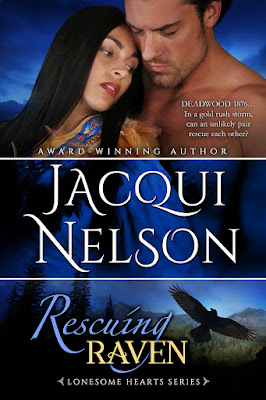
Rescuing Raven's Book Cover


RESCUING RAVEN 


Story Inspiration page ~ from the back of the book

Being an avid fan of the Dances with Wolves movie (starring Kevin Costner and Graham Greene) and the Deadwood TV series (starring Ian McShane and Timothy Olyphant), I’d always wanted to write a story set in South Dakota or the town of Deadwood. After registering for the 2018 Wild Deadwood Reads (WDR) author-reader event, an intriguing opportunity arose—join 16 authors (who would also be attending the event) in writing a new story for a limited-edition anthology called Wild Deadwood Tales. The anthology would be available for 2018 only, it would be showcased at WDR and Deadwood’s annual Professional Bull Riders (PBR) event, and all proceeds would go to the Western Sports Foundation (WSF).


The WSF and the PBR connections had many of the anthology authors choosing to write stories about modern-day bull riders, but I’m a historical fiction author—who now had her chance to write about Deadwood in 1876! 


Why 1876? That’s the year the town of Deadwood was born. Prior to 1876, the site was a gulch with dead trees. Then gold was found in the Black Hills and white settlers flooded in—illegally taking permanent residence on the Lakota’s sacred land that had been forbidden to whites by the U.S. government’s 1868 Fort Laramie Treaty. 


1876 is also the year of the Battle of the Little Big Horn—which was followed by General Crook’s march (from Montana Territory into the Dakota Territory) in pursuit of the Lakota Sioux. But General Crook only took enough rations for a few days—which resulted in the Horsemeat March (also known as the Starvation March) when his men had to eat their horses to survive. Near Deadwood, General Crook and his men fought the Battle of Slim Buttes and stole not only the Lakota’s winter food preserves but their horses (to replace the ones they’d eaten). 


Al Swearengen arrived in Deadwood early in 1876 and opened the Cricket Saloon, a barebones establishment that he built before his fancier and much more well-known Gem Theater. Not long after his arrival, his relationship with his first wife, Nettie, became extra complicated when a very attractive saloon girl named Kitty Austen came to town and became Al’s employee and more. 


All of this history created many complications for Raven (a Lakota woman born in the Black Hills) and Charlie Jennings (a white man from Oregon) who were perfect for each other even if their two worlds were not.

The reward is worth risk. Read Rescuing Raven for free on my website www.JacquiNelson.com


RESCUING RAVEN

Deadwood, Dakota Territory – 1876

Raven wants to save one person. Charlie wants to save the world. Their warring nations thrust them together but duty pulled them apart—until their paths crossed again in Deadwood for a fight for love.

In a gold rush storm, can an unlikely pair rescue each other?

Rescuing Raven features a grown-up Charlie Jennings who was a young boy in my Oregon Trail story, Between Heaven & Hell (set in 1850). You’ll also get to meet real-life (and really complicated) Al Swearengen—one of the first men to set up a business in Deadwood. Al’s most well-known saloon was The Gem Theater, but his first Deadwood saloon (the one shown in my story) was The Cricket. 

Click here to read an excerpt on my website.

Book review "grabbed my interest from the first page and did not let go until the end."


THE LONESOME HEARTS SERIES 


Resuing Raven is part of my Lonesome Hearts series, which follows the frontiersmen and women who meet on the Oregon Trail and afterward. Each story includes one or more of the characters from the other books but is also a standalone read.


Hope you enjoyed my writing inspiration and that your Friday and your weekend are filled with sunny summer inspiration ☀️❤️

~ * ~

Jacqui's author photo

Join me on 

Follow me on 

Tuesday, June 19, 2018

Mustangs Still Run Free

by Heather Blanton

And I'm not talking about the BLM Round-ups. On a recent trip to South Dakota with my sister, we discovered the Black Hills Wild Horse Sanctuary. The place is awe-inspiring, the horses jaw-dropping, and the dedication of the volunteers humbling.

In short, this preserve protects 700+ Mustangs on a little over 13,000 acres in southern South Dakota.
There are also 200 head of red Angus so the ranch can benefit from some government grants. Wild horses alone don't qualify. They're considered feral animals.

Imagine 700 horses that have never been saddled. The herd contains actual Spanish ponies, descendants of Cortes' foray into the Southwest. There are also a few Choctaw ponies the reserve is trying to bring back. And there are dozens of the striking smoky-blue gray grulla horses. You can tour the ranch (which I highly recommend) and interact with the horses. You can also sponsor horses. Or you can just flat-out donate. With a feed bill of one million dollars, they won't turn your money away.

If you are ever in the state, anywhere in the state, make the trip. Go see the Mustangs. You can find out more about them here!
A little Choctaw Indian Pony with my seester Dawn
 
Our guide showing us the basin where the main part of the ranch sits.


Some of the horses were sweet. Some, not so much.

Wednesday, July 27, 2016

Crazy Horse

I'm very fortunate to be able to take a cross-country RV trip and see sights I've only heard of.  One of my desired stops was South Dakota since I'm enamoured with the Sioux and a few of my westerns deal with the Paha Sapa (Black Hills.)  As we drove through the beautiful mountains of the area, my mind pictured brave warriors among the trees and I immediately saw why they viewed the hills as sacred and wanted to keep them.

I'm sharing a bit of what I learned there from visiting the Crazy House Museum:

Taken from Observation Deck
Firstly, the park is not a federal or state park and is fully funded by the visitors.  We also saw Mount Rushmore and learned the carving of those sculptures inspired this second colossal piece of art.
I say colossal because the faces on Mt. Rushmore would all fit on one of Crazy Horse's cheek.

Korcak Zlolkowsk (jewel-cuff-ski)  assisted in the carving of Mt Rushmore in 1939 and was contacted by Chief Henry Standing Bear of the Oglala, asking him to consider carving a sculpture dedicated to the American Indian, in fact the reason in the letter stated a desire to let the white man know the Indian also had heroes. Korcak agreed and with only $174 in his pocket began work in 1948. Lots of blasting has taken place and still there is lots to do.

Ruth Ross followed Korcak to South Dakota to be an assistant, and in 1950 they married.  They had ten children to make this a family undertaking.  Sadly, Korzak died in in 1982 and Ruth ran the foundation they started to assure completion of the sculpture.  Ruth passed in 2014 and some of the family members and staff carry on the dream.

To give you an idea how big the finished product will be, the head is 87 1/2 feet high, his feather will be 44 feet, his arm will be 253 feet, horse's head 219 feet and the entire piece will be 641 feet long and 563 feet high.  I took this information directly from a flyer we received.

Here is an example of what the finished product will look like:

Wednesday, August 26, 2015

The Slaughter at Wounded Knee by Ginger Simpson #wounded knee #history

Last month I shared how the Ghost Dance originated and as a result, Sitting Bull was killed.  Now I'm progressing to what happened in the aftermath of the Ghost Dance...The slaughter at Wounded Knee:

Rumors flew through all the reservations in Dakota around September 1890, that in reprisal to the Ghost Dance, the government would take action.  Of course, fear spread like wildfire, that the government would erase any future the Sioux had, so those 400 or so left of Sitting Bull's followers fled,  seeking shelter and aide under Chief Big Foot at the Cheyenne River Reservation.  Very few of the original number reached their destination because the remaining were intercepted and convinced to surrender to the authorities.

Those who made it safely to Chief Big Foot  found themselves trapped by the Cavalry, who didn't move to attack until they received orders.  The fear the Lakota felt now spread to Big Foot's people and during the night on December 23, 1890, around 350 total, including the Chief, left the village.

The soldiers, along with their small arms arsenal followed, and on December 28th, the renegades gave up and made camp at a place called Wounded Knee.  When the army demanded the tribe surrender their weapons, the Indians refused and a scuffle ensued,  What was a peaceful encampment turned into a nightmare.

The Indians stood firm, but since the combatants were not equally armed, they didn't stand a chance.  The proverbial 'heat of battle' led many of the cavalry on a killing spree, cutting down defenseless women, the babes in their arms and old men, women and children as they tried to flee.

The death count:  25 soldiers (many killed by friendly fire.) 39 wounded.
at least 153 Indians died, but some claim as many as 300.

The military dead were buried with full honors, but a civilian crew was hired to dig a common grave and dump all the bodies of the deceased Indians into it.

Quoting one civilian worker:  "It was a thing to melt the heart of a man, if it was of stone, to see those little children, with their bodies shot to pieces, thrown naked into the pit."

The massacre at Wounded Knee remains the day the Plains Indians' resistance ended, however, the slaughter serves as a symbol of how the whites treated those with red skin.


Note from Ginger:  I have paraphrased this from my favorite research source, America's Fascinating Indian Heritage from Reader's Digest.  How sad that we learned nothing from this experience.

Wednesday, March 19, 2014

Lakota Woman - Posted by Ginger Simpson

Last month, I posted a letter I'd received from an expert on American Indians.  He suggested that if I wanted to get into the true spirit of the Sioux, I should order Lakota Woman by Mary Crow Dog.  I got the book and have been reading it to aid my writing and boost my research about the Lakota people.  I've been so moved by the story, I want to share the very beginning of the book.  Although this scene is not written about the same era which I elect to share in my novels, the content definitely has the hook that makes you want to read more...plus I'm getting a real feel of what the Indians have gone through at the hands of our government and the treatment they've received at the hands of the white people who call themselves Christians.  Let me introduce, Mary Crow Dog  (her married name):

I am Mary Brave Bird.  After I had my baby during the siege of Wounded Knee, they gave me a special name--Ohtika Win, Brave Woman, and fastened an eagle plume in my hair, singing brave-heart songs for me.  I am a woman of the Red Nation--A Sioux woman.  That is not easy.

I had my baby during a firefight, with the bullets crashing through one wall and coming out through the other.  When my newborn son was only a day old and the marshals were really upon us, I wrapped him up in a blanket and ran for it.  We had to hit the dirt a couple of times and I shielded the baby with my body, praying.  "It's all right if I die, but please let him live."

When I came out of Wounded Knee, I was was not even healed up, but they put me in jail at Pine Ridge and took my son away.  I could not nurse.  My breasts swelled up and grew hard as rocks, hurting badly.  In 1975, the feds put the muzzles of their M-16s against my heard, threatening to blow me away  Its hard being an Indian Woman.

My best friend was Annie Mae Aquash, a young, strong-hearted woman from the Micmac Tribe with beautiful children. It is not always wise for an Indian woman to come on too strong.  Anne Mae was found dead in the snow at the bottom of a ravine on the Pine Ridge Reservation.  The police said she had died of exposure, but there was a 38-caliber slug in her head.  The FBI cut off her hands and sent them to Washington for fingerprint identification, hands that had helped my baby come into the world.

My sister-in-law, Delphine, a good woman who had lived a hard life, was also found dead in the snow, the tears frozen on her face.  A drunken man had beaten her, breaking one of her arms and legs, leaving her helpless in a blizzard to die.

My sister, Barbara, went to the government hospital in Rosebud to have her baby, and when she came out of anesthesia found she had been sterilized against her will.  The baby lived only for two hours, and she had wanted so much to have children.  No, it isn't easy.

When I was a small girl at the St. Francis Boarding School, the Catholic sisters would take buggy whips to us for what they called "disobedience."  At age ten, I could drink and hold a pint of whiskey.  At age twelve, the nuns beat me for "being too free with my body."  All I had been doing was holding hands with a boy.  At age fifteen, I was raped.  If you plan to be born, make sure you are born white and male.

It is not the big, dramatic things so much that get us down, but just being Indian, trying to hang on to our way of life, language, and values while being surrounded by an alien, more powerful culture.  It is being an iyeska, a half-blood, being looked down upon by whites and full-bloods alike.   It is being a backwoods girl living in a city, having to rip off stores to survive.  Most of all, it is being a woman.

Among Plains tribes, some men think that all a woman is good for is to crawl into the sack with them and mind the children.  It compensates for what white society has done to them.  They were famous warriors and hunters once, but the buffalo is gone and there is not much rep in putting a can of spam or an occasional rabbit on the table.

As for being warriors, the only way some man an count coup nowadays is knocking out another skin's teeth during a barroom fight.  In the old days, a man made a name for himself by being generous and wise, but now he has nothing to be generous with, no jobs, no money and as far as our traditional wisdom is concerned, our men are being told by the white missionaries, teachers and employers that it is merely savage superstition they should get rid of it they want to make it in this world.  Men are forced to live away from their children so they can get Aid to Dependent Children.  So, some warriors come home drunk and beat up their old ladies in order to work off their frustrations.  I know where they are coming from.  I feel sorry for the, but I feel even sorrier for their women.

Skipping ahead a little...

The Brule, like all Sioux, were a horse people, fierce riders and raiders, great warriors.  Between 1870 and 1880, all Sioux were driven into reservations, fenced in and forced to give up everything that had given meaning to their life--their horses, their hunting, their arms, everything.  But under the long snows of despair, the little spark of our ancient beliefs and pride kept glowing, just barely sometimes, waiting for a warm wind to blow that spark into a flame again.

Skipping again...just to the conditions in which Mary lived with her grandparents:

The old couple raised us way out on the prairie near He-Dog in a sort of homemade shack.  We had no electricity, no heating system, no plumbing.  We got our water from the river.  Some of the things which even poor white or black ghetto people take for granted, we did not even know existed.  We knew little about the outside world, having no radio and no TV.  Maybe that was a blessing.

****

Wow....I can't wait to read more of this book...in fact by the time this blog is published, I will probably have finished it, but I wanted to whet your appetite.  I'm thinking that Yellow Moon (my current WIP) is going to take on a whole new meaning after this.  My current beginning chapters are way off base, according to the expert, and if anything, I want to get my historical facts right.

Maybe next month, I'll share more from Mary's story.  I think you might like that.  Right?


Saturday, May 19, 2012

Badlands of South Dakota

You haven’t truly seen “the west” until you’ve seen the Badlands.

Why do I say this? I am no expert, but to me, this area had a surreal quality about it. A weather-beaten aged beauty. Lots of dust, and those varying shades of rust, brown, gold I’d always envisioned “the west” to be. I could picture horse herds here more than anywhere else, and bands of Indians (er, Native Americans) roaming the prairie.

On a drawn-out trip out west to visit family in Montana in 2002, my husband, daughter and I decided to hit a few landmarks along the way in South Dakota, plus Yellowstone. The Corn Palace was one, since I’d run across that oddity (to us) on some type of “Don’t Miss” travel tips. Wall Drugs was another, of course, due to all the signs we’d seen. Mount Rushmore, of course—and I was stunned that we could glimpse part of the massive stone heads from the highway. That was a majestic sight. But we all loved seeing the Badlands.

And I mean big time “l-o-v-e-d” as in “we HAVE to stop here on the way home again” love.

Why? We couldn’t explain that. Sure, they have a ‘rugged beauty’ and ‘striking geologic deposits’ according to the National Park website. It’s nice to know that ‘ancient mammals such as the rhino, horse and saber-toothed cat once roamed here.’ Yes, it’s astonishing that it covers almost a quarter of a million acres, that it includes mixed-grass prairie. And that ‘bison, bighorn sheep, prairie dogs and black-footed ferrets live there today.’ Great.

I don’t know about the other animals, but we saw prairie dogs. Hundreds of ’em. I could have watched them pop in and out of their holes for hours. Cute little buggers.

First of all, a disclaimer. I live in a state known for its “leafies” – oak, maple, elm, birch, ash, pine plus plenty more, and that’s just in my neighborhood. Michigan is known for its forests and Great Lakes, plus all the small lakes in the Mitten and the UP. Green and blue are the primary colors (and I’m not talking green and white for Michigan State or blue and maize for UM). The prairie, as I first caught sight of it when we crossed from Minnesota farmland into South Dakota farmland, was fairly green, mostly brown. Wide open spaces, as the song goes, cottonwoods (I think) that usually grew near creeks or rivers. You could see rain clouds in the distance and never get wet. Very odd to us. Even the trees looked different.

So at first we didn’t notice a whole lot, driving the expressway – being from Michigan, a car ride can be pretty much "same old, same old" boring. Then we turned off to where we’d scoped out Google maps ahead of time. No trees here. Like none. Just a few scattered houses in dry, brown land. I have to say it was the middle of a hot summer, too. Anything above 85 is hot to us. It must have been 90+. And don’t tell me it’s a dry heat. Hot is hot. We drove down a two-lane country road and suddenly the world dropped off.

That’s the Badlands to me.

We stopped the car, although the road curved along the rim’s edge – maybe for a ways, we didn’t know. Or care. We all piled out. Stood on that rim, my husband and daughter closer than I ever could get to the edge. And just stared. Awestruck. The rock formations, the little gullies, the striations in the soil and the way the sunlight hit them just right, giving the browns, gold and rust hues a tinge of purple, blue, rose, even a faint gray brown. It was marvelous. No photograph can do it justice.

I can’t even describe it here all that well. But my imagination lit up, and whether or not any cowboys drove their cattle along the rim or the Indians meandered around the gullies at the bottom, I had a sense of the true magic of “the west.” Yes, the Rockies are just as magnificent. I’m sure there are other canyons that are just as wonderful. I guess it struck me so hard because this was my first visit past the Mississippi River. I’m still a greenhorn. I haven’t seen Wyoming’s Wind River range, or Colorado’s Pike's Peak, or Utah’s Green River area, or Nevada’s desert, or even Idaho and Arizona. We saw plenty of cowboy gear at Wall Drugs. Hats, boots, scarves, chaps, belts, weapons and spurs, you name it.

There was no fence along the rim. A sign here and there, maybe, warning of a sheer drop off and the danger in trying to climb down. On our drive back home from Montana, we chose a spot where we could drive through a larger area (off 240, or whatever they call the roads there) and that was even better. Again, hard to explain the scenery. We parked and walked along part of the gully bottom, saw the interesting types of “greenery” – not sure if they were grasses, or cacti, or some type of heather or what have you – and my husband and daughter climbed to a rocky hill (I’m too chicken and dislike heights) so I could take photos.

Alas, I haven’t scanned those in yet to my computer. But we sure enjoyed our visit out west. To me, the Badlands epitomize what “the wilder west” might have looked like when I thought of “the Hole in the Wall” and other remote spots for black-hat bad guys to hide.

The Badlands do not figure in my book, Double Crossing, which is set for the most part on the transcontinental railroad from Omaha, Nebraska to Sacramento, California. But it did win the 2012 Spur Award for Best First Novel! That's a great honor.

Check out the 5-star reviews on Amazon and Goodreads!

2012 Spur Award Winner for Best First Novel from
Western Writers of America

 BUY LINKS:

Astraea Press, AmazonBarnes & Noble, Smashwords

 Want to connect with Meg? Check out these links.


Website * Twitter * Facebook * Double Crossing * Blog