Showing posts with label frontier forts. Show all posts

Friday, March 24, 2023

Fort Halleck, Wyoming Territory by Zina Abbott


Established at the base of Elk Mountain on the northern extremity of the Medicine Bow range in Wyoming Territory, Fort Halleck went into operation on July 20, 1862. The building of the Fort was prompted by the hostile Indian warfare existing on the Plains during the early 1860s. Its primary purpose was to aid in keeping the line of transportation open between the East and the West. That included protecting both Ben Holladay’s Overland Stagecoach travel and the telegraph lines.
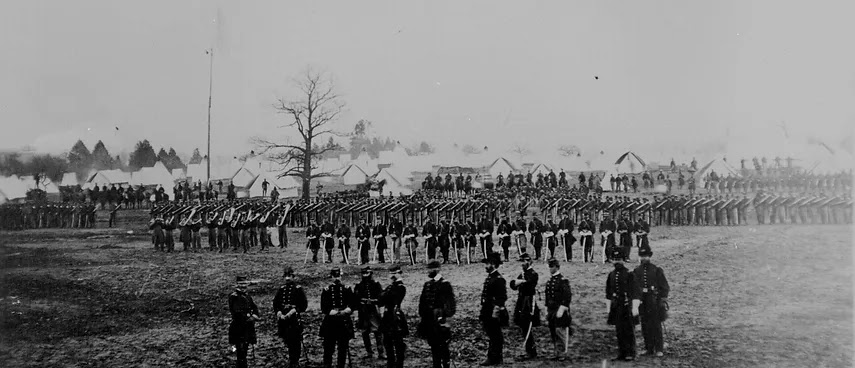
11th Ohio Volunteer Calvary

Soldiers of Company A of the 11th Ohio Volunteer Cavalry stationed in Camp Collins in Colorado were dispatched north to build Fort Halleck to protect the trail from Camp Collins to the Green River stage station in the west. 


They named the fort in honor of Major General Henry Wager Halleck commander of the Department of the Missouri and later General-in-chief of the Union armies.


Drawing of Fort Halleck by Bugler C. Moellman

The site was located on the north side of Elk Mountain at an elevation of about 7300 feet. It was built near a spring, had plenty of wood, and the region was filled with ample game. The fort complex consisted of stables large enough to hold 200 horses, storehouses, two sets of company quarters, officers’ quarters, a store, a bakehouse, a jail, and a hospital. The buildings consisted of log structures, huts, and dugouts flanking a small parade ground. Native materials from the nearby mountains were used, and some of the structures were made by placing logs upright in the ground close together and then adding a sod roof. The majority, however, were the conventional low profile log cabin style. There is no evidence that the Fort ever had a stockade surrounding it.

The location had its challenges, several involving climate. On March 2, 1863, Lt. Col. William Collins wrote to his superior officer, stationed in Omaha, Nebraska Territory. “It had stormed more or less for two days, and on the third day (Feb. 28) a few hours after leaving camp a terrific storm came on which lasted all day and into the night. The air was so filled with snow that it was often impossible to see ten yards in any direction. … Finding it impossible to kindle a fire on account of the violence of the wind, after a delay of about half an hour the march was resumed.”

Arrows show locations of Ft. Halleck and Rock Creek Station

Though it was considered one of the most dangerous sections of the trail, and the troops were kept busy defending the area, it was also a busy location. In 1864, over 4200 wagons carrying 17,584 emigrants passed the fort, bringing over 50,000 animals.

The trail was at its busiest in 1864 and 1865. During this time, troops were often used as escorts and drivers for the stages. At times in 1864 and 1865 ongoing attacks caused the mail to accumulate at stations in Colorado and at Fort Halleck until it could be transported to Green River via government wagons. 

Busy or not, after just four short years, the fort was abandoned in 1866. By the following year, one traveler described it as “the most dreary place on the entire route.”

For a detailed account of what took place during the years Fort Halleck was in operation, read the account at WyoHistory

Location of former Fort Halleck - Map courtesy of Google Maps

Fort Halleck was officially abandoned by the military on July 4, 1866 by then, commanding officer, Captain Henry R. Mizner. He dismantled the Fort and removed the usable materials and supplies to Fort Buford (later Sanders), a newly located post on the Laramie Plains established in anticipation of the forthcoming construction of a transcontinental railroad.


The four year period in which Fort Halleck was in existence represented a critical time in American history. Although short-lived, the Fort filled a vital need in serving the interests of the United States government when maintaining contact with the Western states became an important consideration in the nation's survival.

The only building remaining on the former Fort Halleck site is the Blacksmith’s cabin, a low-roofed log structure. To see images of this building, please CLICK HERE.


I have two books set in the region of Elk Mountain and the former Fort Halleck. Both take place about fifteen years after the fort was decommissioned.

Lauren, Book 2 in the Rescue Me (Mail-order Brides) series is largely set in Rock Creek, Wyoming Territory. It was on the original Overland Trail, plus it became a rail stop on the Union Pacific Railroad. To read the book description and find the purchase options, please CLICK HERE.


My Runaway Brides of the West series book, Ellie, has scenes in both Medicine Bow, just north of the Fort Halleck site, and in Como Bluff, across the Medicine Bow River from the town. To read the book description and find the purchase options, please CLICK HERE.


Sources:

https://www.hmdb.org/m.asp?m=95377

https://www.legendsofamerica.com/fort-halleck-wyoming/

https://www.wyohistory.org/encyclopedia/fort-halleck-and-overland-trail

https://wyoshpo.wyo.gov/index.php/programs/national-register/wyoming-listings/view-full-list/435-fort-halleck

https://en.wikipedia.org/wiki/Fort_Halleck_(Wyoming)

Friday, March 27, 2020

Kansas Forts Along the Smoky Hill Trail-FORT RILEY by Zina Abbott


For my next four books, my writing has taken me to frontier Kansas. In particular, I have researched the primary trails and frontier forts along those trails. For the next several months, I will be sharing with you regarding the Kansas Forts along the Smoky Hill Trail.

Today I am starting from the eastern part of Kansas with Fort Riley. Even though by the time the American Civil War ended, this part of Kansas was no longer on the frontier, it was a primary supply center for the forts in western Kansas. Situated along the Smoky Hill Trail in eastern Kansas, goods traveled by military mule teams, or, more commonly, by contract freight trains comprised by oxen-pulled wagons to their destinations in the west.

In the early 1850s the army needed a site west of Fort Leavenworth to cope with the inevitable clashes between emigrant tribes, long-established tribes, and Americans who were arriving in greater numbers. Military officials decided that necessary repairs to Fort Leavenworth, along the Missouri River in Kansas, would be a waste because it was too far to the east to enforce boundaries and policies. A more strategically sensible position was desired. 

In 1852, a troop of the First Dragoons escorted Major E.A. Ogden went on a reconnaissance mission to find a site for a new post. Major Odgen found the most promising terrain near the juncture of the Smoky Hill and Republican rivers, a long-established crossroads of Indian activity. It was first known as Camp Center, because of its proximity to the geographical center of the United States.

Plan for Fort Riley
Fort Riley is located on the north bank of the Kansas River three miles from Junction City at the junction of the Republican and Smoky Hill Rivers. It was located between the Oregon and Santa Fe trails to provide protection for travelers on overland routes. It was established 17 May 1853 in Kansas Territory by Captain Charles S. Lovell, 6th U.S. Infantry, on a site recommended by Colonel Thomas T. Flauntleroy, 1st U. S. Dragoons.

On 27 June 1853, it was designated Fort Riley, in honor of Colonel Bennett Riley, 1st U.S. Infantry, who led the first military escort along the Santa Fe Trail and who died on 9 June 1853. Construction of the permanent cavalry post was commenced in 1855 under the direction of Captain Edmund A. Ogden, 8th U. S. Infantry.

Soldiers erected a few temporary buildings in 1853, but Major Ogden oversaw the principal construction of the permanent buildings of the fort beginning in 1855. In July of that year, a cholera epidemic broke in the fort. Although short-lived, by the time it ended, an estimated 75 to 125 persons in the region died, including Major Ogden.

Fort Riley and the Plains Indians
Even before the Civil War, soldiers from Fort Riley fought in major campaigns against Indians as they executed and enforced the laws and policies of the United States government. Fort Riley was the stage for the Second Dragoon Sioux Campaign of 1855, the Cheyenne Expedition of 1857, the 1860 Comanche and Kiowa Expedition, and the Curtis Expedition of 1864.

With the opening of Kansas Territory in 1854, Fort Riley’s first mission was to protect those Americans settling in the new region. Eventually, it's main function became organizing and drilling troops and source of supplies. As more forts were established in the west part of the state, it soon became a supply depot headquarters for the western Army forts.

As a cavalry post, the horse trade was especially important. The army had strict regulations about the quality of horses to be purchased and who might serve as suppliers. Most of the cavalry horses at Fort Riley came from Fort Leavenworth and St. Louis. These “American” horses were capable of carrying a 450-pound load.
 
Fort Riley 1866
Fort Riley also served as the headquarters of the District of the Upper Arkansas, responsible for the army’s operations and posts in western Kansas and eastern Colorado under the command of Major General Samuel R. Curtis at Fort Leavenworth who headed the Department of Kansas, which included the Territory of Colorado, Indian Territory, and the state of Kansas.

Soldiers from Fort Riley assisted in treaty arrangements with many Indian nations. Some agreements were concluded with relative ease, often facilitated by chicanery as in the cases of the Kaws and immigrant Potawatomis, Shawnees, and Delawares. Many Indians in Kansas became US citizens through the treaty process, but others were more resistant to change. These included Cheyennes, Arapahos, Comanches, and Kiowas. It was because of the resistance from these tribes that Fort Riley and many of the forts to the west that it supplied fought military campaigns over the 1860s into the early part of the 1870s to conclude what they considered meaningful treaties with these tribes. Even after peace treaties were in place, the problems did not end.

Fort Riley involved itself with policing actions. Notable among them was their failed efforts to control squatters from taking over Kaw reservation land in Council Grove. Other policing actions included incarcerating Indian prisoners, which proved to be unsuccessful since the facilities were open and its boundaries easily breached.

After the Civil War, troops from Fort Riley were needed to protect workers constructing the Kansas Pacific Railroad from the Indian attacks.

In 1887, Fort Riley became the site of the United States Cavalry School. The famous all-black 9th and 10th Cavalry Regiments, the soldiers of which were called "Buffalo Soldiers", were stationed at Fort Riley at various times in the 19th and early 20th centuries.

There were nine major frontier forts established in Kansas, as well as several smaller, temporary camps. Of those forts, Fort Riley is one of the two nineteenth century forts still active today.

Starting in the twentieth century, during World War I, the fort was home to 50,000 soldiers, and it is sometimes identified as ground zero for the 1918 Spanish flu pandemic, which its soldiers were said to have spread all over the world. Since the end of World War II, various infantry divisions have been assigned there. Most notably, from 1955-1996 the post was home to the famed Big Red One. Between 1999-2006, the post was headquarters to the 24th Infantry Division (Mechanized) and known as "America's Warfighting Center". In August 2006, the Big Red One relocated its headquarters to Fort Riley from Leighton Barracks, Germany.

Notable people from the nineteenth century at Fort Riley:

Major E.A. Ogden who died in the cholera epidemic to hit Fort Riley in 1855.

In 1864 Major Benjamin S. Henning commanded the U.S. Army’s District of the Upper Arkansas from Fort Riley.

7th Cavalry at Fort Riley
George A. Custer was stationed at the fort in 1866. That same year he formed the 7th Cavalry. 

Wild Bill Hickok was a scout for Fort Riley starting in 1867.

Today is release day for my novel, Hannah’s Handkerchief, Book 24 in the Lockets & Lace series (also Book 4 in the Atwell Kin series). The opening chapters take place at Fort Riley. As will my other Atwell Kin books, an underlying theme involves the situation with the Kaw (Kansa) tribe who made early treaties with the United States which were not enforced to these people’s detriment.

To read the book description and find the purchase link, please CLICK HERE.


Sources:
http://www.vlib.us/old_west/forts.html#riley
Sherow, James E.;  Kansas History: A Journal of the Central Plains
Wikipedia: Fort Riley