Showing posts with label laundry. Show all posts

Wednesday, June 3, 2020

Hilarious Housekeeping Hints from the 1800's By: Julie lence

Amazon.com

In most homes, women tackle the cleaning and the laundry. We have our favorite mops and soaps, and  somewhere between the scrubbing and folding, we long for a self-cleaning house. But compared to the housekeeping grind of the 1800’s, today’s philosophy and methods are simpler. Take a gander at some of the humorous logic from back then, courtesy of  …And You Think You’ve Got It Bad. I’d wager you wouldn’t wish for a self-cleaning house again, but I’d be lying.

Cleaning Tips:
While painting, keep the room well ventilated and eat acid fruits. Any woman with a mechanical turn of mind can paint.

To rid your home of moths, take common lamp-oil and wash the floor all over. It smells “loud” but will be gone in about two days. So will the moths.

Bellows, courtesy of objectlessons.org
To clean a papered wall, cut a large loaf of two-day old bread into eight pieces. Blow dust off wall with a bellows, rub a piece of bread down the wall in half yard strokes. Begin at the top of the room until upper part is cleaned then go around room repeating process until all has been gone over.

Laundry Tips:

According to …And You Think You’ve Got It Bad, wash day is Monday, and should be completed by 10 a.m. One should prepare the wash water Saturday night. Soft water works best, but if you don’t have soft water you can soften a barrel of well water by pouring a half-peck of boiled hard-wood ashes (and the water used to boil the ashes) into the barrel water. You’ll know enough has been added to produce the desired effect when the water takes on a curdled appearance and soon settles to perfectly clear. If milky in appearance, add more ashes and lye, but not too much as it will affect your hands in an unpleasant manner.

To stiffen linen cuffs and collars, add a small piece of white wax and one teaspoon of brandy to a pint of fine starch.

Victorian Vanity Set courtesy of Pinteret 
Clean a silk dress by first brushing with a velvet brush. Grate 2 potatoes into 1 quart of water. Let stand to settle, then strain it off quite clear. Sponge dress with potato water. (The velvet brush is the long brush at the top of the photo)

After reading these hints, I think I’ll stick to my All laundry soap and Snuggles fabric softener and hire a painter when needed.   

...And You Think You've Got It Bad by Barbara Fairchild Gramm can be purchased at Amazon.com  
Original Cover


Wednesday, July 6, 2016

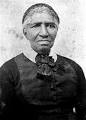
Clara Brown


Life was often hard and unfair for women in the 1800’s. Cooking, cleaning, the loss of a child; women overcame much and kept on going. In thumbing through a collection of works I stumbled across one woman who led a long life and triumphed through patience and hard work. Meet Clara Brown:    
Clara Brown was born a slave in 1803 Tennessee. At the age of 3, she and her mother were sold to another slave owner. Clara remained with this owner for twenty years. During this time, she married and had four children, but when her owner passed, she and her family were sold at auction. Clara was bought by a George Brown and taken to his home in Kentucky. Unable to read and write, Clara lost contact with her husband and children.  
George Brown was a Kentucky planter, whose last name Clara adopted. He was a kind man who helped Clara gain her freedom in 1859 and move to Missouri where former slaves were protected by law. Clara went to work for a St. Louis merchant and moved with his family to Leavenworth, Kansas, where the merchant helped er establish a laundry. While in Kansas, Clara heard about the gold rush and joined a wagon train to Colorado. With no money to pay her way, she earned her passage by cooking, taking in laundry and nursing. She arrived in Denver in 1859 and was the first African-American woman in the gold fields.
While in Denver, Clara heard about George Jackson’s huge gold strike in Central City. She moved to the mining town, opened a laundry and invested in the mines and real estate. Being a devout Christian, she also organized a church complete with Sunday school. Little by little, her income and investments grew to where she could deposit money in the bank and helped other newly freed African-Americans come to Colorado to make a living. By 1866, she had saved an unheard amount of $10,000 and began searching for her family. Two of her children had died and she couldn’t find anything pertaining to her son or her husband.
Clara left Colorado for a spell to search for her daughter, Eliza Jane, in Kentucky. Like her son and husband, Clara couldn’t find any trace of her daughter and eventually returned to Colorado. In 1882, at the age of 79, Clara finally found Eliza Jane and her granddaughter, Cindy. They were living in Iowa. She enjoyed a few years with her daughter and was made a member of the Society of Colorado Pioneers for her role in the Colorado gold rush before passing away in 1885. Clara is buried in Riverside Cemetery, Denver.  
        

Monday, November 16, 2015

Doin' the laundry and makin' the bed by Paty Jager


Back before there was a Sleep Center or Laundromat people had to make do with what they had.

If the story I’m writing down for my new western historical series, the characters spend the night in a cabin that is for travelers in this road. In the cabin are two sets of bunk beds made with rope. This is how a rope bed is made. Many people used this kind of bed.

Making a rope bed:
If wood and hemp weren't available to make a rope bed, they would make a pallet on the floor. A rope bed consisted of a bed frame made of four posts and four side boards. Holes were bored through the sides every nine or ten inches and rope or cording woven in and out of the holes back to front and side to side making a grid. Then sacking or ticking was used to make the casing for the mattress and it was either filled with straw or feathers from ducks or geese. If straw was used they would take out the old and put in new every year at threshing time. If there wasn’t any grain to be threshed they might take it out and let it air in the sun for a day and then put it back in after they washed the ticking.
Washing clothes:

If a person found themselves traveling far from towns, the best way to clean clothes would be to beat them on rocks near a stream. Where they could be dunked, the dirt smacked out of them, and then dunked again and hung up to dry on bushes or rocks.

Did you know that dirt was rinsed and beat out of clothes before they were put in the boiling water? They did this to not set the stains with the hot water. One way to do this if there wasn't a washboard around was a rough board raised on legs. The garment being washed was dunked in water, placed on the board and beat with a paddle, shoving the dirt and water out of the cloth and into the grooves in the board. This was done thoroughly, the garment was rinsed, turned over and beat again, making sure the stains and dirt were gone before they were put in the soapy water and boiled. After twenty minutes  of stirring the garments to make sure the soap had filtered through it all, they were lifted out with a square, long-handled paddle and put in a barrel or tub of fresh clean water, rinsed and put in another tub of fresh water, then hung up to dry. 

photo taken by Paty Jager
A heavy cast iron kettle was usually used for boiling the clothes. A fire was built under the kettle after a bucket or two of water was added, so as not to crack the kettle from the heat. As the water continued to heat, buckets were added until the right amount was in the kettle and the water boiled. Wood had to be kept under the kettle to keep it hot.  

The long paddles were made of pine because it was a light wood. The long handled paddle for stirring the garments had a square handle. This kept the handle from spinning in their hands when they pulled a heavy object out of the kettle and less clean garments were dropped on the ground.  The paddle end had rounded corners to make sure the kettle could be scraped thoroughly to get all garments out of the water before it was dumped out.

I can say after reading about how they did laundry I'm thankful for my washer and dryer. Research and digging up how people did things in the past is one of the reasons I enjoy writing historical books.

Have you ever had to do laundry the old fashioned way?  I did when we were first married and the washing machine froze in the winter. I had a baby and had to do the laundry. I washed the cloth diapers and baby clothes in the bathing tub. I let is soak, smashed it around and used the side of the tub to smash and push the dirt out. It was hard bending over the tub but clean clothes were essential and we couldn't afford to fix the washer or pay at a laundromat. 

This information was taken from a Firefox book. They are great references for how settlers and pioneers lived.  http://www.amazon.com/Foxfire-11-Kaye-Carver-Collins-ebook/dp/B003FCTYY8

Monday, July 7, 2014

From Dutchland to Texas by Ciara Gold


I took a trip to Europe the end of June and saw all sorts of things that sparked ideas for stories and even blog entries. One of our excursions took us to the Zaanse Schans, an open air museum featuring wooden houses, windmills, warehouses and businesses from the 17th and 18th century Zaan region of the Netherlands. In 1594, Cornelis Corneliszoon van Uitgeest invented a crankshaft that made it possible to turn horizontal wind direction into a vertical sawing movement. In its heyday, the Zaan region sported over 600 windmills capable of sawing wood and powering other ingenious apparatuses, one of which was a washing mechanism for clothing.

Of course, the Dutch and German immigrants to the United States brought with them the technology for building these windmills. But western settlers needed the windmill to do more than saw wood or power machinery. They needed the windmill to pump water and in 1854, Daniel Hallady provided the plans for such a windmill. The first American windmill was built in Ellington, Connecticut and sported a vane or “tail”, the name given it by Texas cowboys.  This “tail” directed the wheel into the wind. By 1888, wooden blades were replaced by galvanized steel and while ranchers debated the use of wooden windmills against the newer backgeared designs, by 1912 only a handful of wooden bladed windmills could be found for purchase.

The windmill was used as a sort of experiment in Texas when barbed wire first came into use. With the land fenced, access to water holes, springs, rivers and creeks became difficult so farmers and ranchers needed a way to dig for water. The first attempts to pump water using a windmill met with little success as few understood the ratio needed for the size of windmill in relation to the depth and width of the well, but Christopher Doty of Schleicher County, Texas had one of the earlier successful windmills.

In 1882, due to a drought, “he ordered a drilling rig from Fort Scott, Arkansas, bored a fifty-two-foot well, and erected a Star windmill, which successfully supplied water for his 4,000 head of stock.” ~ Texas Online. Others followed suit but The King Ranch’s extensive use of the windmill played the most influencial role for the windmill in Texas and by the 1990s, the practice of using windmills to water stock became a common endeavor.

The need for windmills  gave rise to a career in the old west that few really think about. I’m always looking for more unique  careers to bestow upon my characters so maybe these will inspire others. The driller, usually a loner, followed fence crews until he could determine the best location for water. He bore well holes with a horse powered drilling rig. If he met with success and found water, the windmiller took over and set up the windmill. Windmillers were also employed by the larger ranchers to insure the equipment stayed in good working order. The range rider greased the windmills twice a week. The need for this duty lasted until 1912 when a dvancements in the design of the mill offered a self greasing mechanism that only had to be fed oil once a year.  “Though Texas became the largest user of windmills in the United States, there were never more than three active manufacturers of windmills in Texas at one time.” ~ Texas Online.

But, while the windmill did wonders for Texas cattle ranches, I'd like to share with you a short video I took of the power of windmills in The Netherlands. At the Zaanse Schans, they had on display a 18th century laundry. The windmill powered the mechanism that agitated three tubs of wash. I was fascinated.