Showing posts with label gold rush. Show all posts

Wednesday, June 5, 2024

Con Man & Gambler Jefferson R. 'Soapy' Smith ~ Julie Lence

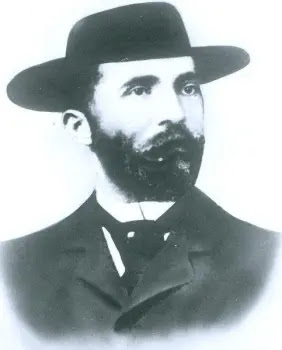
courtesy Denver Post
 Jefferson R. Smith was born into a wealthy Georgia family in 1860. By the end of the Civil War, his family was in financial ruin and moved to Texas, where Jefferson received a good education, due in part to his father’s position as a lawyer, and became an eloquent speaker. But proficient in speech didn’t net him a job, so he hired on with a cattle drive to Abilene, Kansas. He made good money, but while in Abilene, Jefferson’s attention was snagged by a con man and the ‘what walnut shell is the pea hidden beneath?’ game. Jefferson lost the money he made on the cattle drive, and found his calling in life as a gambler and con man.

       Having the gift of gab, he spent the next decade roaming the west and perfecting his skills, determined to be the best poker player. He made his way to Leadville, Colorado in 1885 and met up with Old Man Taylor, whose reputation pegged him the King of the Shell Game. The two joined forces and set up a con involving bars of soap. Taylor would blend in with the crowd while Jefferson, using a tripod and suitcase, would set out several bars of soap and invite people to play a game, hooking their interest with the line, ‘Cleanliness is next to godliness, friends, so step right up and watch me very carefully’. Players were to find the greenbacks he’d hidden within the bars of soap. Taylor would volunteer to be the first plyer and find the $100 bill, giving others the incentive to try their luck, but most only 5 cents, while Jefferson and Taylor raked in the cash, though Jefferson didn’t always keep the money for himself. He gave substantially to churches, widows, the poor, and often paid for the funerals of the girls from the red-light district, and never would he con the townsfolk. His games were strictly for unsuspecting tourists.

         Jefferson eventually left Leadville for Denver, where he added singing and joke telling to his routine. A complaint was filed against him and the sheriff, when filling out the paperwork, couldn’t remember Jefferson’s name but remembered the complaint had something to do with soap, so he wrote Soapy Smith and the nickname ‘Soapy’ stuck.

Soapy went on to become a successful gambler in Denver and opened his own saloon, Tivoli Saloon and Gambling Hall, with the Latin inscription Caveat Emptor (Let the Buyer Beware) above the door. He also formed a gang and a bond with the police department, which benefited both sides. Soapy helped the poor, especially at Thanksgiving by giving out turkeys so none were stolen, and by donating to churches. He even rescued an innocent girl from a detective agency trying to force a confession from her. Eventually, he learned of the silver boom in Creede, Colorado and left Denver for more riches.

In Creede, he formed another gang and put into motion taking control of the town, much to the dislike of rival Bob Ford, better known as the man who killed Jesse James. Ford wanted in on the controlling of Creede, and a third party arranged a meeting between them before bloodshed broke out. The two agreed to keep out of each other’s way, but Soapy went on to build the New Orleans Club with his longtime pal, Joe Simmons. From there, Soapy and his gang did take control of Creede, with Soapy still helping the poor. But the townsfolk tired of Soapy’s control and he went back to Denver and opened a ticket office, where he advertised tickets to Chicago for $5. Another scam, as when people tried to buy these tickets, he told them they were only sold on certain days, of which the present day was not one of them. With Colorado’s governor looking to clean up the lawlessness in Denver, he called in the militia to run Soapy out of town, but Soapy hunkered down in city hall with dynamite, threatening to bomb the building if the militia fired at him. Federal troops from Fort Logan were brought in to keep the peace. The governor withdrew the militia and finally ran Soapy out of town.

Making his way to Mexico, Soapy joined forces with Mexican president, Porfirio Diaz and set up other scams. But when he tried to convince Diaz that Mexico needed a foreign legion and set up a recruiting office for a hefty price, his scam was discovered and the deal broken.

1897 found Soapy heading to Skagway, Alaska when news of the Gold Rush broke. There he built another saloon/casino under the name Jeff’s Place, assembled another gang and used his winnings to open a phony telegraph office; the wires were under water and folks ‘often’ received word from back home to send money, of which Soapy kept. Eventually he stole $3,000 from a miner and a vigilante group demanded he pay it back. Hearing about the meeting the vigilantes were holding on the docks, Soapy armed himself and went, only to meet up with Frank Reid, a foe of Soapy’s. Soapy struck Reid with the butt of his rifle. Reid fired at Soapy and missed. The two got into a scuffle, with guns firing again. Soapy was killed and Reid died almost 2 weeks later from his injuries.
Soapy is buried on the outskirts of Skagway’s cemetery. A plain marker gives the dates of his birth and death. He was 38 and left behind an estate of $250.

Tuesday, December 14, 2021

Colorado News - Travel

 Post by Doris McCraw

writing as Angela Raines

Photo Property of the Author

Some of us are traveling this time of year, while others may wait until next year. One thing is almost certain, our characters travel. I thought it might be fun to look at the news around traveling from some of the early Colorado Newspapers. I'll start you off with one from the April 23, 1859 issue of the Cherry Creek Pioneer.


It is a bit hard to read, but it tells of flat-boats on the Platte River heading for the Missouri River. Unfortunately, it seemed two of them, according to the report, are now underneath the Platte River. 

As someone who grew up near the Mississippi River and learned its history, a number of the rivers in the early days had rapids, were hard to navigate, and one always had to deal with floods. Even the Mississippi, with all the attempts to control it, still manages to defy man and flood.

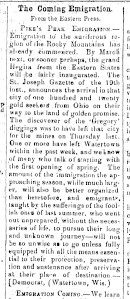
The next piece is from the February 29, 1860 issue of The Western Mountaineer. This piece is a report from one of the Eastern papers about the migration of 'gold-seekers'.


The article references the Pikes Peak or Bust era. I've always found this interesting as Pikes Peak is some seventy miles to the south of the area that started the rush. They mention that St. Joseph, (Missouri) had recently seen one hundred twenty 'gold seekers' from Ohio who were heading to Colorado. It says the next 'wave' will be better prepared with all the provisions, etc. that one would need on such a trip.

The final article is from the July 12, 1860 issue of The Western Mountaineer. This one is a reprint of a Leavenworth Herald piece. It also speaks of the migration and travel to the gold fields in the West.


It boggles the mind that so many families were making the trek in 1860 for a new life. As the article says, according to the gentleman who'd traveled from Denver to Leavenworth, there was a total of 17,086 people. Then another gentleman traveling from Denver to Fort Kearney indicated that he'd seen 22, 974 people heading west. 

So much of that early travel was to either find gold, silver, or land. Regardless the newspapers were documenting the migration. As a storyteller, I wonder what the stories were of those early travelers.

Until next time, each of you has a wonderful Holiday Season, Merry Christmas, and Happy New Year.


Doris Gardner-McCraw -

Author, Speaker, Historian-specializing in
Colorado and Women's History


Friday, July 12, 2019

The Wild Woman Philanthropist & Angel of the Mining Camps


Historic Angel of the Mining Camps & philanthropist

By Jacqui Nelson

In mining camps—where gold fever and greed ran rampant—an angel appeared. Meet the wild woman philanthropist who used her business sense, her strong work ethic, and her unstoppable determination to earn money for charitable causes and save lives.

Ellen “Nellie” Cashman
~ Aka the Angel of the Mining Camps ~

( born 1845 in Midleton, County Cork, Ireland ) 

 Nellie Cashman, San Francisco - 1874
 Nellie Cashman
San Francisco - 1874
Nellie was a businesswoman, boardinghouse owner, restaurateur, nurse, gold prospector, and philanthropist who also became known nationally as a frontierswoman.

In 1850, Nellie’s mother brought her and her sister to the United States to escape the poverty of Ireland’s Great Famine. As an adolescent, Nellie worked as a bellhop in a Boston hotel.

In 1865, her family moved to San Francisco.

In 1874, she struck out on her own and set up a boardinghouse for miners at Telegraph Creek, British Columbia, Canada. She asked for donations for the Sisters of St. Ann’s St. Joseph’s Hospital in return for the services at her boardinghouse.

Sisters of St. Ann, British Columbia, Canada
While delivering a $500 donation to the Sisters of St. Ann (in Victoria, British Columbia), she heard that miners had been stranded by a snowstorm and were starving in the Cassiar Mountains. She led a rescue party that hauled 1,500 pounds of food and supplies. It took 77 days to find the miners but her efforts saved 75 souls.

Cassiar Gold Rush, British Columbia 
In 1880, she moved to Tombstone, Arizona, where she raised money to build the Sacred Heart Catholic Church, did charitable work, and became a nurse. In 1883 when her sister died, she assumed the role of raising her five nieces and nephews.

In the late 1880s, she set up several restaurants and boardinghouses in Arizona. Legend says that a client once complained about Nellie's cooking. Fellow diner Doc Holliday drew his pistol and told the customer to repeat what he'd said. The man replied, "Best I ever ate."

Nellie Cashman
From 1898 to 1905, Nellie took up prospecting in the Yukon’s Klondike Gold Rush. She also opened a store in Dawson Creek. She used her earnings to help fund a new hospital in Fairbanks.

In 1925 when Nellie developed pneumonia, friends took her to the Sisters of St. Ann and the hospital that she’d raised donations to help build half a century earlier. When she died, she was buried in Victoria's Ross Bay Cemetery.

St. Joseph's Hospital, Victoria - past

St. Joseph's Hospital, Victoria - present (June 2019)

Nellie Cashman - 1924, Arizona Historical Society

~ * ~ 

I live only a 5-minute walk from St. Joseph's hospital (which is now an apartment for seniors). On the other side of the street is the Sisters of St. Ann's Academy and Orchard (which still has its apple trees but is also a lovely public park). I walk along this footpath worn into the field every time I go to visit my sister and nephew.

St. Ann's Academy and Orchard, Victoria - June 2019

Only a few weeks ago I sat on the steps of Victoria's Parliament Building alongside Danni Roan (my fellow Cowboy Kisses blogger) and listened to Nellie Cashman and Queen Victoria reenactors talk about their part in British Columbia's history.

Nellie Cashman & Queen Victoria reenactors - June 2019

It often catches me by surprise that I live so close to all this adventurous history. As my mom used to say, it's in our backyard. All I have to do is pause for a moment and look for it. I think I'm going to pause and look more often :)

Do you have an interesting historical tale from your "backyard"? I'd love to hear about it. Leave a comment below. 

~ * ~

CLICK HERE to read more Cowboy Kisses Wild Women blog posts *

Read about my stories on my 

Hope you'll join me on… 
Or follow me on… 

Don't forget to download my FREE story Rescuing Raven (Raven & Charlie's story in Deadwood 1876) 

Friday, January 6, 2017

So Far Away...Communicating Long Distance with Loved Ones Then and Now

Smoke signals: One way to send a message a long distance when you're short on time

For the next six months I will be separated from my daughter by almost four thousand miles, an ocean, and a six hour time difference. This got me thinking how recent this ease of communication has become and how much that one thing has changed in my lifetime.

The pain of separation is lessened by knowing two things: My daughter will have a great time, and I can talk to her almost anytime I want--for free, thanks to computers and smartphones. There are so many ways nowadays to keep in touch with far-flung loved ones, it makes my mind spin: email, Facebook, Skype, Messenger, and texting. Changes are coming so fast, probably a few new ones have been developed in the time it took me to type this sentence.  Not to mention via social media you can see what your loved ones are up whether they like it or not on Instagram, Twitter, Pinterest, and Facebook to name a few.

On Tuesday night we put our daughter on a plane to London where she's going for a semester. At three in the morning I got a text from her informing us she'd landed. Okay, fair enough, we did tell her to let us know when she got there. But then at 4 a.m. I got another text. "I think I left all my money at home."
I rolled out of bed and sure enough found the envelope full of pound notes still in her room.

Then came a series of increasingly panicky texts from Heathrow. "I don't know where I'm supposed to go! I don't see the bus from school." My husband threw the covers over his head and said, "Let her figure it out."
With visions of my daughter falling victim to human trafficking or being persuaded to join a terrorist cell, I made my way down to the computer and went to the website for her college. I learned the buses left from the airport every two hours and sent her that information from my phone. There continued a number of texts, which I won't document, but the upshot is apparently there are no employees, information desks or security guards at Heathrow! Unbelievable! An airport that runs itself.

While I was trying to talk my daughter down from jumping in a taxi for a hundred dollar ride, I emailed a friend of mine who I knew would be up early doing yoga or meditating or something else that would be good for her. She had recently told me the story about her own twenty-something year old son and his plan to travel by himself to Thailand. To start off his journey he left his passport two states away. But because we live in modern times, they were able to get someone to send his passport overnight. So, off he goes passport in hand. Later when she was at work she got a text from him. "Mom, I'm in China. Where do I go from here?" By the way, did I mention her son is deaf? And alone.

Between clients at her office my friend frantically tried to access her son's itinerary which he had left at home. Searching through her emails, she was able to find his next travel step from China to Thailand and texted him the information.

Anyway, that morning she replied right away to my email with the following advice: "Take a sleeping pill and turn off your phone."

But, no, I didn't do that. I stuck to my cell phone and computer, sending emails to staff at Queen Mary University alerting them to the fact that one stressed-out American student was wandering around the airport. I also found a help number which I texted to my daughter. When I at last got a message from her that she found the bus and was on her way, I let out a big sigh of relief and forgot how annoyed I was with her over the leaving her money here thing. I also got an email from someone at her school telling me they'd found her.

Because my daughter had a friend leaving for London that night, I was able to message that friend via Facebook and arrange to give her my daughter's money to bring over. Crisis averted. My point here being, we have so many avenues in 2017 to cut through long distance complications without even leaving home. Now if these kids would have figured it out on their own or learned from their mistakes is another question.

Me (in the purple) and my roommate, London, 1980

It's easy to communicate now, but when I did my year abroad in Britain, it was a different story. It wasn't that long ago, but the only tools available to me back in 1980 were telephones and airmail. When I landed in Heathrow back in the dark ages, my parents would have no way of knowing I got there safe and sound until they got my postcard telling them so.

I had a blast that year, but now I think of my poor parents rarely hearing from me for an entire year, and as a parent myself now, I feel for them. The phones were hard to use and expensive. Besides having to work out the time difference and hoping someone was home to pick up, we had to continually feed coins into the phone in order to have a conversation.

 Mainly, we wrote letters to each other. Letters written by hand on thin blue airmail paper. If I had a problem--and believe me I had more than a few--I was on my own.

Cut back a hundred years to 1880. My great grandfather and his cousin left Evanston, IL to seek their fortune in the silver mines of Leadville, Co. I have a picture of the two men on their western adventure. I don't know much, except his cousin died while there, and my great grandfather brought his body back home. He stayed put in Evanston after that.

My great grandfather (seated) and his cousin, Colorado 1880

I can't imagine having to handle an emergency on that scale in 1880. On top of everything else, my great grandfather must have felt so isolated in a communication desert. Telephones weren't common yet, but they did have the telegraph. I imagine he sent a telegram to their families back home alerting them to the death of their relative. Maybe he wrote a long, detailed letter as well, which would travel with the speed of stagecoaches, trains and mail carriers.

America has had a postal service from almost the very beginning. The first postal system was a private enterprise, but the U.S. government bought it months after it's inception. The postage was due when the letter was received--by the recipient. They quickly figured out this wasn't the most efficient method, and in 1842 the first postage stamps were issued. The cost of sending a letter was three cents.

I was surprised to read that the first air mail delivery was in 1870, decades before the first airplanes. Over five hundreds pounds of mail was sent off attached to balloons. There is no record of any of these airmail letters reaching their correct destinations. It was an idea way ahead of its time and probably best left on someone's drawing table.

Hordes of people made their way to California during the gold rush. The expansion left many folks miles away from the reach of the railroad or stagecoach. The Pony Express was developed to tackle this problem. Riders could deliver mail to remote outposts, often having to travel through hostile Indian territories. I was almost as surprised to learn that the Pony Express only ran for 18 months as I was about the first airmail deliveries.

The big development in communication was the invention of the telegraph. The first message sent in 1844 by Professor Samuel F.B. Morse said, "WHAT HATH GOD WROUGHT."  Interesting first choice.

The telegraph brought on a revolution in communication. For the first time delivering news was not limited to how fast man or machine could move. Think of how this instant exchange of information over great distances was a game-changer.

But, still for the average person in their daily lives snail mail was the way they kept in touch. My thoughts go back to families that were separated by long distance for long periods of time, and I wonder how much information was lost--or how many people were lost to each other. I can't imagine the heartbreak of seeing loved ones go off for distant parts and not knowing if you'd hear from them again. My daughter can wake me up at 3 a.m. anytime to tell me she's safe. Do you have your own stories of separation in your family history?


Wednesday, July 6, 2016

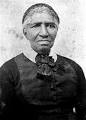
Clara Brown


Life was often hard and unfair for women in the 1800’s. Cooking, cleaning, the loss of a child; women overcame much and kept on going. In thumbing through a collection of works I stumbled across one woman who led a long life and triumphed through patience and hard work. Meet Clara Brown:    
Clara Brown was born a slave in 1803 Tennessee. At the age of 3, she and her mother were sold to another slave owner. Clara remained with this owner for twenty years. During this time, she married and had four children, but when her owner passed, she and her family were sold at auction. Clara was bought by a George Brown and taken to his home in Kentucky. Unable to read and write, Clara lost contact with her husband and children.  
George Brown was a Kentucky planter, whose last name Clara adopted. He was a kind man who helped Clara gain her freedom in 1859 and move to Missouri where former slaves were protected by law. Clara went to work for a St. Louis merchant and moved with his family to Leavenworth, Kansas, where the merchant helped er establish a laundry. While in Kansas, Clara heard about the gold rush and joined a wagon train to Colorado. With no money to pay her way, she earned her passage by cooking, taking in laundry and nursing. She arrived in Denver in 1859 and was the first African-American woman in the gold fields.
While in Denver, Clara heard about George Jackson’s huge gold strike in Central City. She moved to the mining town, opened a laundry and invested in the mines and real estate. Being a devout Christian, she also organized a church complete with Sunday school. Little by little, her income and investments grew to where she could deposit money in the bank and helped other newly freed African-Americans come to Colorado to make a living. By 1866, she had saved an unheard amount of $10,000 and began searching for her family. Two of her children had died and she couldn’t find anything pertaining to her son or her husband.
Clara left Colorado for a spell to search for her daughter, Eliza Jane, in Kentucky. Like her son and husband, Clara couldn’t find any trace of her daughter and eventually returned to Colorado. In 1882, at the age of 79, Clara finally found Eliza Jane and her granddaughter, Cindy. They were living in Iowa. She enjoyed a few years with her daughter and was made a member of the Society of Colorado Pioneers for her role in the Colorado gold rush before passing away in 1885. Clara is buried in Riverside Cemetery, Denver.  
        

Friday, July 24, 2015

The Red, White and Blue and Scarlet Serge By Alison Bruce

My dear American friends, have you ever been talking about the Great American Pastime, only to have your northern neighbour point out that baseball was a Canadian invention*? Strike back by pointing out that their beloved RCMP owes its invention to the United States.

Fort Whoop-Up (Now Lethbridge, Alberta)
The Cypress Hills Massacre

Before the Pikes Peek Gold Rush of 1859, relations between "white" trappers, prospectors and settlers and the "red" nations as generally peaceful, mostly out of enlightened self-interest on the part of the Americans. The Civil War slowed hostilities as the focus of conflict was in the east, but as soon a the war ended, the hostilities ramped up again.

Meanwhile, in Canada, the 1860s saw the withdrawal of the Hudson's Bay Company's (HBC) control over what would later become Manitoba, Saskatchewan and Alberta. American trappers and traders took advantage of this to encroach on Canadian territory. The most infamous of these were the wolfers, a gang of 100-300 Americans who had stolen a couple of US Army cannons and set up shop about in a former HBC fort about fifty miles north of the border. Originally designated Fort Hamilton, it was nicknamed Fort Whoop-Up.

The wolfers traded whiskey, which was an illegal and potentially lethal brew, and hunted buffalo for the hides. They got their name for poisoning the remaining buffalo carcasses, leaving them for wolves to consume. Then they'd return and harvest the pelts. It didn't matter to them that dogs, and in some cases people, were eating the meat and dying.

In 1873, a party of wolfers lost their horses at Cypress Hills and blamed a group of Nakoda (Assiniboine) camped nearby. They retaliated, massacring the Nakoda men, women and children.

First Mounties at Fort Walsh
The news outraged eastern Canadians. Prime Minister MacDonald had already received approval to form a military company to police the Canadian west and facilitate treaty making. Cypress Hills sped up the process.

Recruitment and training of the North West Mounted Police started, followed by the arduous trek west. Just over a year after the massacre, Division B under the command of Superintendent James Morrow Walsh reached the site.
"Walsh was sent to the Cypress Hills in command of B Division to establish an independent post which he was allowed to name for himself. Fort Walsh (Sask.) was to be the most important North-West Mounted Police establishment for the next seven years" (Dictionary of Canadian Biography)
James Morrow Walsh

Walsh's mandate was to stop the whiskey trade and bring the wolfers to justice. Easier said than done. By the time they reached Fort Whoop-Up, the illicit alcohol had been cleaned out. Bringing the men responsible for the massacre to justice was even more frustrating. Arrests were made, but no convictions. In the American courts, killing Indians wasn't considered a crime. In Canada, the cases were dismissed for insufficient evidence.

Walsh prevailed, however. It took time, but he cleared out the whiskey traders and gained the respect of the plains nations for upholding the law equally. This reputation which was met with skepticism by Chief Sitting Bull when he sought refuge in Canada.

Accompanied by six men, Walsh paid Sitting Bull a visit at his 1,000-warrior encampment. He told the chief that he was welcome to stay as long as he wanted in Canada, so long as he obeyed the law. Sitting Bull laughed at the notion that one man with six followers would tell a mighty chief what to do. Regardless, Sitting Bull stayed in Canada for four years, during which he and Walsh developed a strong mutual respect.

Sam Steele
Sam Steele and the Klondike Gold Rush

The NWMP were not meant to be a permanent force. Once the prairies were peacefully settled and Canadian sovereignty secured, they would no longer be needed. It could be said that Americans save the mounties from that fate. Bringing order to the Gold Rush, in particular the American prospectors, gave Sam Steele adding to the Mountie legend.
"Sam Steele was the quintessential Canadian man of action in the Victorian era. Physically strong and courageous, he personified the heroic qualities of the early North-West Mounted Police. He even looked the part to perfection: tall, barrel-chested, and handsome, inspiring confidence in men and admiration in women." (Dictionary of Canadian Biography)
 Steele was one of the first recruits to the NWMP and, like many of his fellows, he already had military training. Many more recruits were farm boys and tradesmen looking for adventure. Steele's talent for training horses and men was put to use very early in his career. He was one of the six constables that accompanied Walsh to treat with Sitting Bull. His intelligence, thoroughness and force of personality ensured that he continued to get choice assignments, including commanding the customs station at Bennett, where the bulk of the rush passed from Alaska into Canada.
"Nothing could have suited Steele better. Not only could he run the police as he saw fit, but the isolation of the Yukon allowed him to make up laws and regulations as necessary. The most famous example of this unilateral authority occurred at Bennett during the spring breakup of 1898, when Steele dictated that all prospective miners register their boats and adhere to strict rules for navigation when heading down river. Later in the year he refused to allow anyone into the territory without a minimum quantity of food and money. These actions were blatantly illegal, as Steel cheerfully admitted, but they so obviously saved lives that both the miners and Ottawa accepted them." (Dictionary of Canadian Biography)
Like Walsh, Steele was able to levy his force of personality to keep the peace with a relatively small police force, establishing the reputation of "One job. One Mountie."

Sgt Preston featured in radio and TV shows.
Promoting the Image

The Mountie is an internationally known Canadian icon thanks, partly if not mostly, to American pop culture.  Hollywood was so in love with the Canadian Mountie, the RCMP eventually started sending advisers to oversee their portrayal.

"The first, but not the last, Mountie motion picture was Rider of the Plains, made in 1910 by the Edison Moving Picture Company. There are well over 200 Hollywood movies featuring the RCMP, or their predecessors, and many more that show Canadian Mounties in their distinctive red uniforms. For American movie audiences, that uniform was the best clue of a Canadian location. The courteous, brave and trustworthy police became clichéd national characteristics; all of Hollywood's Canadian heroes were members of the RCMP." (The Force of the North)

My favourite portrayal of a man in red serge is Benton Fraser of Due South. Constable Fraser both embodies and pokes fun of the image of Canada and the RCMP. Fraser has the best traits of Sam Steele, without the 19th century prejudices.

References: (not already sited)
Klondike Gold Rush - The Canadian Encyclopedia
James Morrow Walsh - The Canadian Encyclopedia
Fort Whoop-Up

*Whether the Beachville (Ontario, 1838) or the Cooperstown (New York, 1839) games were really baseball can be argued 'til the cows come home. As Wikipedia and the American Congress agree, "the modern professional major leagues, that began in the 1870s, developed directly from amateur urban clubs of the 1840s and 1850s, not from the pastures of small towns such as Cooperstown."

Friday, May 23, 2014

The Death and Life of Soapy Smith

By Alison Bruce

"I beg to state that I am no gambler. A gambler takes chances with his money, I don't"

Jeff R. Smith, 1894

1896, George Carmack, Skookum Jim and Tagish Charlie discovered gold near Dawson Creek, Yukon. It took a year for the news (and gold) to reach San Francisco and Seattle. When it did, the last great gold rush was kicked off and Jefferson "Soapy" Smith headed north to take advantage of it.

Skagway was chief gateway to the Klondike.The port, formerly called Mooresville, became a tent city, unable to keep up with its sudden growth. Soapy Smith and his gang set up shop, going into business with a local saloon keeper. Soon he was taking over the town's underworld, just as he had in Denver and Creed. (See The Good, the Bad and the Soapy) With a corrupt Deputy Marshal in his pocket and miners blinded by gold fever, Soapy never had it so good.


In order to prevent starvation, the Canadian Government required prospectors to bring a year's worth of provisions with them. All those provisions, plus the horses or mules used to cart them, had to move through Skagway. While the Klondikers prepared to hit the arduous trail through the mountains, Soapy separated the fools from their money. Most of his victims were too intent on getting to the Klondike to stick around and press charges. The few that did, had to travel to neighboring Dyea to find an honest cop.

Soapy also contributed to the community. He gave generously to charity. When the town council was raising money to hire a night watchman, he gave enough to hire two. On the flip side of this, he ran a telegraph office so men could contact their families one last time before risking their lives of getting over the Chilkoot or White Pass. Miners could send a message anywhere in the world for $5. One problem. Skagway didn't have telegraph service at the time. The lines in the office went nowhere.

Perhaps his most ambitious project was raising a militia company after the sinking of the battleship Maine in Havana Harbor. Soapy offered his military services to President McKinley. The true purpose of his army, however, was to maintain absolute control over Skagway. With his Department of Defense sanctioned authority, he could declare martial law if he so chose.
Captain Smith's proudest moment in Skagway must have been leading his volunteer military army as grand marshal of the 4th of July parade. He obtained a captured bald eagle which was caged and placed on a red,white, and blue decorated horse wagon which followed behind Soapy in the parade. He was the hero of the day and everyone seemed to appreciate all he had done for the good of the town. However, some citizens did not appreciate the lawlessness and his rivals who sought his power capitalized on that feeling for their own ends. (http://www.soapysmith.net)
In the absence of real law enforcement, vigilante groups sprouted up in Skagway. At first they didn't have much support. Most of the legitimate merchants liked Soapy and benefited from his business. When word of Skagway's lawlessness began to spread, the public's attitude started to change. Miners might stay away from their city and go through Dyea instead. A vigilance committee calling themselves The 101 petitioned the federal government to intervene. Smith retaliated by forming his own law and order committee.He printed handbills warning the vigilantes to cease taking the law into their own hands.

Soapy was in his establishment, Jeff Smith's Parlour, when he was told that The 101 were meeting. Rounding up his men, he went to put a stop to it. 
At the first meeting of the Citizens Committee, Thomas Whitten of the Golden North hotel had been elected chairman. He appointed four men “to guard the approach to the dock in order that no objectionable characters might be admitted to disturb the deliberations of the meeting.” (Wikipedia)
Soapy's Saloon: The Jeff Smith Parlour, Skagway
I think it can be said that Soapy Smith, so far as The 101 were concerned, was an objectionable character. Yet, none of the four guards tried to stop him. Soapy ordered the first two off the wharf and they jumped off, onto the beach below. The second two turned a blind eye to Soapy. Further on, standing alone, Frank Reid stood his ground.

As he walked, Soapy's rifle was shouldered. When he closed in on Reid, he brought his rifle down, either to club or threaten Reid. Reid parried with his arm, grabbed the rifle and drew his revolver. Soapy yanked back as Reid shot him in the leg and shoulder. Finally getting control of his weapon, Soapy pressed the rifle barrel into Reid's belly and shot.

Seconds later, the Soap Gang rushed in. Murphy, one of the guards that had ignored Soapy, got to him first and wrested the rifle out of his hands.

Witnesses report that Soapy cried out: "Oh my God, don't shoot!" But Murphy did shoot and then he aimed Soapy's rifle at the Soap Gang.

It might have ended badly for Murphy but he got lucky twice. First, the members of The 101 came out at the sound of gunfire. They out numbered the Soap Gang, who backed off. Second, the community decided to credit Reid with killing Soapy. Self defense. Heat of battle. And Reid was dead. It was only recently that Soapy's descendant and biography, Jeff Smith, brought to light the documents that state that Murphy killed the wounded and unarmed Soapy.
The funeral services for Soapy Smith were held in a Skagway church he had donated funds to help build. The minister chose as the text for his sermon a line from Proverbs XIII: "The way of transgressors is hard." (http://www.history.com/this-day-in-history/soapy-smith-killed-in-skagway-alaska)
Soapy's criminal empire died with him. The vigilantes took over Skagway and rounded up the Soap Gang. Their reign was short, broken up when the US Army stationed in Dyea threatened martial law if authority wasn't returned to the town council.

Soapy, on the other hand, was never forgotten. Loyal friends toasted Soapy's Ghost then, and his descendants continue to make that toast now. Since the 1974, Soapy's Wake has been held annually at Eagles Hall, Skagway; Alaska, Magic Castle, Hollywood, California; and The Tivoli Club (a reproduction of Soapy's saloon in Denver, Colorado), Whitehorse Ranch movie lot, Yucca Valley, California.

Jefferson "Soapy" Smith, born November 2, 1860. Died July 8, 1898. Lived on in legend ever since.

For a more extensive biography of Soapy Smith, check out www.soapysmith.net. You can also find Jefferson Randolph Smith II on Facebook care of his descendent Jeff Smith.