Tuesday, April 16, 2019

Research and Rememberance

You never know what will happen when you jump down the rabbit hole of research when preparing to write. It is a continuos and complicated process to find the details you need for a book. It is also often a huge surprise of where you find things you never expected to write about.
In my current Work in Progress (WIP) I am delving into an era I'm am not as familiar with. WW I is a little different than what I'm used to writing and when I started searching for women's roles in The Great War I was surprised to discover some interesting information on the Salvation Army and how they served in Europe during this time. What did I discover? Doughnuts! Yes, Doughnuts. During World War I the doughboys loved doughnuts.

As the United States joined the war effort the Salvation Army petitioned to be allowed to provide what services they could to soldiers serving in Europe. It was a hard fought battle but in the end, the Salvationists were allowed to follow the doughboys overseas.

Among the group of Salvation Army workers, nearly five hundred women were included. Their job was to provide what homey items they could for the soldiers. These young women made fudge, cookies, and pancakes as well as leading services to minister to the soldier's souls.  At one point with a wet summer moving into a cold and wet autumn two young women Margaret Sheldon and Helen Purviance, with few supplies decided to make doughnuts for the doughboys. The young women had only flour, sugar, lard, baking powder, and canned milk and improvised starting the Salvationists on a new track. The doughnuts were so well received that all of the young women began making them.

Many young men, some cowboys from the ranches of the western United States, fought in the Great War and they would have been thrilled at the doughnuts, up to 5,000 cooked in any given day, that were provided to them.

The Salvation Army not only served during WWI but also into WWII and other wars. Throughout the campaigns, doughnuts were always part of the provisions. This generous act and simple treat led to National Donut Day which is celebrated on the first Friday of June. Next time you bite into a donut perhaps you'll think of those brave young men and women whose only wish was to serve their fellow man.

Image result for donutsThe First World War ended on November eleventh, 1918 when an armistice was signed bringing the aggression to an end. Today this date is better known as Armistice Day, Remembrance Day, Veterans Day or Poppy Day.  due to the red poppies that are exchanged. The red poppy became the symbol of remembrance based on World War One Poem In Flanders Fields. But the remembrance goes even further. The simple doughnut did its own humble part to boost the morale of the men in the trenches.

Keep watching for Mary Bridgette's story as I step into something new as we explore the Generations of The Cattleman's Daughters.  This series was my very first and has been well received even though I was still learning as I worked my way through it.  Now I get to start over and discover where their children went and how they found their very own happily ever afters.


Monday, April 15, 2019

Learning Admiration for the Crow Indians by Paty Jager

I've never been one to let one perspective influence how I made decisions or what I thought.  I like to learn all I can about something before I make judgement. But I'll have to say, all the research I did on the Nez Perce and Blackfoot Indian tribes to this point had me thinking bad things about the Crow.

Now as I delve into the history and information about the Crow, I understand why they were scouts for the Army against the other tribes. And I understand why the other tribes disrespected them for it.

My latest work in progress has a Crow hero. I could have picked Blackfoot or Cheyenne, but for some reason my mind kept circling to Crow. And I'm glad it did.

I started researching and learning about the Nez Perce and the Blackfoot Indians years ago when I came up with my historical Native American Spirit Trilogy set among the Nez Perce. They had battles with the Blackfoot and I understood their battles and their desire to stop battling this enemy. And as I wrote book three in the trilogy where the U.S. Army was chasing the Nez Perce and Crow scouts were helping the army to find the band that had warred with them, I thought, as did the Nez Perce, that it was unthinkable for one tribe of Indians to help the army.

Fast forward to the last couple of months. I've been researching for my hero in my upcoming Silver Dollar Saloon book: Freedom. Reading books like From the Heart of the Crow Country: The Crows Own Stories by Joseph Medicine Crow and Plenty-coups Chief of the Crows by Frank B. Linderman I'm understanding why they were helpful to the whites and how the government, as they had every chance they could, reneged on their promises.

As a researcher of several Native American tribes, I've found the same significance in dreams/visions in all the tribes. Each one has their own type of "vision quest" and how the dream is interpreted- as in whether they keep it to themselves, sing it to the whole band, or only tell the medicine men and elders who help them interpret the vision.

The Crow had several of their notable clansmen who had similar dreams about the Whites coming. Where the Crow had once been many in number and strong. Their being pushed westward and warring with other tribes being pushed westward along with the tribes they were encroaching on, their numbers were small in comparison to the tribes around them.

They raided the other tribes and stole horses as well as counted coups which was stealing a horse tied to an enemy's tipi, or touching them in battle without killing or getting harmed oneself. The more coups they accumulated helped them to become chiefs.They weren't blood-thirsty like some tribes. They were more passive like the Nez Perce, only battling when they had no other choice. Because in battles you lost warriors, and their numbers were small.

Being one of the smaller tribes and having been told of visions of the Whites who were coming,
Crow Scout
killing their food supplies, and taking land, they made friends with the first whites to come to their country. A treaty of friendship was signed in 1825 between the United States and the Crow tribe. When forts were built on their hunting grounds, they made friends with the army to keep their land. The first treaty in 1851 called the Fort Laramie Treaty gave them 35,531, 147 acres. It was all the land they had roamed for centuries. Then in 1868 when ranchers decided it was good grazing land, a new treaty reduced the land to 8,000,400 acres. 

When the army started hunting down bands of Cheyenne, Arapaho, Sioux, and eventually the Nez Perce, the Crow offered warriors as scouts with an agreement they would not lose anymore land, would be compensated for the land that had already been taken, and their people would receive food.

In 1882 after the surrounding tribes had been detained by the army, their land was further reduced until by 1890 they were left with 2.5 million acres of land on the eastern edge of their territory. The only consultation... they were one of the few tribes given land that was once their hunting grounds.

The Crow are not a backstabbing tribe as I had thought all those years ago, they are a pragmatic tribe who saw siding with the U.S. Government as a way to save their people. They managed to save more of their culture and language than other tribes.

Oh, and those dreams I mentioned before...they told of the white man coming, the buffalo disappearing, the spotted buffalo or cattle coming, and a chickadee represented that they listen. Learn  how other tribes lost to the white man and learn how to escape such a defeat for their tribe.

My take-away from this? I will never make an assumption about anyone until I have done my research. 
###

Paty Jager is an award-winning author of 39 novels, 6 novellas, and numerous anthologies of murder mystery and western romance. All her work has Western or Native American elements in them along with hints of humor and engaging characters. Paty and her husband raise alfalfa hay in rural eastern Oregon. Riding horses and battling rattlesnakes, she not only writes the western lifestyle, she lives it.


photo source: Deposit photos and Wikipedia

Friday, April 12, 2019

Wild Women Dancers of the West


By Jacqui Nelson

A dancer’s life can lead a person on many adventures. Meet two Wild Women Dancers who led very different lives. One became a countess and a courtesan. The other (after being tutored by the first) became a nation's darling.

Marie Dolores Eliza Rosanna Gilbert 
Aka Lola Montez, the Countess of Landsfeld

( born 1821 in Grange, County Sligo, Ireland ) 

In 1837 at the age of 16, Marie eloped with Lieutenant Thomas James. When they divorced in Calcutta five years later, she moved to London and made her debut as "Lola Montez, the Spanish dancer.” When she was recognized as Thomas Jane’s wife, the notoriety hindered Lola’s career. She kept moving and found success in Paris and Warsaw.

Lola Montez - 1847
Painted by Joseph Karl Stieler for Ludwig I of Bavaria
In 1846, she arrived in Munich and became the mistress of King Ludwig I of Bavaria. Her influence on him and her temperamental manner made her unpopular with the locals. Ludwig made her Countess of Landsfeld in 1847, but the start of the Revolutions of 1848 forced him to abdicate and her to flee Bavaria.

She returned to London and quickly married George Heald, a young cavalry officer with a recent inheritance. But the terms of her divorce did not permit remarriage, so they were forced to flee England to escape a bigamy charge. After Heald mysteriously drowned, Lola set off for America.

Lola Montez - 1851
From 1851 to 1853, Lola performed as a dancer and actress in the eastern United States. In 1853, she moved to the gold mining community of Grass Valley, California where she performed and also gave dance lessons to a neighbor—six-year-old Lotta Crabtree.

In 1855, she departed for a yearlong tour of Australia that was plagued by turmoil—including after reading a bad review, her allegedly attacking the newspaper editor with a whip. Upon her return to the States, she failed to mount a theatrical comeback. Lola spent her last days in rescue work among women.

Charlotte Mignon Crabtree
Aka Lotta Crabtree, the Nation's Darling

( born 1847 in New York City ) 

In 1853 in Grass Valley (in the gold mining hills outside San Francisco), Lotta’s family ran a boardinghouse. It was here that she met her notorious neighbor, dancer Lola Montez who encouraged Lotta’s talent and enthusiasm for performing.

When she was eight, Lotta made her first professional appearance at a tavern and began touring the California and Nevada mining camps as a dancer, singer, and banjo player.


Lotta's mother was her manager. She collected Lotta’s earnings in gold and carried it a large leather bag. When the earnings became too heavy, she transferred it to a steamer trunk. When that became too heavy, she invested the earnings in real estate, race horses and bonds and also donated to many charities.

In 1863 Lotta and her mother left the west to tour the East Coast and Lotta began acting in theater plays. Her petite size made her a favorite for portraying children. At age 20 she was a national star.

Lotta Crabtree - 1868
By 1875 and at age 28, she was touring with her own theatrical company. In the 1880s, she was the highest-paid actress in America, earning up to $5,000 per week. Lotta left an estate of $4 million in a charitable trust for veterans, aging actors, and animals.

I'm a terrible dancer and an even worse singer and musician. Maybe that's part of the reason why in my story-in-progress, I've made my heroine a talented singer and musician. I get to experience the adventure (via the words in my story) of doing something I'll never do in real life. 

How about you? Is there a talent you wish you had? 

~ * ~

* CLICK HERE to read more Cowboy Kisses Wild Women blog posts *

Read about my stories on my Cowboy Kisses author page or my website JacquiNelson.com

Hope you'll join me on… 
Or follow me on… 

Don't forget to download my FREE story with my Newsletter

Fall in love with a new Old West...
where the men are steadfast & the women are adventurous.

Wednesday, April 10, 2019

Cricket Raised Me by Rhonda Frankhouser


Photo credit to owner
Okay, I admit it - I'm a junkie. Country everything is my drug. Music, clothes, food, animals, gardening. The whole farm lifestyle was cool to me even before Chip and Joanna Gaines made it cool for everyone else. I love it all but there was one special thing about being raised in the country that I'll never forget. Travel with me through a cherished memory.

As the youngest in my family, I spent many years as the only child on our little farm in central California. I had faithful dogs and prolific rabbits, temperamental chickens and a few stray cats to keep the mice from coming in the house, but my savior was a beautiful, steady-riding Appaloosa mare named Cricket.

I'm just gonna say it, Cricket raised me. Sounds odd, but she showed more patience with me than any human in my life. She taught me perseverance and respect. How to take care of others and how to communicate without using words. She taught me what a true friendship should be; honoring and loving unconditionally.

Picture a scrawny, towheaded kid following a twelve hundred pound horse around a fruit tree pasture, talking away like the mare would actually respond. She'd perk her soft, fuzzy ears at the right times and nibble at my face and hair to cheer me up. She was the absolute best listener a little, chatty girl could have. We were inseparable, Cricket and I, and every day she was the first 'person' I wanted to see when I woke up.

My biggest obstacle at three foot nothing and sixty pounds was trying to figure out how I was ever going to get on her back without help. But Cricket knew the answer. When it was time to ride, she'd dip her head into the rope halter, then saunter under a low lying branch and nicker. I finally figured out what she was trying to get me to do. I'd climb the tree and edge my way along the branch until I could safely climb aboard. She was a genius, right?

Cricket glided beneath me when we rode, careful not to knock me off. She'd look both ways before crossing a street and never move a muscle until she felt my small hand grasp a handful of mane to hang on. She was my security blanket. Her unique, calming scent cured many ails throughout those tumultuous teens. I'd stain her shining coat with huge monster tears while she held me in the curve of her neck. Consoling. Patient. Quiet and kind.

I owe my writing career to my sweet Cricket as she endured hours and hours of my amateur storytelling. She'd nicker and bob her head, encouraging me to continue. Looking back I'm sure it was just one kind, intuitive animal bonding with another, but I'll always be thankful for that special horse and the unconditional love and friendship she gave to me.

Did you have a horse growing up? A special friend? Maybe a dog or cat that understood you better than any other being on Earth? Tell me your story.

Thanks for listening. Rhonda

Learn more about Rhonda & her books...


Tuesday, April 9, 2019

WHAT'S AGE GOT TO DO WITH IT?

Post by Doris McCraw
Fall in Colorado
photo by author
I’ve had less time to research with the new novel that arrived on April 6, 2019. So for this post, I'm re-posting an older, revised post. I’m sharing some statistics about early women doctors. For this post, I focused on the women who were licensed prior to 1890. This is just a sample of these amazing women.
I've written a number of time of Alida Avery,who was one of the first women doctors in Colorado, arriving in 1874. She worked to be admitted into the Colorado Medical Society. She did not succeed, but her efforts helped those who came later. By 1881, when Colorado began licensing doctors, it didn't matter whether you were male or female. If you met the criteria, you were licensed.
There was Julia Loomis, who was Colorado Springs first female doctor. She arrived sometime between 1876 and 1878. She passed away in 1880. Her contemporary was Harriett Leonard, the first in Manitou Springs. She also arrived between 1876 and 1878. 
Below are additional women who received a Colorado license prior to 1890. This is not a complete list, but a sampling.
Augusta B. Nelson: practiced in Denver, received her license in 1888 and was 59 at the time.
Mary Ogden: practiced in Denver, received her license in 1886 and was 45.
Caroline F. Parker: practiced in Longmont, received her license in 1883 at the age of 43.
Celestia D Messinger: practiced in Leadville and other places was 41 when she was licensed in 1883
Anna Marsh: received her license in 1881, was 43. She started her practice in Greeley.
Madeline Marquette (Baker): was licensed in 1888 at a young 28 and along with Dr. Josepha Williams opened a private sanitarium in Denver.
Mary Mallory: licensed in 1888 also at 42 years of age. She started her practice in Salida, but moved to California in 1890.
Julia McNutt: was 41 in 1884 when she received her license and practiced in San Juan County Colorado
Trail to the North Star mine up King Solomon Mountain, Cunningham Gulch. San Juan County, Colorado. 1875.
 Julia Adams: was 50 in 1881 and practiced in Chaffee County. Her license is #124.
Elnora W. Anderson: was a young 35 in 1881 when she received license #184, setting up a practice in Denver.
There are twenty plus additional women on the list, and with rare exception the age at time of receiving their license is forty or older. Yes, a lot of them set up a practice in Denver, but as you can see by the sample above they also headed out to the mountains and other less populous areas.  The more I learn about these women who followed their dreams the more I want to know. Their desire and fortitude show me that a dream doesn’t end when you reach a certain age, it is ageless. Can I do any less?
Until next time, here’s to history and the stories it tells.
Amazon ebook
My novel "Josie's Dream" is this story of an early women doctor who comes to Colorado in 1879 to settle in the fictional town of Kiowa Wells.  Here is an excerpt from that story:
Since corresponding with Dr. Harriett Leonard, a past student of her medical school and dear friend, despite the difference in age, Josie had been dreaming of coming to Colorado. Dr. Leonard had offered to let her work at the Spa in Manitou Springs where Harriett was the proprietor, but Josie wanted to create a practice in a smaller town, where people really needed her.
Now here she was in Kiowa Wells, on the eastern plains of Colorado just a few miles from the railhead at Kit Carson. Her biggest obstacle now was finding a place to set up her medical practice.
Despite his reservations, her father gave her a medical bag, equipped with the basics. “Something to remind you of this commitment, your Hippocratic oath,” were his parting words.
Her parents, though still in Iowa, were in her heart. Still, she knew it had been time to leave. While others of her friends were getting married, she had gone to medical school, her path clear to her.
“Can I help you?” The voice behind her asked, a hand reaching around to grab her bags.
Turning to face the speaker, Josie took in the disheveled appearance, the look of cunning in the eyes.
“I can manage, thank you,” Josie replied, taking a firmer hold on her belongings.
“Now, there is no need to be rude. I was just tryin’ to be helpful,” the man said as he tugged at her bag.
Stiffening, Josie sternly repeated, “I can manage.”
With a hard yank, the man managed to pull her doctor bag loose and without a thought, Josie swung her large bag at the man, striking him on the legs as he turned to run off. Instead, he found himself flat on the ground.
Calmly, Josie bent, retrieved her property, and knowing he was just stunned, started down the street. She had only gone a few steps when she heard a bellow behind her.
“Let me get to the point quickly,” she said as she turned to her tormentor, who stopped so quickly he almost fell. “I have nothing of value you could use. So, unless you are in need of medical care, I suggest you stop while you are ahead.” Now, standing close, she could smell the liquor on him. Her eye took in his inability to stand upright without swaying. But to be fair, his fall might have had something do to with that.

“Doctorin’?” he questioned, “you’re lying.”


Doris Gardner-McCraw
Author, Speaker, Historian - specializing in
Colorado and Women's History
Angela Raines - author: Where Love & History Meet
For a list of Angela Raines Books: Here 
Angela Raines FaceBook: Click Here

Monday, April 8, 2019

A Special Kind of Crazy

by Laura Drake


Hey y’all!  For any who don’t know me, I’m Laura Drake, a Contemporary Western Romance author. But I mostly write about a specific kind of cowboy – the crazy ones – bull riders.
I’m a city girl from Detroit, but I married a Bigger-than-life Texan. On my first trip to Texas, he took me my first rodeo and I fell in love! Then I found out bull riding was on TV every Saturday and I was hooked! There’s something about a guy having the courage to get on a one-ton animal that wants to stomp his guts out that gets me. Done right, it’s a like a dangerous ballet. I’ve met a bunch of the riders, and my faith in the younger generation was bolstered; they’re down home country boys who still say ma’am and sir, and use the manners their mamas taught them. Well, and then there’s always the Wranglers in chaps!

I tend to jump in with both feet, but even I admit, I got carried away. I’ve been to ten regular events, and four World Finals in Vegas, one after breaking my leg in a freak fly fishing accident (that’s another blog). Hey, I’m a dedicated fan….and it was a bonus that the handicapped staging area was right outside the guys locker-room!


I wrote a three-book series set in the world of pro bull riding, Sweet on a Cowboy. When the first one came out, I called in all my markers, and got with Jory Markiss, who at the time, was the #10 bull rider in the world (and he’s pretty darned cute, besides).


Speaking of seriously cute, for the model for my last hero in the series, Cam Cahill, I used the bull riding legend, Chris Shivers. I mean…whew!


Seeing an event in person is hard to describe: the pyrotechnics, the entertainment, the electric excitement of the crowd – if you ever get a chance to see a PBR event, GO!


So, bottom line, yes, I’m a bit obsessive about bull riding. And I haven’t even talked about the bulls! Yes, many fans are there to cheer for them! But that’s a subject for another day. AND I just bought tickets for this year’s World Finals in Vegas, baby!


So – have you ever been to a bull riding event? 


Friday, April 5, 2019

Digging to China: Unearthing a Frontier Chinatown

by Patti Sherry-Crews

Go to any Chinatown found in cities around the world, and you get that feeling of being transported to the Orient without even leaving the country. I'm sure many of us have enjoyed dining and shopping in these neighborhoods with their distinctive looking, colorful buildings. But less familiar to us would be the vanished Gold Rush Chinatowns that cropped up alongside mining camps.

These places aren't as well documented as the boom-towns they grew up within, but in recent times there's been interest in these communities within a community. An archaeological dig in Deadwood, South Dakota revealed some clues of the life of the Chinese immigrants in the 19th century.

The Boom Town of Deadwood, S.D., 1876 (wiki-commons)

What induce a person to travel so far to a land half a world away where everything from the language to the culture would be an unknown? In this case gold was the enticement. When word of the discovery of gold reached China, it set off a steady stream of migration. Chinese, mainly from the Guangdong Province, an area hit by the Opium Wars with Britain, revolution, famine, and crop failure, headed to America--note these immigrants would primarily be men venturing out alone, leaving their families behind.

Unfortunately, making a fortune in the gold mines didn't always go as planned. Coming into competition with white miners, the Chinese soon found themselves given limited mining rights or restricted to mines that were thought to be depleted. In the face of that, the immigrants found employment building the railroad. But once the rail-line was complete, they had to find new occupations.

They sought out ways that didn't compete with or threaten their white neighbors. Seeing opportunity in the mining camps, where there were few women in proportion to men, the Chinese set up businesses that catered to the miners: laundries, restaurants, housework, and restaurants for examples (water from washing miners clothes were screened for gold dust).

In 1870's, gold was found in the Black Hills and the town of Deadwood was born. If you've ever been to Deadwood, you know it's built in a narrow gulch nestled in the mountains with little room to expand beyond its central streets. It's a crowded, bustling town, which I imagine was much the same back in its early days. It was at the south end of Main Street that the Chinese settled. We don't know how large the Chinese population was but it seemed to have ranged from over 200 to up to 500 residents.

If you're a fan of the series Deadwood (and I am), you may be familiar with Chinatown pigpens being a convenient place to dispose of bodies. Fiction. That never happened, so let's start with putting that notion to rest. Likewise, don't imagine the Chinatowns you may be familiar, with the characteristic oriental features. Deadwood Chinatown seemed to have looked like the rest of the town. Nothing of it remains today. Buildings and people are all gone.

In 2001 a team of archaeologists from the South Dakota State Archaeological Research Center began a four year project. Using old fire insurance maps, they were able to locate the area that was once Chinatown.
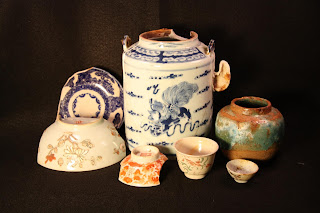

Imported Porcelain and Pottery found during excavation (City of Deadwood)

A spot where a boarding house had burned down hid a treasure trove of artifacts, because the building collapsed on the contents of the house. Among the things found were gaming pieces, pottery, tableware, everyday personal hygiene aids, hair ornaments, Chinese coins, opium paraphernalia, and more.

As unpleasant as it might seem, another place archaeologists get excited digging around in are the privies. Much of the trash of the day would be thrown into them. In addition to man-made objects, animal bones and botanical refuse, such as seeds, give clues to the diet of the people who lived there. Keeping in mind they didn't have a garbage collection like we do, the privy was a popular place to dispose of garbage like bottles or objects that had lost their usefulness.

In all, after excavation over 600 boxes of artifacts were recovered and stored.

The picture painted by the findings is one of a community that exported their lifestyle almost whole from China. From the pottery to the medicine bottles to opium, all were brought to America. There was a remarkable oriental-flavored homogeneity to the items unearthed. Even the animal bones tell us the Chinese preferred pork over the beef favored by their neighbors.

Though the Chinese did coexist with the white community while holding onto their ways, cultural exchanges could not be avoided. In the artifacts found, mahjong tiles lay along side gaming dice. American beer bottles mingled with bottles that once held traditional Chinese medicine.

What did the Chinese bring to their non-Chinese neighbors? Of the eleven restaurants in Deadwood, seven of them were Chinese establishments, who not only served frontier fare but also introduced Asian food. Immigrant Fee lee Wong opened the Wing Tsue Emporium, a large store selling imported silk, medicines, porcelain, and other goods to Chinese and non-Chinese alike. Not to be bragged about, but we can't ignore one thing the Chinese brought to Deadwood: opium. The Chinese got the westerners hooked on opium just as the British had gotten the Chinese hooked on the drug. In the early days, opium dens were legal and were treated like saloons, in that to open one all you had to do was apply for a license. Later opium would be outlawed.

Wing Tsue Emporium (image: Adams Museum, Deadwood, S.D.)


Though living cheek to jowl with the other residents of Deadwood, the Chinese maintained their own community. For obvious reasons, they weren't going to blend in the way an European immigrant could, and often being targets for discrimination and even violence, banding together was a means for security and support. Chinatown even had their own fire and police brigades. All that said, the relationship between the Chinese and general population of Deadwood seems to have been relatively harmonious when compared to some of the other settlements of the day. The residents of Deadwood enjoyed Chinese parades and holiday celebrations which might include fireworks.


"The Champion Chinese Hose Team, who won the great Hub-and-Hub race at Deadwood," 1880 (Wiki-commons)

As important and vital as the Chinese community was in the late 19th and early 20th century, it no longer exists. What happened and where did they go?

Remember, this was a wave of migration that typically didn't include women and families. Of course there was a small group of females and children in Deadwood's Chinatown as represented by women's hair ornaments and such and children's toys found in the dig, but the population was heavily weighted on the male side. The typical Chinese male immigrant was sending money back to his family in China. He may have even been under contract, and when he'd fulfilled his obligation, he left America.

To give the Chinese even less incentive to settle, the Exclusion Act in 1882, halted the flow of immigration from China, denying citizenship to even those born here. Men could not send for their families or brides. So when the gold dried up, there was little reason to stay in Deadwood. Just as the town was limited in growth by its geography, Chinese growth was limited by the society of the time. The Chinese moved on to larger communities like you'd find in San Francisco, or they went back to the East.

But while they were there, the Chinese immigrants played an important part in society.

Reconstructed Altar and Burner, Mount Moriah Cemetery (Wiki-Commons)

In the Mount Moriah Cemetery situated on a beautiful pine tree dotted hill you can see the final resting places of such iconic figures like Calamity Jane and Wild Bill Hickok. You can also visit the Chinese altar and ceremonial burner. In 1908, the leaders of the Chinese community were given permission to build the altar and burner to honor their dead in their own way. In later years, decades after the last of the Chinese left, the altar and burner fell into disrepair.

Then in the early part of the 21st century, long after all other traces of the Chinese presence were gone, the city of Deadwood reconstructed the altar and burner, using bricks saved from the demolished Wing Tsue Emporium, to construct it.

To me this unimposing structure tells the tale of the Chinese in Deadwood, South Dakota: their emergence, acceptance, decline, and finally getting a place of honor in the frontier town they helped create.

In the words of Fee Lee Wong's great granddaughter, Edith Wong, who came from California for the dedication of the new altar and burner.

"The addition of this restored burner, just as the integration of the Chinese in a largely white pioneer community, signals acceptance of a different culture and a different way of life," Wong said. "What tangible evidence of the Chinese still exists in Deadwood? Really, not very much. Instead of solely an interpretive sign, this burner will be a physical reminder that the Chinese culture and traditions were definitely an integral part of Deadwood's history."

You can find me at Amazon https://www.amazon.com/Patti-Sherry-Crews/e/B01C7L8QUU/ref=dp_byline_cont_ebooks_4