Monday, April 10, 2017

American Indian Day & Boarding Schools by Paty Jager


Carlisle Indian Boarding School in Pennsylvania

There were many indignities bestowed upon the American Indian. One that I have researched for a historical western romance I’m writing is Indian schools.
 
In 1819, the U.S. government came up with the “Civilization fund”. This was a law providing “for the civilization of the Indian tribes adjoining the frontier settlements”.  This was a payment to churches, missions or anyone of good moral character to teach Indians agriculture suited to where the area they lived and teach the children reading, writing, and arithmetic.
  
By 1824, thirty-two missionary schools were operating among the tribes, teaching nine hundred children. Churches and missions jumped on the governments money to civilize the American Indian. At this time, the schools were day schools. The children remained with their families and came to the school for a portion of the day. They wore their own clothes but were usually given a name easier to pronounce.

During Indian treaties, grants were authorized to provide schools for the tribes the government wanted to befriend. 
 
The schools followed much the same pattern. Half of the day was spent on curriculum comprised of common school academic subjects – English language, arithmetic, history, geography, and the religion of the denomination of the mission. The other half of the day consisted of learning labors appropriate to the gender. Boys learned blacksmithing, woodworking, and agriculture. Girls learned cooking, dressmaking, and other domestic arts. 

1876 the BIA- Bureau of Indian Affairs- was established. This government agency was put in place to expand Indian schooling.  BIA started their own schools on reservations forcing out the missionaries.
Attendance at these schools was made mandatory by regulation on many reservations. Native American children aged six through sixteen had to attend. And these schools were boarding schools. They children had to cut their hair, give up their clothing to wear the government issued uniforms. They also could not speak their language, nor practice any spiritual leanings other than the church.

But the schools inside the reservations didn’t work. The children were still in close proximity to their families which kept them from becoming fully ensconced in the white language and values. The government moved the boarding schools away from the villages, putting them closer to agency headquarters. The children were only permitted to go home during the summer months and at Christmas. While they hoped this would stop the children having contact with native influences, they didn’t take into consideration parents visiting their children and speaking their language.
Powwow in Wallowa, Oregon
  
To keep the contact between student and parent as limited as possible, off-reservation boarding schools were built. The government had finally found a way to rid Indian children of their language and culture. In many cases, the children were sent hundreds of miles away from their family, language, and culture. This model for Indian schools came from what they had been learning about assimilating Indian prisoners to the Whiteman’s ways.

As with the other boarding schools, the children had to cut their hair. Hair to an American Indian is strength. They had to wear uniforms and their names were changed. 

Many Indian parents refused to send their children to the reservation schools.  There was widespread opposition to stealing their culture and their children. Indian agents had strong powers of persuasion. Rations were withheld from uncooperative families, and in cases where even the withholding of food would not persuade a parent to send their child to school, police were sent to take the children by force.
The off-reservation boarding schools were popular with the communities in which they resided. The schools provided employment for local residents, supplies were purchased from local merchants, and the students were a source of cheap labor for the owners of the surrounding farms. The program where the students were loaned to the farms to learn agriculture was called an “Outting”.

A good book that shows the life of American Indian children in a boarding school is: The Middle Five (Indian Schoolboys of the Omaha Tribe) by Francis La Flesche. 

To learn more about the government and Indian schools here are two books: American Indian Children at School, 1850-1930 by Michael C. Coleman and The Churches and the Indian Schools, 1888-1912 by Francis Purcha

Paty Jager is an award-winning author of 30+ novels, dozen novellas, and short stories of murder mystery, western romance, and action adventure. She has a RomCon Reader’s Choice Award, EPPIE, Lorie, and RONE Award. All her work has Western or Native American elements in them along with hints of humor and engaging characters. This is what readers have to say about the Letters of Fate series- “...filled with romance, adventure and twists and turns.” “What a refreshing and well written love story of fate and hope!”


 photo source: Public Domain, https://commons.wikimedia.org/w/index.php?curid=4797733
powwow photo by Paty Jager

Friday, April 7, 2017

Bucking the Tiger


Picture the scene: a saloon in the old west. A long bar, shelves lined with bottles on the wall behind it, and maybe a painting of a scantily clad woman. Cowboys, gamblers, lawmen, the town drunk, tinny player piano music, and dance hall girls. At one table sit men playing a game of poker that's been going on for hours. Someone's accused of cheating. Chairs scrape on the floor as accuser and accused jump up and reach for their guns. A scene we've seen played out countless times on both the big and little screen.
Scrape. "Are you calling me a cheater?"

The characters played poker because that's the card game the writers and directors were familiar with. Except in reality, the card game of choice in the old west is one no longer played. Not poker. Faro.

 I was raised watching the great western series of the 1970's and have been a fan of the genre all my life, and yet I never heard of faro until recently when I read a book about Doc Holliday's Tombstone years.

I was curious about the game so I did some research. I was surprised to find out that faro was the most popular gambling game--far more common than poker. Opposed to the long poker game, faro is a fast game, taking about ten to fifteen minutes. Also unlike poker, very little skill is involved. And like the roulette wheel or Blackjack in today's casinos, there is somewhat of a community atmosphere with spectators. Any number of players could play at one time, so it could be quite raucous.


Faro comes to us from 17th century France where it was known as pharaoh, which in turn is derived from the English game, basset. The game came to America with the French who settled in Louisiana. It then made its way up and down the Mississippi River at the gambling tables on steamboats. Before long it became so popular that every saloon out west had a faro table.

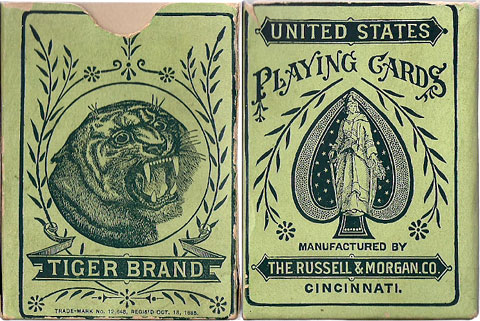
Because decks of cards at the time often featured a tiger, playing faro was also called "Twisting the tiger's tail" or "Bucking the tiger." Gambling districts were known as "Tiger Towns" or "Tiger Alleys."

Playing cards

The game was played on a table covered in green baize with thirteen spaces for players to place their bets on cards they hoped the dealer would draw from "the shoe." The dealer would pull two cards. The first was the "banker's card" and the second was the "player's card." The banker's card was always the "losing card." So if you were lucky, your card was on the space on the board corresponding with the "player's card." Pretty straight forward. No need to bring your poker face to the faro table.
Faro table in the Oriental Saloon, AZ. Notice the crowd of onlookers.

A couple of elements made the game more interesting. Cards played were keep track of on an abacus-like device called a "casekeep," and as more cards were played, the game got more exciting with diminishing possibilities. The only skill involved in the game was being able to keep track of the cards already played. A player could also reverse the win/lose cards by placing a copper disc on the board, which was known as "coppering the bet."

Famous faro players? Wyatt Earp started out his stint in Tombstone as a faro dealer in the Oriental Saloon. Doc Holliday supplemented his income in the same town as a dealer in at the Birdcage Saloon.

So, why don't we play faro anymore? Cheaters ruined it, that's why. It was so easy to cheat that the expert book on card games, Hoyle's, warned against it.

Want to know how to cheat at faro in case you come across a game? Watch those dealers. Because faro is a game where the player is as likely to win as the house, the dealer would sometimes resort to methods to insure his livelihood. For one thing, the cheating dealer could rig the shoe by placing tiny mirrors inside. If he didn't like the look of the card about to be played, the dealer could hide that card in a special compartment in the box. Then the deck itself could be tampered with so some cards were marked. For instance the backs of two cards could be sanded so they'd stick together, drawing a third unmarked card out of the shoe. And because the sometimes the unruly atmosphere around the table lent itself to acts of deception, there was the old sleight of hand. The dealer could move the winning card to his side if nobody was watching.

But, never fear, player! There are ways you too can cheat. The sleight of hand employed by the dealer worked for the player as well, though this is a riskier move. A less risky move would be to attach a horse hair or a silk thread to the bottom of a card and move it to a more favorable spot. Likewise the copper could be moved in this way. I have to say I have trouble picturing someone doing this undetected. They must have been nimble-fingered and quick. And what did they use to stick the hair to the card, I want to know? Or do I....

I am alone in not knowing about faro? How many of you knew it was the game of choice in the old west? Is it a game you'd like to play? Cheat? Do you like to gamble at all? What's your favorite game of chance?


Wednesday, April 5, 2017

The Making of a Good Villain


courtesy of nvdmyeloma.blogspot

Whether on the silver screen or within the tattered pages of a book, many of us enjoy a good villain. We remain glued to a script detailing police chasing down a serial killer. A land baron swindling his neighbor out of water rights. A cad cheating on his naive, unsuspecting wife. The more despicable the act, the more our pulses pound. The more we cheer for the good guy. The more we enjoy a love-hate relationship with the bad guy. But what makes for a good villain?
Two of my all-time favorite villains are J.R. Ewing and Abby Ewing. Both were daring, ruthless, selfish, and egotistical. Whether scheming, cheating, backstabbing, or bed-hopping, millions of people tuned in each week to watch their next cunning move. The bigger the risk, the more we cheered, hoping they’d get caught while secretly rooting they’d get away with their latest endeavor. But for as many scandals as they caused, for as many people they bankrupted and the numerous hearts they stomped on, there was another reason viewers connected with them. Each had a vulnerable side.
courtesy of mumu2901
Abby Ewing’s soft spot was her children. Like any mother, she loved her son and daughter and would never sacrifice them for her latest scheme. Nor would she sacrifice another woman’s children. We saw how much she valued children when a colleague kidnapped Val’s twins. Unbeknownst to Val, Abby did what she could to locate and return Val’s children.
J.R.’s weakness was his brother, Bobby. One cannot dispute he back-stabbed Bobby daily. But constantly butting heads with Bobby was fun to J.R.; a harmless brotherly rivalry. Viewers often weren’t sure just how much J.R. loved his brother until Larry Hagman delivered some powerful, emotionally distraught scenes the season Bobby Ewing died. We saw more of the tender side to J.R. only occasionally glimpsed when he shared screen time with his mother or his son. J.R.’s tears were our tears, and we loved him that week. The following week we were back to our love-hate relationship with him.
In drafting a television show or a novel, a villain should be developed with the same care and concern as the hero and heroine. A villain is like an onion, filled with layers. The first layer is the crime he commits to grab our attention. His second layer is his vulnerability to connect with us. The last layer is his reason for why he does the things he does, some sort of misery meant to pull at heartstrings and secure a bond between him and us. For Abby, her poor-to-average upbringing instilled in her a desperate need for wealth. J.R.’s last layer stemmed from his upbringing, too. His parents came from a poor background, struck oil and became rich. As the first son, it was up to J.R. to maintain the family wealth and make the Ewings more powerful in the oil industry than his father had.
Courtesy of Prophecy Six Blog
Hate ‘em or love ‘em, sympathize with their flaws or not, villains enrich a script, and keep us entertained.


**Larry Hagman photo courtesy of Quotesgram

Tuesday, April 4, 2017

Grass Valley

by Shanna Hatfield

I recently opened the door to my writing cave, packed a weekend bag, and went on an adventure with my favorite auntie and four cousins.

We met at a location in a central area for us all, which meant I had a five hour drive to reach the destination.

On my way there, and on my way home, I drove along a highway that rolls through several old towns.

Grass Valley was among them. I have a contemporary series,  Grass Valley Cowboys , set in the area, but the abandoned old buildings there capture my eye every time I drive past them.


Although it is assumed members of the Lewis and Clark party were among the first to see Sherman County where Grass Valley is located. 

Tall grass waved in the breezes, providing a wonderful cover for deer and made hunting them a challenging. Despite the hordes of Oregon Trail travelers who came West, none stayed in the area for more than a few days of rest.

Then Samuel Barlow marked the Barlow Trail across the Cascade Mountains. Oregon Legislature authorized the road in 1845, and by September 1846, the road provided an alternate route to the transporting wagons via raft down the Columbia River. Barlow Road started at The Dalles and headed south to Tygh Valley. It wasn't long until a shortcut was made from Tygh Valley that entered in Grass Valley canyon. The trail went through the canyon to where tall rye grass grew and the town of Grass Valley would eventually grow.

Grass Valley's settlement didn't happen overnight. A few stock ranches were established first, then settlers began to arrive in Sherman County. They plowed the rich grass that sustained cattle to make way for wheat fields.


The town was officially established in 1878 when Dr. Charles R. Rollins, a New Hampshire physician, settled in the area. He built a two-story hotel that included a clinic, and named the town after the rye grass that grew in the alkali soil.

Although the population has dwindled, I still find a wealth of inspiration in this town, taken from the tall waving grasses that once covered the area.

***

♪ ♫ ♪  You're invited to the Ball! ♪ ♫ ♪ 
Please join me and twelve of my friends for four hours of fun on Facebook at the 3rd annual Petticoat Ball! 
It takes place this Thursday, April 6, from 10 a.m. to 2 p.m. (Pacific Time).  Oodles of prizes, games, giveaways and opportunities to connect with authors will make for a lively event!
Hope to see you there!

***


USA Today Bestselling Author Shanna Hatfield writes character-driven romances with relatable heroes and heroines. Her historical westerns have been described as “reminiscent of the era captured by Bonanza and The Virginian” while her contemporary works have been called “laugh-out-loud funny, and a little heart-pumping sexy without being explicit in any way.”
Convinced everyone deserves a happy ending, this hopeless romantic is out to make it happen one story at a time. When she isn’t writing or indulging in chocolate (dark and decadent, please), Shanna hangs out with her husband, lovingly known as Captain Cavedweller.

Find Shanna’s books at:

Shanna loves to hear from readers. Follow her online at:
by Shanna Hatfield


***

USA Today Bestselling Author Shanna Hatfield writes character-driven romances with relatable heroes and heroines. Her historical westerns have been described as “reminiscent of the era captured by Bonanza and The Virginian” while her contemporary works have been called “laugh-out-loud funny, and a little heart-pumping sexy without being explicit in any way.”
Convinced everyone deserves a happy ending, this hopeless romantic is out to make it happen one story at a time. When she isn’t writing or indulging in chocolate (dark and decadent, please), Shanna hangs out with her husband, lovingly known as Captain Cavedweller.

Find Shanna’s books at:

Shanna loves to hear from readers. Follow her online at:

Monday, April 3, 2017

Martha Summerhayes

By Kristy McCaffrey

Martha Summerhayes
Martha “Mattie” Summerhayes is best known for her memoir, Vanished Arizona, which recounts her life as an army wife in the 1870’s. Today, it’s considered a literary masterpiece and one of the finest accounts of 19th century Arizona.

Born Martha Dunham in 1846 in Nantucket, she was raised by a prosperous New England family. She lived in Germany for two years as a young woman, studying the language and living with the family of a high ranking German officer. She mixed socially with many Prussian officers, gaining a romantic view of military life. Not long after, she returned to the United States and fell in love and married John “Jack” Summerhayes, an officer in the U.S. Army.

In August 1874, Mattie traveled with the 8th Infantry Regiment to Arizona. Since the railroad hadn’t yet arrived, they journeyed to San Francisco and boarded a steamship for a 13-day voyage around Baja California to Port Isabel at the mouth of the Colorado River. They then embarked on a flat-bottomed paddle-wheeler upriver to Fort Yuma. By the time they reached the fort, three men had died from the heat. Mattie was five months pregnant.

Fort Apache, 1877.
Eighteen days later, they arrived at Fort Mohave, then traveled north to Fort Whipple, near Prescott. When they finally arrived at their destination—Fort Apache—Mattie was seven months pregnant. Over time, she developed a deep respect for the young men in the military. “I was getting to learn,” she wrote, “about the indomitable pluck of our soldiers. They did not seem to be afraid of anything. At Camp Apache my opinion of the American soldier was formed and it has never changed.”

Mattie and Jack spent the next several months living in a primitive log cabin at Fort Apache. In January, she gave birth to the first white child born at the fort, a son named Harry. The blue-eyed, blond-haired baby drew ranchers, settlers, and even friendly Apache to pay their respects. By April, Jack was assigned to Fort McDowell, in the desert foothills north of the Salt River Valley (near present-day Phoenix), but at the last minute the orders were changed to Ehrenberg, an uninspired settlement along the Colorado River. Mattie wasn’t happy.

She spent one year in Ehrenberg, but returned to New England with the baby to avoid a second summer in the blistering heat. She returned to the Arizona Territory in December 1876. Jack was now stationed at Fort McDowell. She brought many furnishings along to make her life more comfortable, but unfortunately the steamer caught fire and all her goods were lost. Thanks to charitable women at Yuma, her wardrobe was stocked with ill-fitting dresses.

Fort McDowell, 1870's.
Mattie was one of five women at Fort McDowell. She set up housekeeping in a flat-roofed adobe house on officers’ row. Soldiers built her a couch and covered it with cotton cloth purchased at the trading post. During the long summers, everyone slept outdoors. To deter the ants, empty tomato cans filled with water were placed under the legs of each cot.

After two years at Fort McDowell, Jack’s regiment was transferred out of Arizona. In 1886, during the last days of the Geronimo campaign, Mattie returned with Jack to Fort Lowell, near Tucson. This time, just eight years later, Mattie was able to make the journey via a Pullman since the railroad had arrived.

Mattie’s ambivalence toward Arizona is apparent in her writing, and yet, she admired and longed for it years later. She writes, “...I did not see much to admire in the desolate wastelands through which we were traveling. I did not dream of the power of the desert, nor that I should ever long to see it again. But as I write, the longing possesses me, and the pictures then indelibly printed upon my mind, long forgotten, amidst the scenes and events of half a lifetime, unfold themselves like a panorama before my vision and call me to come back, to look upon them once more.”

After the Spanish-American War in 1898, Jack retired and he and Mattie returned to Nantucket. At the urging of family and friends, Mattie wrote Vanished Arizona, which was published in 1908. She wrote it primarily for her children, believing there would be little public interest. But she was wrong. The book was popular among women and, most especially, ex-soldiers. The first edition sold out within a year, so a second was released in 1911.


A few weeks after the release of the second edition, Jack and Mattie died within two months of each other. Both were buried with full military honors in Arlington National Cemetery. “I had cast my lot with a soldier,” she wrote, “and where he was, was home to me.”

Connect with Kristy