Showing posts with label Tombstone. Show all posts

Thursday, April 16, 2026

Gun Control in the Old West


  In popular imagination, the Old West of the 1880s is often pictured as a lawless frontier where everyone carried a gun at all times. But for many Western towns trying to establish order and attract families, business, and investment, gun control was not only present--it was taken seriously.  Places like Dodge City, Tombstone, and Deadwood adopted local ordinances that restricted the carrying of firearms within town limits. Visitors were often required to check their weapons with the sheriff or at a saloon upon entering town, a practice that reflected a broader desire to reduce violence in rapidly growing communities.


 These measures weren't driven by abstract political ideology so much as practical necessity. Frontier towns were filled with a mix of cowboys, miners, merchants, and travelers, many of whom were armed and living in close quarters. Disputes could quickly escalate into deadly encounters if weapons were readily at hand. By enforcing gun restrictions in populated areas, local authorities aimed to prevent spur-of-the-moment violence, especially in saloons where alcohol and tempers mixed freely. Lawmen like Wyatt Earp and Bat Masterson became known not just for gunfights, but for enforcing these rules and maintaining a semblance of peace.


For Western readers today, the history of gun control in the Old West offers a more nuanced picture than the myth suggests. Firearms were certainly a part of daily life on the frontier, especially for hunting, ranching, and self-defense in remote areas. Yet within town limits, many communities recognized the need for boundaries. Rather than representing a contradiction, this balance reflected a practical understanding of freedom and responsibility--one shaped by the realities of life in a developing and often unpredictable landscape. 

Till next time.

Sandra


 Available at Amazon
 

Wednesday, May 17, 2017

The Gunslingers’ Good Fellow


It interests me that the profession of doctor and the profession of gunslinger should both be so dependent on dexterity—and hand/eye coordination—yet one takes life and the other saves it. But it fascinates me even more that the most famous gunfight in the history of the Old West should have taken place at a time when one of the greatest doctors in the nation, a specialist in gunshot wounds whose methods are still employed today, should have been practicing in Tombstone, AZ.
George Goodfellow, photo by C.S.Fly, Tombstone
George Emory Goodfellow was born a westerner although educated back east. Son of a miner—eventually a mining engineer and mining executive—Goodfellow was sent off to boarding school at the age of twelve but returned to California to attend military academy.  His future was certainly oriented toward a career in the armed services, and he briefly attended Annapolis before being expelled for fighting with the first African American cadet. Having a wide range of interests, Goodfellow sought out his cousin, a doctor, and studied with him before going on to medical school in Ohio. Returning west, he eventually settled in Arizona Territory, initially working in Prescott with the Army before relocating in 1880 to the flourishing mining town of…Tombstone.
If you’re envisaging a kindly country doctor along the lines of Doc Adams in ‘Gunsmoke,’ think again.  The hard-drinking gambler, Goodfellow had been boxing champion at Annapolis and had a penchant for getting into fights, both with his fists and with a gun. Furthermore, he was quite the Renaissance Man with numerous and varied interests. Aged just twenty-five, he opened his office on the second floor of the Crystal Palace Saloon and settled down for his place in history. While many of his cases involved mining accidents, there was mounting practice in gunshot wounds. Making advancements in this area, he would eventually write articles that appeared in learned journals propounding that gunshots from .44 or .45 caliber into the abdomen were almost always fatal, as opposed to .32 calibre and lower. In those cases, he deduced, the main danger would be from either fecal or urinary matter causing infection. The higher calibire shot would rest in the abdominal cavity, thereby causing the victim to bleed to death unless a laparotomy was performed almost immediately. His treatise on this subject, ‘Cases of Gunshot Wound in the Abdomen Treated by Operation’ eventually appeared in the May, 1889, edition of The Southern California Practitioner.  Goodfellow, who believed in Lister’s practice of antisepsis surgery and Germ Theory, actually performed the first laparotomy on a miner shot outside of Tombstone. This procedure is still in use today. He also observed a shoot-out that took place at close range, and discovered the bullet that entered one of the contenders was still wrapped in a silk handkerchief from the man’s pocket.  Studying this closely, he wrote, ‘Notes on the Impenetrability of Silk to Bullets,’ also for the Southern California Practitioner. He advised that bullet-proof vests could be manufactured from silk, and made the first one of eighteen layers of silk. By the end of the century, such vests were in production.
So, by the time October, 1881, rolled around and there took place something now called Gunfight at the O.K. Corral, it was extremely opportune that George Goodfellow was on call. Goodfellow tended to the wounded on both sides of the argument. Unable to help cowboy Billy Clanton with six bullets in him, he removed the boy’s boots because Billy had promised his mother to die with his boots off. Goodfellow's testimony at the Earps’ and Doc Holliday’s trial played a large part in having the case against them dismissed as self-defense; he testified that the position of Billy Claiborne’s arm could not have been raised in the air.
Two months later, Virgil Earp was ambushed as he walked from the Oriental Saloon, hitting him in the arm with buckshot. It was Goodfellow’s belief that the arm should be amputated but Virgil refused.  Operating at the Cosmopolitan Hotel, Goodfellow removed approximately four inches of the shattered humerus bone, saving the arm but leaving it crippled. Still, Virgil had his gun arm and was later able to serve as a US Marshal. His brother Morgan was not so lucky. Shot in the back while playing billiards, he died within the hour. As County Coroner, Goodfellow performed Morgan’s autopsy.
But while he was known as ‘The Gunslingers’ Surgeon,’ Goodfellow’s advances in medicine did not stop with gunshot wounds, nor was medicine his only field of expertise.  In the coming years, he performed the first successful prostatectomy and was among the first surgeons to use spinal anesthesia. He performed reconstructive face surgery, and also advocated the dry air of the desert as a treatment for tuberculosis, facilitating the large number of sanatoriums that would soon appear in Arizona.
Outside of medicine, in 1886, Goodfellow rode with the US Army to recapture
Geronimo
Geronimo who had escaped from the San Carlos reservation. He eventually befriended the man. In 1887, he made two trips to aid survivors of the Sonoran earthquake and to study the effects of the quake. He reported his findings in the US scientific journal, Science, and for his work, the Mexican President awarded him the gift of a horse.
Goodfellow on his gift horse
He proved, in 1891, that the bite of a Gila Monster was not necessarily fatal and published his findings in Scientific American. And having become personal physician to General Shafter during the Spanish-American War, he is credited with helping in negotiations for the peace settlement, due to his knowledge of Spanish.
Goodfellow’s later career had him setting up practice in Tucson prior to moving to San Francisco.  Sadly, the 1906 earthquake and fire destroyed his manuscripts and patient records, and Goodfellow was forced to take a job with the Southern Pacific Railroad in Mexico as their chief surgeon.  He subsequently returned in 1910 to his sister’s home in Los Angeles, where he died aged fifty-five.
George Goodfellow, the ‘Gunslinger’s Surgeon,’ is credited with being the first trauma specialist.


http://andreadowning.com

Friday, April 7, 2017

Bucking the Tiger


Picture the scene: a saloon in the old west. A long bar, shelves lined with bottles on the wall behind it, and maybe a painting of a scantily clad woman. Cowboys, gamblers, lawmen, the town drunk, tinny player piano music, and dance hall girls. At one table sit men playing a game of poker that's been going on for hours. Someone's accused of cheating. Chairs scrape on the floor as accuser and accused jump up and reach for their guns. A scene we've seen played out countless times on both the big and little screen.
Scrape. "Are you calling me a cheater?"

The characters played poker because that's the card game the writers and directors were familiar with. Except in reality, the card game of choice in the old west is one no longer played. Not poker. Faro.

 I was raised watching the great western series of the 1970's and have been a fan of the genre all my life, and yet I never heard of faro until recently when I read a book about Doc Holliday's Tombstone years.

I was curious about the game so I did some research. I was surprised to find out that faro was the most popular gambling game--far more common than poker. Opposed to the long poker game, faro is a fast game, taking about ten to fifteen minutes. Also unlike poker, very little skill is involved. And like the roulette wheel or Blackjack in today's casinos, there is somewhat of a community atmosphere with spectators. Any number of players could play at one time, so it could be quite raucous.


Faro comes to us from 17th century France where it was known as pharaoh, which in turn is derived from the English game, basset. The game came to America with the French who settled in Louisiana. It then made its way up and down the Mississippi River at the gambling tables on steamboats. Before long it became so popular that every saloon out west had a faro table.

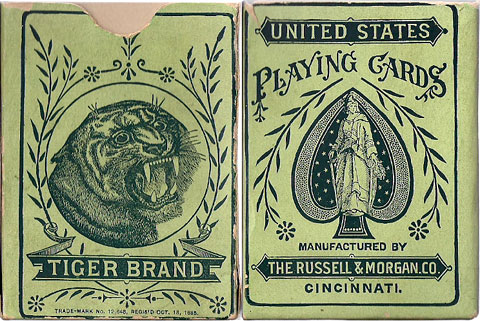
Because decks of cards at the time often featured a tiger, playing faro was also called "Twisting the tiger's tail" or "Bucking the tiger." Gambling districts were known as "Tiger Towns" or "Tiger Alleys."

Playing cards

The game was played on a table covered in green baize with thirteen spaces for players to place their bets on cards they hoped the dealer would draw from "the shoe." The dealer would pull two cards. The first was the "banker's card" and the second was the "player's card." The banker's card was always the "losing card." So if you were lucky, your card was on the space on the board corresponding with the "player's card." Pretty straight forward. No need to bring your poker face to the faro table.
Faro table in the Oriental Saloon, AZ. Notice the crowd of onlookers.

A couple of elements made the game more interesting. Cards played were keep track of on an abacus-like device called a "casekeep," and as more cards were played, the game got more exciting with diminishing possibilities. The only skill involved in the game was being able to keep track of the cards already played. A player could also reverse the win/lose cards by placing a copper disc on the board, which was known as "coppering the bet."

Famous faro players? Wyatt Earp started out his stint in Tombstone as a faro dealer in the Oriental Saloon. Doc Holliday supplemented his income in the same town as a dealer in at the Birdcage Saloon.

So, why don't we play faro anymore? Cheaters ruined it, that's why. It was so easy to cheat that the expert book on card games, Hoyle's, warned against it.

Want to know how to cheat at faro in case you come across a game? Watch those dealers. Because faro is a game where the player is as likely to win as the house, the dealer would sometimes resort to methods to insure his livelihood. For one thing, the cheating dealer could rig the shoe by placing tiny mirrors inside. If he didn't like the look of the card about to be played, the dealer could hide that card in a special compartment in the box. Then the deck itself could be tampered with so some cards were marked. For instance the backs of two cards could be sanded so they'd stick together, drawing a third unmarked card out of the shoe. And because the sometimes the unruly atmosphere around the table lent itself to acts of deception, there was the old sleight of hand. The dealer could move the winning card to his side if nobody was watching.

But, never fear, player! There are ways you too can cheat. The sleight of hand employed by the dealer worked for the player as well, though this is a riskier move. A less risky move would be to attach a horse hair or a silk thread to the bottom of a card and move it to a more favorable spot. Likewise the copper could be moved in this way. I have to say I have trouble picturing someone doing this undetected. They must have been nimble-fingered and quick. And what did they use to stick the hair to the card, I want to know? Or do I....

I am alone in not knowing about faro? How many of you knew it was the game of choice in the old west? Is it a game you'd like to play? Cheat? Do you like to gamble at all? What's your favorite game of chance?




Wednesday, January 18, 2017

TOMBSTONE: THE TOWN TOO TOUGH TO DIE?


If you’re stopping by Cowboy Kisses,  most likely it’s because you’re interested in the historic west.  And if you’re interested in the historic west, most likely you know a reasonable amount about the gunfight at the O.K. Corral, Wyatt Earp and his brothers, Doc Holliday, and Tombstone, Arizona. Tombstone, of course, was made famous by that gunfight; had it not been for the O.K. Corral and Wyatt Earp, most likely Tombstone would have gone the way of many old mining towns and become a true ghost town, or possibly it would be some artists’ enclave like nearby Bisbee.  But the gunfight did take place, and it took place at a time when Tombstone was a thriving metropolis, as difficult as that is to envisage now.

If you need a quick refresher course on the gunfight behind the O.K. Corral and are reluctant to head to Wiki or grab a relevant issue of ‘True West’ magazine, let me briefly recount what happened.  At approximately 3 p.m. on Wednesday, October 26, 1881, town Marshal Virgil Earp along with brothers Wyatt (a former Kansas lawman from Dodge City) and Morgan, as well as pal Doc Holliday, faced down the brothers Ike and Billy Clanton, Frank and Tom McLaury, and Billy Claiborne, and had a shoot-out in the most historic 30 seconds of the Old West.  And why did this occur?  In 1881, tensions from the War Between the States hung on.  In Tombstone, antagonism between the lawmen—representing the Republican north, capitalists and upright townspeople—and the Cowboys (giving them a bad name much to my personal consternation!), who were mostly former Confederates and Democrats, not to mention cattle rustlers, all boiled over, along with personal animosities. Thirty bullets later, Billy Clanton and the McLaury brothers lay dead, three of the lawmen—not Wyatt—were wounded, and Ike Clanton the coward and Billy Claiborne had taken off. 
In the representation shown here, based on a sketch Wyatt drew some years before he passed, one can see at what close quarters the shoot-out took place. Ike Clanton is not represented because Wyatt refused to acknowledge the presence of the “coward.”  But whoever was there, those 30 seconds tossed Tombstone into eternal recognition.
So, what was Tombstone like at that time?  Was it worth the attention the gunfight seems to have merited?  Tombstone was then the county seat of Cochise County, created in February of that year out of part of Pima County, Territory of Arizona.  Settled in 1877, by 1879 it  was prospering and well on its way to producing the forty plus million dollars worth of silver bullion it would present.  From a population of around one hundred, it soared to over fourteen thousand, and with that populace came the amenities to entertain, feed, and service the people.  Night spots such as The Bird Cage vied with an opera house for the upper crust.  Dance halls and gambling joints, brothels, soiled doves’ cribs,  and one hundred ten saloons sat alongside a bowling alley, an ice cream parlor, a school, two banks and four churches.  Society was fluid:  a miner one day might be a millionaire the next.  And there were three newspapers. 
If you read the copy of The Tombstone Epitaph from the day after the shoot-out, the most interesting items are not necessarily the statements from so-called witnesses, but the advertisements in the margins that indicate the kind of town Tombstone was. Yes, there are things that we'd expect:  Tuttle’s Tombstone Corral with accommodation for 100 horses; Spagenberg’s Gunsmith and Locksmith; Risdon Iron and Locomotive Works for Engines and Boilers; the Tombstone Carriage Shop; Hibbard, Spencer & Bartlett Hardware; and Fish Bros. Wagon Company, along with the Arizona Mail and Stage Line; Watt & Tarbell Undertakers; and Mme. LeDeau’s, which asks you to “ask any man.” But there is also Pioneer Baking Powder, Mooney’s Fashion Saloon, 4-Paws Monster Railroad Circus,  a Tonsorial Palace, and Estey’s Pianos.
Of course, as the silver ran out, so did the population.  In 1929, the County Seat of Cochise moved to Bisbee where it is today, and Tombstone would have become one more true ghost town near the Mexican border—except for one thing, and we know what that was.  As I drove down from the ever-growing Tucson, through windswept open spaces punctuated by towns not much more than trailer settlements, the feeling that civilization was being left behind was intense.  Now that the main thoroughfare of Tombstone is pedestrianized, it more resembles what it once was, except for the different uses of the buildings.  The saloons are now family eateries with live music—and the one we attended, the Crystal Palace, had the worst live entertainment I’ve encountered anywhere, anytime.  The usual southwestern shops are there: native American jewelry mixed with western souvenirs.  And the fact that there is a six dollar charge to stand on the hallowed ground of the O.K. Corral, see their museum, and pick up a copy of the Tombstone Epitaph from the day after the shoot-out, rather detracts from the whole experience. 

But as the wind howled and moaned, banging saloon doors and sending signs clattering with ghostly whines, tumbleweed rolling down the dirt streets, and a stagecoach lurching through town, Tombstone stepped away from its Disney-like existence, and for one brief moment the desertion and silence of the residents' prior to the gunfight became real.  Maybe it is a ghost of itself, but Tombstone, for now, isn’t dead nor dying.

Thursday, April 10, 2014

Springtime In The Old West by @JacquieRogers


Springtime in the Wild West

Spring is here and we're tossing off our coats for sleeveless shirts.  It's a time for change, and all things look brighter.  So what were the folks doing in the Old West?  The farmers were planting, the ranchers were herding cattle to higher country, and these things:

April 1, 1877
In Arizona Territory, Edward Lawrence Schieffelin discovered a rich silver vein and named it Tombstone, which would eventually become the name of the lode, the hills, and the yet to be established town.

April 2, 1885
Spurred by hunger and mistreatment, the Cree, led by Wandering Spirit, killed nine Métis and white settlers at Frog Lake, Saskatchewan, in what is known as the Frog Lake Massacre.

April 3, 1860
The first Pony Express rider left St. Joseph, Missouri, headed to California.

April 4, 1858
Gold fever is discovered in the area between Hope and Lillooet on the banks of the Fraser River near current day Langley, British Columbia, marking the beginning of the Fraser River Gold Rush, which would attract 30,000 souls and change the culture of the area forever.

April 6, 1880
Charles Russell, takes a job as a cowhand at a ranch near Utica in Montana Territory.  Read a fictional account of this famous artist's cowboying days in Jackson Lowry's West of the Big River: The Artist.

April 7, 1898
Heck Thomas and Bill Tilghman shot and killed Richard "Little Dick" West while resisting arrest on this date at the Arnett Ranch in Oklahoma Territory.

April 9, 1867
The US Congress ratified the Alaska Purchase from Russia (called Russian America). It passed by one vote, and naysayers dubbed it "Seward's Folly" after its chief proponent, US Secretary of State William H. Seweard.

April 10, 1875
The North-West Mounted Police began construction on Fort Brisebois to protect the fur trade and defend against US whiskey traders.  It was later renamed Fort Calgary, and the city of Calgary, Saskatchewan, sprouted from it.

April 11, 1895
Anaheim, California became the latest city to receive electrical service.

April 13, 1860
Remember that rider who left St. Joseph, Missouri, on April 3rd?  The mail arrived in Sacramento, California--Tom Hamilton carried the packet.  The various riders traveled 1,966 miles in 10 days.


April 15, 1862
The Civil War made its way West to New Mexico Territory at the Battle of Peralta.  One Union soldier and four Confederate soldiers were killed.  A dust  storm ended the battle.

April 16, 1882
Cockeyed Frank Loving was killed in a shootout with John Allen in front of Hammond's Hardware Store in Trinidad, Colorado.  Allen was arrested but acquitted and became a street preacher.

April 18, 1878
In New Mexico Territory, a Lincoln County grand jury indicts William Bonney (Billy the Kid, born Henry McCarty) and others for the deaths of Sheriff Brady and George Hindman.

April 19, 1875
Helena becomes the new capital of Montana Territory, taking the honor from Virginia City.

April 21, 1836
An army of Texans led by General Sam Houston defeated General Santa Anna's troops at the Battle of San Jacinto, and won Texas's independence from Mexico.

April 22, 1889
10,000 people raced to claim 160-acre parcels in the first Oklahoma Land Run.  Boomers followed the rules.  Those that didn't were called Sooners.

April 26, 1860
Abe Lee discovered a rich lode of gold in the California Gulch, which led to the creation of a boom town named Leadville.


April 27, 1865
The four boilers on the steamship Sultana exploded, killing over 1,500 people (many of whom were Union soldiers who'd been prisoners of war) and wounding many more.  The worst steamship disaster before or since had little coverage because the newsmen were preoccupied by another major news story--the assassination of President Lincoln.

April 28, 1880
Chiricahua Apache chief Victorio led a raid on Cooney, New Mexico Territory.

April 29, 1878- Texas- Sam Bass and his gang are found hiding at the home of Jim Murphy near Cove Hollow and a four-day running gunfight ensures.


Contact Jacquie: