Saturday, May 5, 2018

KEEPING A BEADY EYE ON THAT JEWELRY: Stephen A. Frost and Native American Trade Beads


KEEPING A BEADY EYE ON THAT JEWELRY
Stephen A. Frost and Native American Trade Beads

It’s a story more apocryphal than true that Manhattan was bought by the Dutch from the Indians for twenty-four dollars worth of beads. Whatever the truth of the matter, up until their meeting with the Europeans, Native American beads were hand made out of natural materials: bone, animal teeth, horn, and shell. But where did the idea come from for the Europeans to trade beads with Native Americans?
Trade beads were originally called ‘slave beads’ because they were used to trade for slaves in Africa; in Ghana, these were called ‘aggry.’ To many of the peoples of Africa, beads were a sign of both wealth and social position, so the beads were the most obvious currency, being brought over from Europe even as ballast in ships. Venetian glass beads were the most popular, but beads also came from Poland and Czechoslovakia, as well as other cities in Italy.
Trade in North America started with small amounts. Lewis and Clark brought small supplies for their cross-country trek in 1804, and the Hudson Bay Company also used them as trade.  From archaeology, we have learned that beads of certain size, shape, and color were favored by different nations, large blue glass beads being one such popular type. By 1848, the peddler’s trade across the plains carried beads, and twenty-eight year old Stephen A. Frost was one such tradesman. After the end of the Civil War, Stephen’s son, Daniel, was able to join him, and their company expanded.
Stephen A. Frost & Son now traded throughout North America, including Alaska and Canada.  The company, with headquarters in New York from the 1870s, was well regarded by the Indians who even created special items in trade for the beads.  In turn, the men collected beadwork products, pottery, basketry, silverwork, blankets, carvings, clothing and so on to sell to Europeans, some pieces even going to museums.  Frosts also sold beads wholesale to other merchants, and manufactured bone ‘hair pipes.’
On Stephen’s retirement in 1900, Dan Frost continued to expand the company into non-Native activities, although it was always the Native American side that was the mainstay.  The company exhibited its collection at the 1904 St. Louis World’s Fair and continued in business until 1937 when Dan Frost retired, aged 87, and closed the business.  During his stewardship, he had associated with such notables as Geronimo, Sitting Bull, Buffalo Bill and Wild Bill Hickock, amongst many others.
The remaining stock of Frost & Son was sold, but the bead sample cards were donated to the Illinois State Museum where they can be seen today.

Friday, May 4, 2018

Author Interview with Kaye Spencer

Please help me welcome Kaye Spencer! I'm so excited to have her here today and to learn more about her.

Kaye Spencer

Your hero, Mingo, in The Comanchero’s Bride is a dynamic character. In creating him, what were your inspirations?


Kaye: I was inspired to write Mingo’s character from the Marty Robbins gunfighter ballad, ‘Meet Me Tonight in Laredo’.  In fact, the story is a retelling of that song, and Mingo (Domingo) is the ‘wild Comanchero’, the former outlaw, who trades his wild and violent life for the love of a good woman (forgive me the clichéd trope…I am a romance writer, after all. *grin*).woman.


Buy now at Amazon


The taking of captives by Indians has an interesting history, especially in Texas. I’ve read a lot on the subject, but I didn’t know about the Comancheros before I read your story. Can you tell us about them?


Kaye: The term Comanchero came about during the 1840s when Josiah Gregg first used it to describe the group of native peoples who traded for a living with the nomadic plains tribes—particularly the Comanche, hence the name Comanchero—in what is now northern and central New Mexico. This area is known as the Llano Estacado and Comancheria. In the early days, the trading was legitimate, and Comancheros hauled their trade goods in oxcarts (carretas). The goods they carried consisted of beads, knives, paints, tobacco, pots and pans, bolt cloth, food staples, coffee and such. They bartered mostly with the Comanche and Kiowa for whatever seemed reasonable. The territorial government attempted to regulate and license Comanchero trading, but it was an unenforceable endeavor and was largely ignored.


Carreta
As way led on to way, trading in illegal commodities, such as stolen livestock and property, firearms, ammunition, and whiskey, became a better source of income for all parties. But this type of trading was nothing compared to the Comancheros’ growing practice of ransoming captives from the Comanche and, in turn, holding the captives for ransom from relatives or selling them as slaves. As slaves, the captives often ended up in Mexico where they  were worked to death as a disposable commodity in the mountain mines.


Carreta and Historical Marker near El Paso

An area near Lubbock, Texas served as the primary Comanchero rendezvous location. It became known as Cañón del Rescate (Canyon of Ransom). Another area in Texas known for a place where captives were held and sold is Valle de las Lágrimas (The Valley of Tears). This location is at the southeastern edge of Briscoe County. Legend has it that the valley was named for the wailing of mothers and children who had been brought there only to be separated and sold.

Ransom Canyon, Historical Marker
I use a combination of these two locations in my story as the capturing and selling of women and children plays a part in Mingo’s past. In fact, it haunts him. The excerpt below is a scene in which Mingo recalls this.


To read more about Comancheros, visit the Handbook of Texas Online.

Ransom Canyon
In The Comanchero’s Bride, you take the reader on quite a journey to many locations, including an historic hotel in Denver that I’ve also used as a setting (so I know you did your research, because I did mine *wink*). Each location we move through, you describe in amazing detail. I’m curious about how you choose a location for your stories when you begin a story. Is the location the starting point and inspiration for you? Or does the story lead you to the location? What research tools do you use?

Kaye: For The Comanchero’s Bride, the foundation location was already determined in the song: Laredo, Texas. However, as the plot unfolds, the reader travels the central part of Texas north to south along the ancient Indian trails and across northern New Mexico (territory in 1880), and then north into Colorado to Denver. From El Paso to Denver, I coordinated the year of the story with the availability of the railroad and stage routes. Transportation plays such an important part in my stories, that it sometimes becomes a character of its own. I often adjust the year of a story to accommodate historically accurate train and stagecoach routes.

Hotels often present a stumbling block when it comes to locating the historical information I need to know about them. Whenever possible, though, I include actual historic hotels. This can also create time-frame issues. For instance, the Horace Tabor’s Brown Palace in Denver was a magnificent structure. It was built in 1892. Even taking a bit of literacy license into account, I couldn’t legitimately stretch history to use this hotel in The Comanchero’s Bride, since it takes place in 1880. Oh, how I wanted to, though. It was “the” place to be seen in Denver. The historic hotel I used in the book is (was) the Windsor Hotel. It was the fanciest hotel up to that date in Denver.

I do meticulous cross-referencing dates and events in my determination to get the history correct in my stories. I have many trusted historical reference sites on the Internet, and I also have an extensive personal library of reference materials and books as well as historically accurate maps of the 1800s that show transportation routes, old trails, battle sites, and so on.

I know music is important to you. Can you share with us what performers and songs have inspired you?

Kaye: Yes. Music is important to me, and I have a straightforward answer: Marty Robbins and his gunfighter ballads run deeply through my writing veins. His songs influence my writing so much that if you’re familiar with his gunfighter ballads, then you’ll recognize snippets I scattered throughout The Comanchero’s Bride. I also included a passing reference to Lorne Greene’s song, Ringo. It was my humble way to pay homage to how much I love Marty’s music.

Besides being a writer, you have another role at Prairie Rose Publications. Tell us a bit about that. What is Blog a Book Scene and how did you come up with that idea?

Kaye: My role at Prairie Rose Publications is in a quiet, *mostly* behind-the-scenes support capacity for the authors in the area of promotions and marketing. I also contribute to the upkeep of the website.

Blog-A-Book-Scene came about because I was determined to increase my blogging activity on my website in order to increase my visibility out there in social media land. I had to figure out how to better use my time, though. Blogging is a time-eater, and it wears a person down just coming up with viable (interesting) blogging topics. It occurred to me that I could recycle words I’ve already written in my published and works-in-progress and thereby accomplish several things at once. The details developed from there. Once I had it figured out, I shared this with the Prairie Rose Publications’ and Imprints’ authors.  

For those of you who haven’t come across the Prairie Rose Publications’ Blog-A-Book-Scene, and you want to know more, drop me an email, and I’ll get you going. [ kayespencer @ live.com – remove the spaces ]

What does a typical day look like for you? Do you have a designated time set aside for writing or do you work whenever the muse summons you? Have you ever had writer’s block?

Kaye: I’m retired, so I’m loosey-goosey about any sort of routine. Late evenings into the night are my most productive time for writing. I’ve not had writer’s block, but I have experienced prolonged periods of lack of interest (or mental energy) in writing. These times have occurred around a death in my family or some other difficult, mentally and emotionally, event.

I believe that even when an author isn’t actively sitting at their desk, tapping away on the keyboard, there are still times you’re writing in your head. There’s a link between walking and creativity, for instance. Do you have other activities or hobbies you find support your writing?

Kaye: I’ve always been a voracious, but persnickety reader—mostly historical fiction, nonfiction, and what are now deemed as classics. I cut my eye teeth, as the saying goes, on Louis L’Amour’s westerns and, like Marty Robbins’ gunfighter ballads, those western stories are deeply ingrained in my creative processes.

As for working through scenes…driving is my go-to activity. Where I live is a long way from everywhere, so I have a lot of opportunity for windshield time. I’ve solved many plot holes or dead ends in a story while on these long drives.


Hobbies? Other than reading and spending time with grand-kids and walking my dogs, writing takes up most of my time. I do, however, collect petrified wood. I also dabble in wine—not as a collector—but reading about, and I enjoying drinking a wide variety from ice wine to champagne and every type in between. I also play the harmonica—old folk songs and cowboy songs. Sadly, the heyday of singing around the campfire with harmonica accompaniment is long past. My grandchildren aren’t familiar with those old traditional songs, so I play for my own amusement and entertainment.

Kaye's Petrified Wood Collection


EXCERPT – The Comanchero’s Bride by Kaye Spencer


Mingo stared into the gray light of the minutes before sunrise. Isabel reined in beside him.

“What is it? Why have you stopped?” He didn’t answer.

“Mingo?”

“Tell me.” He continued to look ahead of them. “What do you see? What do you feel?”

She turned in her saddle, looking all around. “Well, I see scattered patches of bare dirt and grass through what’s left of the snow. It looks much like what we’ve already crossed—sometimes flat, sometimes hilly. Now, with more light, the shadows look like dark, bottomless pits. But I don’t feel anything. What is this place?”

“All night, we followed along Yellow House Canyon. When the light is just right, there are yellow dirt cliffs in the canyon that, from a certain distance, give the illusion of a town.” He made a wide, sweeping gesture. “And though you cannot see it, Buffalo Springs is near. It is a good place to rest for its water and grass, but it is a place we must avoid in case someone is watching.”

“But we’re low on water. Is there another source we can use?”

“Over the ridge and down the slope.” Mingo stared straight ahead, his thoughts taking him to a dark place in his mind he didn’t like to visit. “Cañón del Rescate,” he whispered.

Isabel sucked in a startled breath. “We talked of it the night of the fiesta.” “It is right in front of us and yet, even after all these years, I cannot bring myself to ride into that canyon. There is still much heartache here. The sorrow weighs heavy on my shoulders.” Memories of what he’d seen still woke him at night. Desperate mothers sobbing, screaming, and pleading as their children were torn from their arms. Images of the little ones, terrified, helpless and hopeless in their plight, others staring through lifeless eyes where they lay in the dirt, casualties of wanton killing.

“It is always with me.”

Isabel placed a hand on his arm. “Tell me, please.”

“It was many, many years ago. I was here with two compadres. We had cattle and horses to trade. Many guns and ammunition, and whiskey. We were young and without a care, and with no consideration to the lives of others. It was the first time—my only time—to come here. I considered myself an important man, but I was only a boy.” His laugh was a harsh, self-deprecating sound to his ears. “I soon learned what it was to be a man.”

Details he’d banished returned now. “I had heard of the women and children, but I could not believe it. Then, when I saw for myself that it was true— what some Comancheros were really trading…demanding ransoms for…” His words faded. He exhaled on a ragged breath. “It was terrible to choose. There were so many, and I could do so little. So very little.”

Memories took tangible form, and the captives emerged before his eyes. He saw them—the women and children stolen from their ranch houses or seized from enemy tribes of the Comanche, and the men and boys to be sold for slave labor in Mexico where they would die in the mines, worked to death and replaced with others who would succumb to the same fate. And all of them pleading for release, begging for their lives.

Except for one.


The Comanchero's Bride is also available now in the collection Under a Western Sky


Wednesday, May 2, 2018

Boreas Pass, Colorado

Boreas Pass Summit
Spring is ushering out winter’s cold and snow. Buds are sprouting on trees. Flowers are peeking up from the ground and people are itching to step outside to enjoy summer’s warmth. For those wanting more than a backyard barbecue, Colorado’s Rocky Mountains are an outdoor enthusiast’s play land. Fishing, hiking, camping, and horseback riding are in abundance, but nestled between crevices, streams, and mountain valleys is a land rich in history, with several historic sites still somewhat intact to explore by foot or car, affording breathtaking views of mountain peaks and Aspens. Boreas Pass linking South Park to Breckenridge is no exception.
Formerly known as Breckinridge Pass, Boreas Pass came into existence during the Colorado Gold Rush. The pass was originally a foot route prospectors used to get from South Park to Blue River Valley near Breckenridge where they panned for gold. In 1866, the foot path was widened to a wagon road for stagecoaches. In 1882, Sidney Dillon of Union Pacific Railroad joined forces with the Denver, South Park and Pacific Railroad and began laying narrow gauge tracks up the pass. During this time, Dillon renamed the route to Boreas Pass after the Ancient Greek God, North of the Wind.
Boreas Town
The railroad tracks connected to Breckenridge and later on to Leadville. This line was deemed a ‘major engineering feat’ because of the deep winter snow at high altitude. Completion of the line not only included the tracks, but dozen of snow sheds along the route and the birth of the town Boreas. Built at the top of the summit, the town’s primary objective was to house workers to clear snow from the tracks during the winter.
Stone Engine House
In its prime, Boreas was home to a 57 x 155ft stone Engine House, equipped with an engine turn table, water tank and coal bin. The town also housed a 600ft snow shed that was later extended to over 900 feet, with doors on the Breckenridge side to block out drifting snow. A depot was built in 1898 to provide comfort for train passengers, but the harsh winter winds and deep mounds of snow often buried the tracks. Clearing them proved costly and time consuming. During the winter of 1898-99, no trains ran from February thru April. By 1905 Boreas was pretty much deserted. Only the Post Office remained. The station itself burned down in 1934. After the fire, train service was discontinued and the line completely abandoned in 1937.

Boreas Pass Today
Today, there isn’t much left at the summit; a few out buildings, a train car and a sign. But the drive up and over the pass into Breckenridge is a great way to spend a Saturday morning. 

Tuesday, May 1, 2018

Lemon Meringue Pie

by Shanna Hatfield

Once in a while, particularly this time of year, I'm overcome with the urge to make a lemon meringue pie. 
The burst of flavor, the fusion of sweet and tart, in this homemade pudding version is positively wonderful. Then there is the euphoric state created by zesting the lemons. The scent is beyond divine and delightful. In fact, it's a possibility Captain Cavedweller may come home one day to find me still melted in a puddle across the kitchen floor after zesting lemons.
Yes,  the scent really is that fantabulous.
And it makes me think of our ancestors as they shook of the last bit of winter and welcomed spring. Do you suppose they also enjoyed a slice of lemon meringue pie?

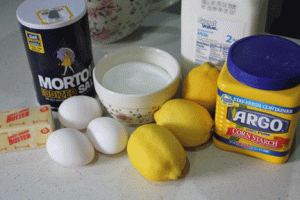
Here are the ingredients for the pudding. You will also need cream of tartar and 1/2 cup of sugar for the meringue as well as a pre-baked pie crust for the pie.

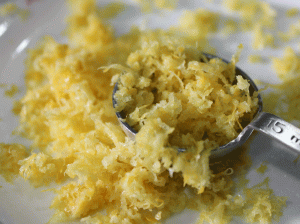
Start by zesting your lemons. Rinse them off well then whip out your microplane and go to town. You need 2 tablespoons of zest. By that time, the amazing scent will have weakened your knees and made you a bit giddy.

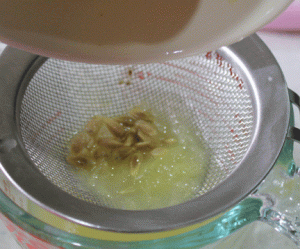
Go ahead and juice those lemons. I used three and it came out to be right at a 1/2 cup of juice. Run the juice through a strainer before using to get out all the pulp and seeds. Squeezing them by hand is great therapy!

Next, whip up the meringue. You need 1/8 tsp. of cream of tartar for every egg white. I used three egg whites so I needed 3/8 tsp. of cream of tartar.

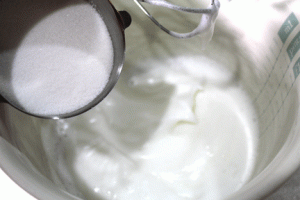
Beat until soft peaks form then add in your sugar. I added 1/2 cup to the three egg whites.

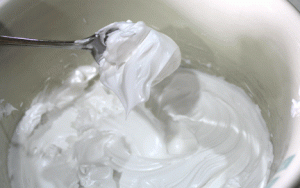
Continue beating until stiff peaks form and the meringue gets all lovely and glossy. It is beauteous!

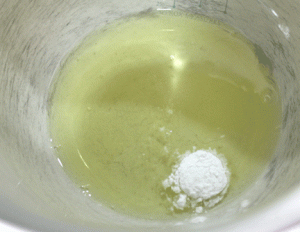
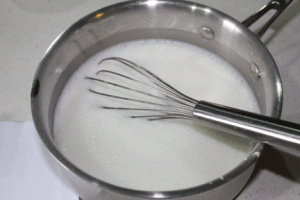
Now we start on the pudding. Mix the cornstarch and sugar together then whisk in the milk.

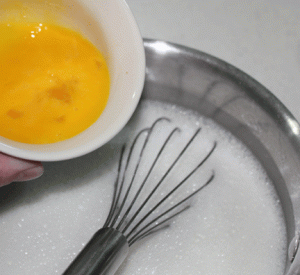
Add beaten egg yolks and mix well, then add lemon zest and salt.

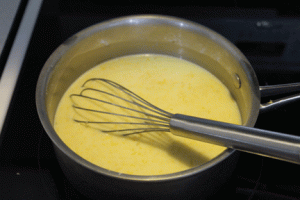
Place over medium heat and cook, stirring until your arm feels like it might fall off, er... I mean until the sauce is thick.

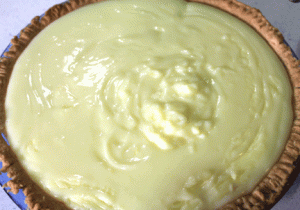
Add lemon juice and butter, stirring well, then pour into prepared pie shell.

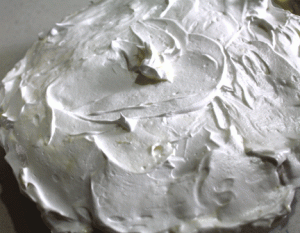
Immediately top with meringue. You want the pudding hot to help cook the inside of the meringue.

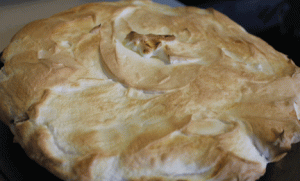
Place in pre-heated oven and brown for about five minutes.

Lemon Meringue Pie
1 pre-baked pie crust, cooled
Filling
Meringue

Meringue
3 egg whites
3/8 tsp. cream of tartar
1/2 cup granulated sugar
To start with, make sure your bowl is completely grease-free. Any oily residue will ruin your meringue. Go for a glass bowl if it all possible. You need 1/8 tsp. of cream of tartar for each egg white. Sprinkle on top of egg whites and beat with mixer on medium speed until soft peaks form. Add in sugar gradually and continue beating until stiff peaks forms and the meringue is glossy and lovely.
You will want to whip up the meringue before you start cooking the pudding.
Filling
3/4 cup granulated sugar
1/4 cup cornstarch
2 1/2 cups milk
3 large yolks, lightly beaten
2 tbsp. finely grated lemon zest
pinch of salt
1/2 cup fresh lemon juice
2 tbsp. butter, softened
NOTE: Three fresh lemons gave me plenty of zest and came out, when squeezed by hand, to be right at 1/2 cup of juice. Do yourself a favor and squeeze your own juice. The flavor is amazing! Also, separate your egg whites from the yolks and put the whites into a large mixing bowl. You’ll use them for the meringue.
Preheat oven to 425 degrees.
Place sugar and cornstarch in a 2-quart heavy saucepan. Whisk to combine. Gradually add milk, whisking until smooth. Add egg yolks.
Stir in lemon zest and salt.
Place saucepan over medium-high heat and cook, stirring constantly, until sauce is thick.
Remove pan from heat and stir in lemon juice and butter. If you don’t want the zested lemon in your pudding you can run it through a fine mesh strainer at this point. If you are like me and don’t care, pour the pudding into the prepared pie crust. You can make your own crust – I highly recommend this vodka pie crustrecipe – or use a store-bought crust. Whatever floats your boat. Mine floated with the vodka recipe.
While the pudding is still piping hot, spoon on the meringue and bake in oven for about 5 minutes or until top is lightly browned. 
Let cool completely before serving. Then enjoy!
~*~
Convinced everyone deserves a happy ending, USA Today best-selling author Shanna Hatfield is out to make it happen, one story at a time. Her sweet historical and contemporary romances combine humor and heart-pumping moments with relatable characters.
When this hopeless romantic isn’t writing or indulging in rich, decadent chocolate, Shanna hangs out with her husband, lovingly known as Captain Cavedweller.
Shanna loves to hear from readers. Follow her online at:

ShannaHatfield | Facebook | Newsletter | Pinterest | BookBub