Friday, July 15, 2016

ABCs OF COWBOY TALK


The Cowboys in the old west had their own way of expressing their thoughts and actions. Though some of the expressions they used are in use today, some are outdated.
Here are a few I thought interesting.


Ace-high ~ first class, respected.


Bend an elbow ~ have a drink.


Crowbait ~ derogatory term for a poor-quality horse.


Directly ~ soon.


Fish ~ a cowboy's rain slicker, from a rain gear manufacturer whose trademark was a fish logo.


Grass widow ~ divorcee.


Heeled ~ to be armed with a gun.


In apple pie order ~ in top shape.


Jawin’ me ta death – talking too much


Knocked into a cocked hat ~ fouled up, rendered useless.


Lunger ~ slang for someone with tuberculosis.


Mudsill ~ low-life, thoroughly disreputable person.


Nailed to the counter ~ proven a lie.


Odd stick ~ eccentric person.


Put a spoke in the wheel ~ to foul up or sabotage something.


Quirley ~ roll-your-own cigarette.


Raise hob – raise hell as in going to town to raise hell


Shave tail ~ a green, inexperienced person.


The Old States ~ back East.


Unreliable as woman’s watch – because women are always late


Viands – food, meals


Who-hit-John ~ Liquor, beer, intoxicating spirits.

X ~ Make the x mark when they couldn't write their name


Yarn the hours away – tell stories

Zonkard - One who is often in a drunken state

Agnes Alexander


Wednesday, July 13, 2016

#WomenoftheWest Belle Starr

Belle Starr, of all the women of the west, has me the most curious. She grew up well (for the time) and had a good education, even an accomplished pianist. And then became a wanted outlaw.

After the death of her brother during the Civil War and the huge hit her father's business had taken due to the war - the family relocated to Texas to hope for a new start.

Once in Texas, Belle began her string of involvements with men of questionable character.

History is unclear as to if Cole Younger or Jim Reed actually fathered her first child - but both were outlaws. By 1869 Belle and Reed were married and she joined in his lifestyle completely Riding Venus, her mare, she used the title "Bandit Queen" for several years and assisted Reed in stealing cattle, money, and horses.

In 1874, Reed was killed by a member of his own gang and Belle was on her own. It didn't change her, though. She went to Indian Territory in Oklahoma and formed her own group of horse and cattle thieves. During this time she met her common-law husband, a Cherokee - Sam Starr.

In 1883, both Belle and Starr served five years for horse theft in a Detroit federal prison. Not changing their ways, in 1886, Belle violently lost Starr during a gunfight with an old enemy.

Not one to hold herself back, she found another husband in a Creek Indian - Jim July. In 1889 she accompanied him part of the way to Arkansas so he could face charges. She turned before they reached Fort Smith.

However, on her way home.....


February 3, 1889 saw Belle Starr being fatally shot by an unknown assailant with two gun shots to her back.

Sunday, July 10, 2016

Wild Bill Hickok as noted in "Destination Deadwood"

I was so lucky to get literature during my vacation about some of the most legendary folks in South Dakota so today I'm going to talk about Wild Bill Hickok.  He was noted as one of the most popular inhabitants of Deadwood, perhaps because it was the place he died.

He came to Deadwood from Abilene when he was hired to uphold the law.  His undoing came when he accidentally shot and killed his deputy.  Remorse drove him to poker, and he was eventually asked by concerned citizens to move on.

Wild Bill joined Buffalo Bill Cody's wild west show because of his excellent horsemanship and being a superb marksman, but failed miserably as an actor because of stage fright.

Discovery of Gold in the Black Hills brought him to Deadwood after Cody let him go.  He traveled with his good friend, Colorado Charlie Utter with the aim of striking it rich.  Hickok's goal was not to be, and he's buried in Mt. Moriah cemetery overlooking the city.

As I said, Hickok came to Deadwood in June of 1876 in order to strike it rich.  Newly married, his beloved Agnes awaited his return to Cheyenne, however on Augst 2, 1876, he walked into Saloon #10 in Deadwood, sat with his back to the door and never saw a loser named, Jack McCall, come within three feet and whip out his 45 and pull the trigger supposedly because the gambler killed his brother but was not held accountable.  McCall was hanged in 1877.  Wild Bill wa not used to sitting with his back to the door, but on this particular day, no one was willing to switch seats with him.

Ever since Wild Bill was shot while playing poker, the hand he held,  black aces and eights is known as "the deadman's hand."  I think if I drew those two pair plus the nine of diamonds as he did, I'd be a little more than nervous.

The original headstone carved by his friend Charlie Utter read,
"Pard, we will meet again in the happy hunting ground to part no more."

Interesting facts:
Wild Bill owed a $50.00 drink tab to Saloon No.10 at the time of his murder.


Wednesday, July 6, 2016

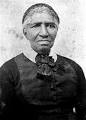
Clara Brown


Life was often hard and unfair for women in the 1800’s. Cooking, cleaning, the loss of a child; women overcame much and kept on going. In thumbing through a collection of works I stumbled across one woman who led a long life and triumphed through patience and hard work. Meet Clara Brown:    
Clara Brown was born a slave in 1803 Tennessee. At the age of 3, she and her mother were sold to another slave owner. Clara remained with this owner for twenty years. During this time, she married and had four children, but when her owner passed, she and her family were sold at auction. Clara was bought by a George Brown and taken to his home in Kentucky. Unable to read and write, Clara lost contact with her husband and children.  
George Brown was a Kentucky planter, whose last name Clara adopted. He was a kind man who helped Clara gain her freedom in 1859 and move to Missouri where former slaves were protected by law. Clara went to work for a St. Louis merchant and moved with his family to Leavenworth, Kansas, where the merchant helped er establish a laundry. While in Kansas, Clara heard about the gold rush and joined a wagon train to Colorado. With no money to pay her way, she earned her passage by cooking, taking in laundry and nursing. She arrived in Denver in 1859 and was the first African-American woman in the gold fields.
While in Denver, Clara heard about George Jackson’s huge gold strike in Central City. She moved to the mining town, opened a laundry and invested in the mines and real estate. Being a devout Christian, she also organized a church complete with Sunday school. Little by little, her income and investments grew to where she could deposit money in the bank and helped other newly freed African-Americans come to Colorado to make a living. By 1866, she had saved an unheard amount of $10,000 and began searching for her family. Two of her children had died and she couldn’t find anything pertaining to her son or her husband.
Clara left Colorado for a spell to search for her daughter, Eliza Jane, in Kentucky. Like her son and husband, Clara couldn’t find any trace of her daughter and eventually returned to Colorado. In 1882, at the age of 79, Clara finally found Eliza Jane and her granddaughter, Cindy. They were living in Iowa. She enjoyed a few years with her daughter and was made a member of the Society of Colorado Pioneers for her role in the Colorado gold rush before passing away in 1885. Clara is buried in Riverside Cemetery, Denver.  
        

Tuesday, July 5, 2016

Celebrating the 4th of July - Pendleton Style

by Shanna Hatfield

All my childhood years were spent on a farm outside a small town where it seemed like everyone knew everyone else.

Not much happened in the way of excitement there. We only had one blinking red traffic light, two one-way streets taking folks through town, a grocery store with a doorway that led into a clothing / home store, a tiny corner drug store, and a Dairy Queen.

But for four-days a year, the town burst with excitement and life during the 4th of July celebration. The biggest draw was the rodeo, bringing competitors from all over. Toss in a Suicide Race, a parade full of horses and antique autos, and events in the park, and you had a quaint hometown celebration many found hard to resist.

Because of the 4th of July being THE holiday everyone I knew celebrated, it has long been one of my favorite holidays as well.

I often tie in a 4th of July celebration into my stories - just because it's fun to think about how people celebrated back in the day.

One of my favorite scenes is taken right out of Pendleton's history. Two arguing politicians were trying to out-shine each other and the end result was a smelly disaster.

The basics of what happened are told through the characters of Caterina (Book 2 in the Pendleton Petticoats series).

 ~*~ 

“Remember the year they were going to have a clambake?” Garrett asked Kade with a broad grin.


Kade nodded his head and wiped his mouth on a napkin. “That was the smelliest mess I’ve ever seen.”

“What happened?” Caterina asked, wondering why they’d have a clambake in Pendleton. They were a few hundred miles away from the ocean.

“There were two politicians trying to out-do each other. One of them was a chairman of the Fourth of July celebration that year and decided to have the biggest clambake ever held in Eastern Oregon. It might have been the only clambake planned in Eastern Oregon. He made arrangements to have a train car load of clams delivered the morning of the fourth from the Washington coast,” Kade said. 

“The other politician got wind of the plans and wired ahead, saying the clams should be delivered the second of July, to ensure they’d arrive in time for the festivities. The problem was that he didn’t think about the clams needing additional ice during the two days the train car sat on the tracks in our hot July weather. When they opened that door…”

Kade and Garrett both grimaced remembering the smell and the flies that crawled all over the clams.

“They hauled the train car out to the reservation to give it a proper burial and no one has suggested bringing clams to town again,” Kade said, making both Caterina and Aundy laugh.


 ~*~ 


 There really was a train car load of clams that ended up baking in the scorching July heat. And they really did take the whole train car out to the nearby Umatilla Reservation and bury it.

However you celebrated the 4th of July - I hope it was safe and full of fun!


 ~*~ 

Convinced everyone deserves a happy ending, USA Today best-selling author Shanna Hatfield is out to make it happen, one story at a time. Her sweet historical and contemporary romances combine humor and heart-pumping moments with relatable characters. When this hopeless romantic isn’t writing or indulging in rich, decadent chocolate, Shanna hangs out with her husband, lovingly known as Captain Cavedweller.
Find Shanna’s books at:
Shanna loves to hear from readers. Follow her online at:  

Celebrating the 4th - Pendleton Style

Monday, July 4, 2016

America’s Independence Day

By Kristy McCaffrey

The Fourth of July—or Independence Day—is a federal holiday in the United States commemorating the adoption of the Declaration of Independence on July 4, 1776. This document, ratified by the Second Continental Congress, set forth that the original thirteen American colonies were now a new nation—the United States of America—and no longer a part of the British Empire.

In actuality, the vote to separate from England occurred on July 2, 1776, but the date written on the Declaration of Independence—July 4—became the popular holiday. (It is also believed that the document itself wasn’t signed until August 2, 1776.) One of the signer’s (and the 2nd U.S. President), John Adams, had this to say in a letter to his wife, although he was incorrect about the date:

“The second day of July, 1776, will be the most memorable epoch in the history of America. I am apt to believe that it will be celebrated by succeeding generations as the great anniversary festival. It ought to be commemorated as the day of deliverance, by solemn acts of devotion to God Almighty. It ought to be solemnized with pomp and parade, with shows, games, sports, guns, bells, bonfires, and illuminations, from one end of this continent to the other, from this time forward forever more.”


Out west, Independence Day celebrations didn’t begin until the 1800’s. For example, the first Independence Day celebrated in Prescott, Arizona took place on July 4, 1864. The town was just over one month old but three hundred people attended the festivities, which included a parade of the cavalry from Fort Whipple and speeches by Governor John Goodwin (the first governor of the Arizona Territory) and Secretary of Territory Richard McCormick. A huge meal was laid out of fried liver, venison and beef steaks, mutton stew, barbecued beef, and pot pies alongside coffee, tea and milk. A local saloon also provided whiskey. Over time, this annual celebration became a modern-day rodeo in Prescott, purported to be the oldest rodeo in Arizona.


Today, not much has changed for Fourth of July celebrations. Americans engage in cookouts, barbecues, picnics, parades, carnivals, fairs, concerts, and of course fireworks.

* * * *
Kristy McCaffrey has been writing since she was very young, but it wasn’t until she was a stay-at-home mom that she considered becoming published. She’s the author of several historical western romances, all set in the American southwest. She lives in the Arizona desert with her husband, two chocolate labs, and whichever of their four teenage children happen to be in residence.


Connect with Kristy