Wednesday, May 20, 2020

The Prairie Pet: Marcial Antonio Lafuente Estefania

By Andrea Downing
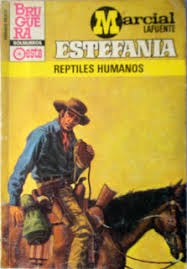
His is not the first name we think of in relation to western writing, nor is it a name that will trip off the tongue for most of us, but Marcial Antonio Lafuente Estefania was the most prolific of western writers—and he was a Spaniard.
He was born in Toledo, Spain, in 1903, and went on to study Industrial Engineering, a profession he practiced not only in Spain but in Angola, Latin America,  and the USA as well. His time in the US, between 1928 and 1931, allowed him to travel the West, an experience he never forgot and would eventually put to good use.
When the Spanish Civil War erupted, Estefania served as an artillery officer on the side of the Republicans.  At the end of the war, he refused to leave Spain and was subsequently jailed and intermittently threatened with death. Forbidden to return to engineering, Estefania started to write—an occupation his father, a lawyer, had also followed. His books were what Americans might call ‘dime novels’—kiosk novels in Spanish, and were initially romances written under the name of his wife, Maria Luisa Beorlegui.  With the success of those, he moved on to adventure books using pseudonyms such as Tony Spring, Arizona, and Dan Lewis, and these eventually evolved into the westerns for which he became famous. His first western, The Prairie Pet, was published in 1943.

How did Estefania get his ideas, sitting there in Spain? For one thing, he used an atlas, a history book, and a phone book, as well as his own in-depth knowledge of the Spanish Golden Age, which stories he transferred to the American West. Most of the plot lines were repeated in slightly altered forms—and no wonder, when his publisher at the time, Bruguera, demanded a novella a week.  The books had ‘dime novel’ covers, kitsch and suggestive.
The language is fast-paced and also outlandish, but the books flew off the kiosks.  Estefania was only one such author at the time; the inability to return to their previous lives left many lawyers, doctors, and other professionals with no choice other than to try their hand at writing, and write they did. Authors like Silver Kane and Keith Luger emerged from the Republican army into the American West. Hard-bitten cowboys, rustlers, corrupt marshals and sheriffs, Native Americans, and soiled doves can all be found on the pages of these novels—with the good guy always winning at the end.  Republican attitudes were hidden in the storylines, and high moral principles were never violated.
By the time Estefania had passed on in 1984, his sons had taken up the profession and continued the stories under his name. Starting in 1958, a story may have been written by the father or one of his sons, Francisco or Federico; grandson Francisco continued along with uncle Federico in his seventies, bringing more than sixty-four years and no less than 3,000 titles of novels by Estefania. This eventually resulted in some fifty million books sold!
When Estefania started in Spain, there was no copyright. His books were sold for a single fee to the publishing house.  Translation rights?  Forget it. All Estefania knew was that some books were available in Brazil, but as to sales, nothing—and no knowledge of what Bruguera was earning from his work. If Estefania needed money for a car or a down payment on a house, the publisher would lend him the money against future earnings. It is no wonder then that Bruguera disappeared in the 1980s under a financial cloud. 

The family business was eventually moved to Editions B but sales slowly dropped below 10K with the advent of other forms of entertainment—television mainly. Federico then ran his own publishing house, Ediciones Cies, and continued to knock out stories on an old Olivetti, the sound of the keys being similar to gunshot in his mind. While the highest sales had been in the ‘50s and ‘60s, with WEEKLY print runs of 100K, the novels continue to be popular today with the Latino population in the USA, despite the fact, as with many westerns, Latin heroes never play a role. Current print runs of the reissued classics reaching 200K are not infrequent, but remember that these novellas are only around one hundred pages and quick to read.  Digital versions were being considered to reach the wider market.

While the books are banned in both Venezuela and Cuba due to their pro-American stories, in Spain alone approximately 2,500,000 copies are still sold per year.  If one includes Latin America, the number is apparently practically double. Keep in mind that the company publishes approximately three hundred of the titles per annum, now grouped into collections such as Aces of the West, Bison, Heroes of the Prairie, and so on. And while there are no new titles now being written, the pulp fiction covers remain the same.

My thanks to Hernando Saffon Salazar for bringing Estefania to my attention, and to Daniel Saffon Laverde and Cristal Downing for help with translating certain research from the Spanish.
To see my own books, please check out my Amazon page at https://www.amazon.com/Andrea-Downing/e/B008MQ0NXS/ref=ntt_dp_epwbk_0

Photo’s original source unknown.  No copyright infringement intended.


Tuesday, May 19, 2020

WHEN RESEARCH IS FUN by Kathleen Lawless @kathleenlawless


I’ll never forget my first road trip with my youngest son, just the two of us.  We headed for the prairies because I was researching the old West and I had heard about a recreated western town from that time period, complete with staff (actors?) dressed in period costume, depicting everyday life in those times.

The book I was researching, GRACE’S FOLLY, featured a female physician as the heroine, a career choice that was unusual for the time, but not unheard of.  I had been struggling to research what Grace’s medical bag would have looked like, and what instruments it would have held.

Imagine my delight when we came across a doctor’s home as part of the old-time town, and laid out across the doctor’s bed were the contents of his/her medical bag.  I wasn’t allowed to touch the display, but I did get close enough to snap some useful photos to refer to once I was back at my computer.   That trip was a lot more fun and meaningful than any other research to date. 

Although, recently I set a contemporary book in a spa, for which copious hours of research were required.  Weeks and months of research . . .            

GRACE’S FOLLY IS part of an award-winning, four-book set of Historical Western Romances, WIDOWS, BABIES, AND BRIDES. 

Grace’s life is a lie.  Dex lies for a living.  Will these two ever admit their feelings and face the truth?  https://www.amazon.com/gp/product/B01F9D1AF6

Starting on Saturday, May 23rd, just in time for the long weekend, the boxed set is on sale for the bargain price of only .99 cents, reduced from its regular price of $9.99
https://www.amazon.com/dp/B086GGVGP2

Here’s a teaser from GRACE’S FOLLY.  Earlier in the story, Grace hired the hero, Dex, to pretend to be her husband.
Warning:  This is not a sweet romance, and has a medium heat level.

    Grace’s breath caught in her throat. Was it
possible Dex really, truly understood? “Are you
saying we’re not so different, you and I?”
     “On the contrary,” Dex said, his voice a sexy
rumble in his throat. She glanced up, recoiling at the
smoldering look in his eyes as his gaze traveled her
length.
    “You’re afraid to get close to me, afraid to touch
me. I, on the other hand, can’t seem to fight this
compulsion I have to touch you.”
     As he spoke, he pushed her blouse off one
shoulder. Grace trembled at the feather light
sensation of his fingertips grazing her skin.
     “Not so bad, is it?”  He caught her hand in his 
and placed it on his chest. She could feel the steady 
beat of his heart, not nearly so erratic as her own. 
His skin was warm and smooth, textured by the 
thicket of hair which spread across his pectorals, 
angled into a thin line, and disappeared into his trousers.
She moistened her suddenly dry tongue, and the
movement seemed to catch and hold Dex’s
fascination.
     Her knees started to tremble as he stared
hungrily at her mouth, then pushed her blouse off
the shoulder and down her arms. Wet cloth clung
stubbornly to her skin. As he peeled the
uncooperative fabric away from her, she could feel
the faintly abrasive rasp as he worked to separate
her from the garment.
     At last he managed to free Grace from her
blouse. He dropped the sodden garment, and it
landed on the wood floor with an ungracious flop.
He trailed his hands lightly up her bare arms.
     “Put your arms around my neck.”
     When she didn’t comply, he took the initiative
and did it for her, looping her arms across his
shoulders and pulling her close. “I faked being a
doctor today, with your help. It’s your turn now.
Your turn to fake being a wife.”

Get this book and three others for only .99 cents, this weekend only.  
The sale starts Saturday, May 23rd.

If you’re a fan of mail-order brides and secret babies, make sure you check out the sweet western series Widows, Brides and Secret Babies.


Kathleen blames a misspent youth watching Rawhide, Maverick and Bonanza for her fascination with cowboys.  Historical or contemporary, cowboys continue to resonate with her today.   
Sign up for her VIP Mailing List and receive a free western novella, as well as updates, special fan-priced sales, and other goodies.  http://eepurl.com/bV0sb1

Monday, May 18, 2020

From Four Feet to Four Wheels

Me, riding with my cousin in Florida
Throughout history, the humble horse has served mankind well. They have provided heavy labor, transportation, and pulling power to build nations. Now, they still serve as wonderful pets, partners on trails, and service animals that help heal. But what about the transition from horse to horsepower?

From the beginning of history, the horse played an important part in human life. Early hunters and gatherers used the horse as a source of food, but as domestication blossomed, they became the primary form of transport across the globe. The horse originated in Europe, though an early form did exist in America only to go extinct, and when European settlers arrived in the New Land they brought horses with them. Descendants of these horses became the American Mustang and Cracker Horses of Florida.

A Cracker Cowboy from the 18th Century


Horses, mules, and oxen transported pioneers across the vast reaches of America to new homes in the west, as they pulled wagons laden with all earthy possessions to the wild west. Horses were important to this early period but as times changed and the country grew they were slowly replaced by the automobile.

The transition from horse to horsepower took time but accelerated dramatically with the mass-produced Model T Ford. From 1908-1927 Ford produced fifteen million Model T cars. With few good roads and no real rules on driving one of these early autos the adventure began and people everywhere took to the roads. Although the Model T was one of the first mass-produced cars it was far from being the first automobile. In 1769 the first steam-driven car was invented and in 1885 Karl Benz created the first petrol-driven automobile. After the gas combustion engine was created many manufacturers began making custom coaches. These sleek, streamline, and unique automobiles of The Great Gadsby fame.
Add caption

This past summer, during our tour of Alaska, my husband and I had the great privilege of visiting the Fountainhead Antique Auto Museum in Fairbanks. We spent the entire day looking at cars, learning the history of the auto in Alaska, and reading about the fashion of the times displayed along with the gorgeous autos. This day helped to inspire aspects of my current work in progress, Blake Allen.

In the Generations of the Cattleman's Daughters I have been following the lives of the James daughters' descendants and the progression of life beyond the Broken J Ranch. In this new addition to the series Blake, Clay and Meg's son, becomes a peace officer of the 1920s. The roaring twenties were known for their fast cars, fine frippery, and daring criminals.

My hero has his hands full as he and his family begin to make the switch from horse to horsepower as the changing times demanded, that doesn't mean that old ways and family traditions would be left behind. As Clayton Allen begins to transition his horse breeding operation from cattle horses to more racing stock to fill demand, his only son steppes out to bring down one of Wyoming's biggest gangs. He will need the help of an unlikely friend and a speedy car to get the job done.

American history is full of transition, and this shift from horse to horsepower was a significant if understated one. Here are just a few of the beautifully preserved cars of the era, along with the fashion of the time. This day, well spent was such a huge inspiration. As an author, you never truly know what will spark an idea for the next story or bring aspects of a yet unwritten work to life.


Don't forget to watch for the next installment of the Cattleman's Daughters, arriving soon.


Additionally, you can find all of the Cattleman's Daughters Series Free on Kindle Unlimited and I have bundled the Companion Stories for this series into one special deal.
Companions of The Cattlman's Daughters


Friday, May 15, 2020

The Essential Yardbird ~ by Kristine Raymond


Having recently acquired a flock of three-day-old chicks, I started thinking about how valuable these birds were to early pioneers and settlers. They were easily transported, not taking up much space on a wagon - a makeshift coop could easily be secured to the outside of the conveyance - and, once settled on a homestead, the birds required little feed, foraging on their own for scraps, keeping weeds and pests out of the garden, and fertilizing the earth with every step they took.


These compact critters were multi-purpose, providing their caretakers with eggs and meat - extra eggs were often sold in exchange for ‘pin’ money - and raising the next generation of chicks.  They were also handy to have around if someone needed tar and feathering!

Often used as a means of currency, most settlers were happy to accept a yardbird in lieu of cash, recognizing the benefits of owning such remarkable birds, and a well-tended flock was a source of pride.

I’m looking forward to the morning when I step into the henhouse and collect my first fresh egg and like the pioneers of long ago, I’ll be singing the praises of these remarkable birds.

Side note - even though I titled this piece The Essential Yardbird, it's mainly in the Deep South that chickens are referred to by that name.

Wednesday, May 13, 2020

How Horses Changed Native American Culture by Rhonda Frankhouser

"No philosophers so thoroughly comprehend us as dogs and horses." —Herman Melville

Introduction of Horses in Native American Culture

There's something truly mystical about a horse.
 Maybe it's their piercing gaze that seems to stare right into your soul or the silent communication between horse and rider that co-mingles two separate energies into one perfect motion. Could it be their uncanny intuition and absolute dedication that brings about an almost spiritual admiration? Their intoxicating scent?

Personally, I think it's a delicate balance of all those elements that brings horse and rider together into one harmonious unit. I can't imagine a life without my lifelong love and respect for horses, but can you imagine what having a horse must have meant to those who counted on them for more than companionship and sport?

During the 16th and 17th centuries, native american cultures acquired domesticated horses from Spanish ranchers in Mexico, New Mexico, and Texas. The largest influx of horses into the native american culture came during the Pueblo Revolt in 1680. Horses spread to other tribes as a result of both intertribal trading and livestock raids. In the 18th century, the regions around Santa Fe and San Antonio became a major distribution center for the rest of the country.

Horses were a miracle addition to Native American culture.


In an instant, many plodding tribes were transformed from marginal hunters and near-starving farmers to fierce, nimble warriors. With the help of strong horses, whole villages, (including the sick and elderly who before were left behind), could move long distances in a relatively short amount of time. With the ability to haul heavier loads, larger personal residents as well as more elaborate gathering places were made possible. Simply put, horses changed the very lifestyle of many native american tribes.

Western tribes looked upon the horse with an almost religious awe. So enamored were native warriors of their horses, they sang to their steeds and carved effigies (like the one below) to those killed in battle. The red dots were meant to show the wounds suffered by their faithful animals.
Wooden figure carved by Sioux Warrior in honor of fallen horse

'My horse be swift in flight
Even like a bird;
My horse be swift in flight.
Bear me now in safety
Far from the enemy's arrows,
And you shall be rewarded
With streamers and ribbons red.'
                                                        Sioux warriors song to his horse

For hundreds of years horses provided necessary transportation, added power for heavy, difficult jobs, and direct, one-on-one companionship for their riders. Without hesitation, these brave animals charged into battle and scaled unknown peaks alongside (or rather underneath), many noble explorers. When they were called upon, they often perished in the service of their rider.

With the advent of technology and changing times, horses are rarely used for transportation and work labor, but they remain an integral, and much revered, member of most native american cultures. Horses represent a majestic tradition, and their spiritual connection to their rider will last until the end of time. 

"A horse gallops with his lungs, perseveres with his heart and wins with his character." —Frederico Tesio


Rhonda Frankhouser is an award-winning author of mainstream fiction, contemporary and western romance. She lives in the beautiful state of Georgia with her husband and three dogs. Follow Rhonda at www.rhondafrankhouserbooks.com.

Tuesday, May 12, 2020

MARTHA MAXWELL - CHARLES E.H. AIKEN

Post by Doris McCraw
writing as Angela Raines

Photo property of the author
In the late 1880s and early 1900s, there was a fascination with nature, especially for those back east. The Audubon Society and Sierra Club were two of the organizations that have lasted although there were others prior to and after the above mentioned. Taxidermy was a means of studying the animals and birds, allowing others to observe them in museums and exhibits.

Both Aiken and Maxwell were taxidermists. Aiken focused on birds and Maxwell wild animals. They both collected their own specimens and both were in Colorado. Aiken in Colorado Springs and Maxwell in Boulder.

Charles Edward Howard Aiken was born on September 7, 1850, in Vermont. The family later moved to Illinois. It was there at the age of eighteen, Aiken began his study of birds. After the family business was destroyed in the Chicago Fire of 1871, they moved to Colorado Springs. Charles continued his study of birds and used the standard method of study by killing them. Aiken went the further step and stuffed and mounted them. He had a music store and museum on Pikes Peak Avenue in Colorado Springs. His collection from his years in Colorado Springs was donated to Colorado College. The Aiken Audubon Society is named for him. For more information: https://libraryweb.coloradocollege.edu/library/specialcollections/Manuscript/Aiken.htmlYou can also access his book "Birds of El Paso County, Colorado" here: https://archive.org/details/birdselpasocoun00unkngoog/page/n64/mode/2up

Charles Aiken died in January of 1936.

Charles Edward H Aiken (1850-1936) - Find A Grave Memorial
Charles Edward Howard Aiken
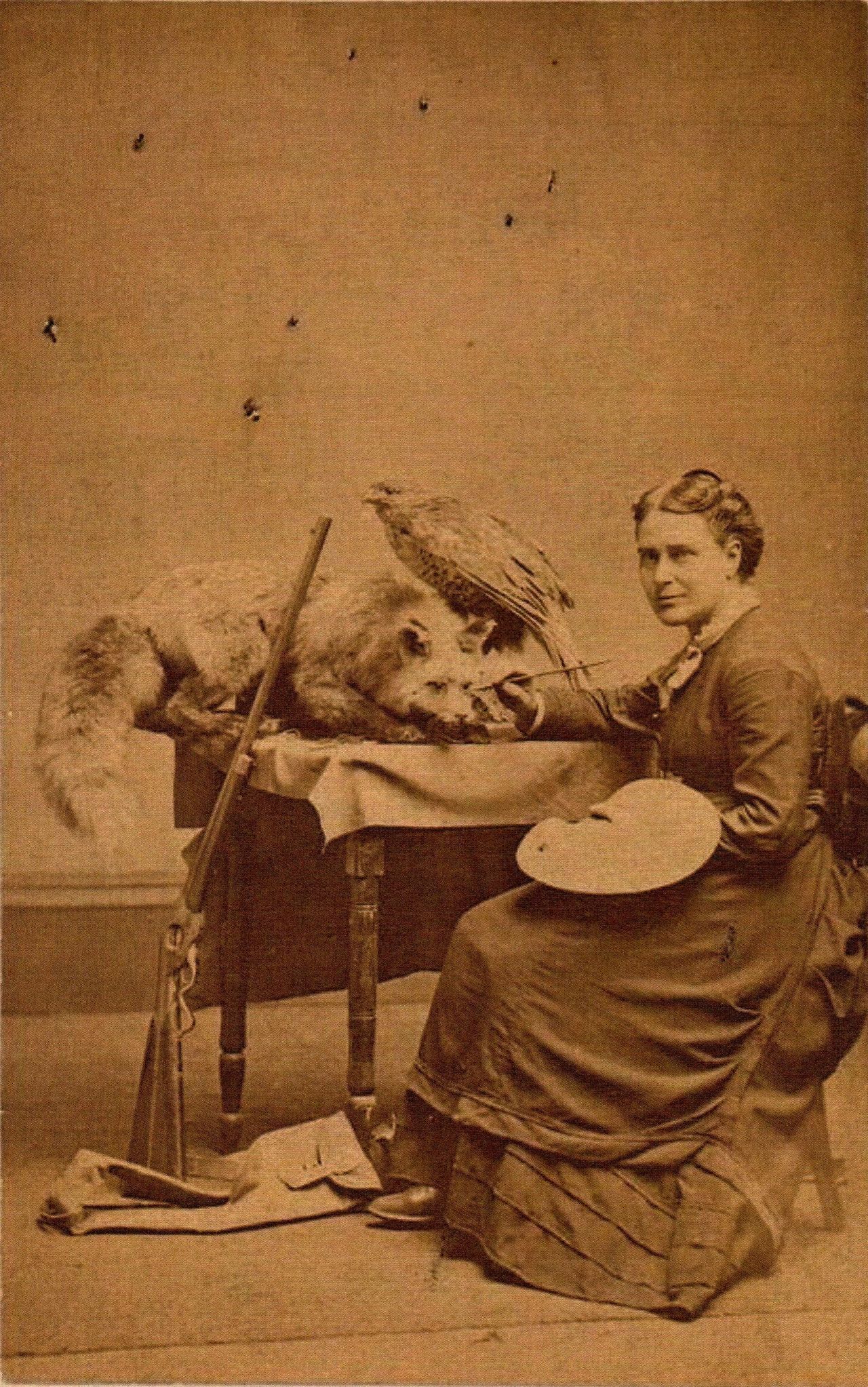
Martha Dartt Maxwell was born on July 31. 1831 in Pennsylvania. According to the information included when she was inducted into the Colorado Women's Hall of Fame, she was five feet tall and life long vegetarian. She and her husband arrived in Colorado around 1863 and she ran a restaurant in the Boulder area. When her mother was ailing she went to Wisconsin to care for her. Here the story gets a bit cloudy. Some say she became interested in taxidermy while in Wisconsin, but other sources say it was when she ran a taxidermist off her property she became interested. No matter what the story by 1868 she opened a museum in Boulder showing her panoramas of animals she had caught, skinned and stuffed. Helen (Hunt) Jackson was so impressed she wrote an article that appeared in publications on the east coast.  If you would like to read her book "On the Plaines, and Among the Peaks, of How Mrs. Maxwell Made Her Natural History Collection" you can access it here on Google Books: https://www.google.com/books/edition/On_the_Plains_and_Among_the_Peaks/ePpGAQAAMAAJ?kptab=editions&sa=X&ved=2ahUKEwiL9b2wn63pAhUPCs0KHW9PDK0QmBYwAHoECAEQBw

Martha Maxwell died on May 30, 1881, in Massachusetts. For more on Martha:https://americacomesalive.com/2014/04/05/martha-ann-maxwell-1831-1881-naturalist-taxidermist/

Martha Maxwell - Women in Taxidermy
Marth Dartt Maxwell

Although the animals in "Angel of Salvation Valley" were living, they also played an important part in the story. Below is an excerpt:

 She was even younger than Luke and the others made her seem. He'd expected someone harsh, old and lined, not someone like this. Drew wanted to explore that thought, but her care took priority. He needed to see to her wounds; then, if the pain or voices in his head would let him, he would try to figure out what was going on.
Suddenly he remembered Ham and Luke talking. "She's a she-devil," Ham had said. "Walkin' like she was offering what you wanted, but then cuttin' you off like you wasn't nothin' she would touch."
"Women like that don't have a reason to be in this world. Women are evil, they can wind a man around their fingers and then squeeze the life out of them," Luke had added.
Looking down at the pale, perspiration–covered face, watching the struggle she was going through to breathe, he wondered whether what they said was true. The dark brown, almost black hair plastered to her face, a face so sweet looking.
"They are evil," Luke's voice sounded in his head. Drew recognized the voice this time.
"Shut up, Luke," Drew muttered, "get out of my head." Drew staggered under the force of the pain that suddenly lashed him. At his words, both the dog and cat moved close, as if to comfort and support him. "Thanks," Drew said, as he placed a hand on each. A sense of peace and support flooded through him, and the pain disappeared.
Drew returned his attention to the task at hand, working to remove the lodged bullet. Once completed, he bandaged her shoulder, then cleaned and did the same for the wound on her left calf. When finished, he pulled a chair over and sat back to wait. He knew Luke would wonder why he didn't immediately return to camp, but he felt compelled to make sure the woman was okay. He couldn't explain it, but he wouldn't leave until he had the chance to talk with, and learn more about, this woman. She didn't seem to fit the picture the others had painted; still, Luke had done so much to help him.

Round and round the thoughts continued. Drew grew dizzy and his head began to throb again, but a dull ache, not the searing pain he'd felt earlier. Perhaps he was still feeling the effects of the poisoning, his body not yet regaining its full strength. The dog came over to lie between them. The woman's hand moved to the dog's head and, without thinking, Drew placed his hand over hers. Soon he fell into a calm sleep, without dreams or worries.
Amazon


Doris Gardner-McCraw -
Author, Speaker, Historian-specializing in
Colorado and Women's History

Angela Raines - author: Where Love & History Meet
Angela Raines FaceBook: Click Here

Monday, May 11, 2020

HISTORY IS A MYSTERY, ESPECIALLY WHEN IGNORED


One of my favorite books to write was a historical romance called KING’S FANCY. It was my first foray into the world of the mail-order bride. I recently offered it as a free promotion for a few days and one reviewer pointed out that it was an unusual take on the subject. I took that as a compliment. When I prepare to write a new book, I start out with a central idea, usually a problem. In this case , that idea was the desperation; a young woman faced with no way to make a living and no family to fall back upon.
In the early history of the US, there was very little in the way of welfare. The need for aid began to force change and new systems were slowly put into place. Very slowly. There was no organized social welfare program in our country until 1935. Before that, the stress on society was huge and several different systems were created to serve as a relief valve – one of those was the orphan trains.
The orphan trains existed from the mid-1800’s to the early 1900’s. As a result of poverty in homes where the parents engaged in crime, or abused alcohol, or were unfit in some other way, there were children who were abandoned or forced to live on the street. Many were orphaned when they lost their parents in one of the epidemic waves of typhoid, yellow fever, or the flu that swept across our nation. Labeled as ‘street urchins’ or ‘street Arabs’, these orphaned children were considered a problem in cities. Worthy of note was that a good majority of these children were of Irish descent.  
Led by a minister from New York by the name of Charles Loring Brace, The Children’s Aid society was founded in 1853. Although orphanages and asylums did exist, Reverend Brace deemed that these homeless children would benefit from a loving family, an opportunity to work, and ample fresh air. Who wouldn’t? Right? This idea came to fruition in the creation of the Orphan Trains. Unfortunately, not every child found that loving family life at the end of their journey. What wasn’t known or heeded at the time was that Mr. Brace was well known for his anti-Catholic sentiments. In his mind, he wanted to take the unfortunate Catholics off the dirty city streets in order to introduce them to Protestantism.
Several other programs began to feed homeless children onto the Orphan Trains – the New York Foundling Asylum and The New England Home For Little Wanderers in Boston. I find the names for these organizations to be a little on the creepy side, like from an indie horror film. Maybe, it’s just me.
As industrialization brought more people to the cities and railroads were constructed, this influx both exacerbated the problem and seemed to create a solution. The railroads leading west offered an avenue of relocating this excess of problem youth to another location. That sounds cold, doesn’t it? Well…it was.
These associations and others began to ship unwanted and orphaned children in groups on trains out to families or farms on the frontier. Indentured forms were filled out by the people who accepted the child, with indenture lasting until they were at least eighteen years of age. It’s sad to note that the majority of these children who were sent to be taken in by the families out west were never adopted at all, but became indentured servants. Adopted children, by law, were entitled to the same treatment as a birth child, including inheritance. Indentured children, of course, did not receive any of those benefits or protections.
Between the years 1854 to 1929, the orphan trains shipped in excess of 200,000 homeless children, ages two to fourteen from the East Coast to the Midwest and beyond to be adopted or taken in for foster care. Now, we know many ended up little better off than slaves. After the Civil War when slaves were freed, this left a gap in the labor force. In many cases, the riders of the orphan trains filled that gap.
This unfortunate page in our history is not well known. It’s not a comfortable historical truth to run across. When King’s Fancy was free, it garnered one reviewer who questioned that indentured servants even existed in the US at that time. We’re more used to the term ‘indentured’ being used when the colonies were being formed and people were sold into servitude as they migrated to America. But to have children who were born here, American citizens, being placed into indentured servitude is something we’d rather not dwell on. Thus, many are not aware of this blot on our record. 
Perhaps it wasn’t the fault of the nuns and the operators of those Eastern asylums and orphanages to think they were providing a better life for the children. Westward expansion and life on a farm or ranch were being idealized to a great extent by journalists, writers, and those who read their work. Of course, it was also true that the act of shipping these unwanted children out West made them someone else’s problems. Of course, one thing that made this flawed plan work out as well as it did was due to the need for cheap labor in the West. The children were caught between a rock and a hard place – a risky move to an unknown future or the reality of urban poverty.
Imagine with me this uncomfortable and sad scene: A train full of street urchins, orphans, and those deemed to be juvenile delinquents are herded onto a train and sent west. When they reach the first town, they’re pulled off, and put on display on makeshift stages. The townspeople assemble and are encouraged to inspect the children, to examine their teeth, to feel of their muscles. They wore a cloth patch on their shirt which showed their names. Some possessed birth or baptismal certificates, some didn’t. Most did have an indenture paper which would legalize the exchange. Seems very barbaric to me.
Anyone interested could select one or more of these children to take home with them. Those who were not chosen were put back on the train and suffered through the same scenario in town after town. When they were chosen, there was no system in place to check the suitability of those taking the children or the circumstances they were offering. True, some families were really looking for children to adopt, but others just needed extra hands to work the farm or take care of their house.
The main objective of those back East was to find a ‘good home’ for the child, alas – this term was very loosely defined and rarely enforced. The youngest, the infants, were first to be chosen. Boys were wanted for their ability to do manual labor. Last and least wanted were girls – like Fancy. We’d like to think that the majority of these kids found a home where they were loved, but we fear that many walked a much rockier path.
When one studies the accounts of these children who rode the orphan train, you’ll find something even more disconcerting…for many were neither adopted or indentured. Their fate is unknown, they just slipped through the cracks. No one knows if they were abused, or became victims of violence, or even sexual exploitation. This is hard for us to consider, but we must realize that the modern thought about human rights and the innocence of childhood is a fairly new concept. Laws to protect the defenseless were a long time coming – and even now seem to be problematic.
As I mentioned earlier, many of the riders of the orphan trains were Irish children. Fancy, in my book, KING’S FANCY, was of Irish descent with her strawberry red hair and freckles. Today, in our oft confused state of what is racism and what is not, we don’t want to remember that the Irish weren’t always considered to be white - which is mind-boggling to me. Irish folk were sometimes considered to be no more than savages, in part because they were mostly Catholic. The anti-Irish sentiment was rampant in some areas. One newspaper article stated that the orphan trains would not allow redheads – which would have been unfortunate for Fancy. In summation, Catholicism in America at that time wasn’t considered to be a form of Christianity. As a person descended from Louisiana Cajun Catholics, this is hard for me to swallow. This shift in racial identity is a process we don’t often explore.
Injustice, unfortunately, comes in many forms. We tend to push what we don’t know and understand away. In Britain, the Scotch-Irish were pushed to Ireland and in Ireland they were pushed to America. The reformers of welfare shipped the unfortunate children, some of whom were Irish, westward. The Native Americans were pushed even further westward, even to reservations, where their children were forcibly sent to boarding schools where their very culture was forbidden.
All of this together, paints an ugly picture that isn’t pleasant to look at.
Orphan trains and indentured servants were just part of that picture – but a very real part.

Here is an excerpt from KING’S FANCY. In this excerpt Fancy speaks of the orphan trains and it also introduces the hero of the next in my Wild West Series –RENO’S JOURNEY

Fancy was talking too much, she knew she was – but she was nervous, and she didn’t know how to stop. “I’m so glad you came along when you did, Mr. Black. If you hadn’t, I probably would’ve tried to walk to the ranch. I didn’t want to disappoint Mr. Ramsay, not after he’s so kindly agreed to marry me. I know my weaknesses and I can’t afford to neglect so kind an offer, I probably wouldn’t get another one.”
Reno listened, speaking when he got a chance. “You wouldn’t have gotten far on an empty stomach, that’s for sure.”
“Yes, your arrival was very fortuitous.” She clasped her hands in her lap and sighed. “I love it out here, this is so different from anywhere I’ve been before. The countryside is gorgeous. I don’t think I’ll ever tire of looking at these rolling green hills and beautiful limestone cliffs.” Fancy sighed. “I’ve never belonged anywhere or to anyone before. I just can’t wait to get to my new home. I’ll be the best wife any man has ever had.”
“Fortuitous is a fancy word, Miss Fancy,” Reno chuckled. “You must have excelled in school.”
Fancy laughed. “I’m self-taught. Mostly. I worked for a school master for a year and a half. He let me use his library.” She smiled, remembering Mr. Tomlinson with fondness. He’d been easy to please and kind to her when it mattered. “At other times books weren’t so easy to come by.” Her voice lowered to a near whisper. “I remember once getting beaten for borrowing a novel at another place I lived. They accused me of stealing, I spent a few days incarcerated. They were going to…molest me, but I wasn’t pretty enough. They just whipped me and let me go.”
Reno didn’t know how to react. The information she passed along was said so offhandedly. He felt anger build up within him at anyone who would raise a hand at so defenseless a creature. “King has a wall full of books, that’s one thing you two will have in common.”
Fancy hugged herself when a shiver of anticipation made her tremble with excitement. “I look forward to many exciting discussions with my husband.”
Knowing Cap’s feelings about his ex-fiancée, he was still having trouble processing the fact that King had connected with this unusual woman and offered to marry her. “Why were you working in so many different jobs?”
“To survive,” she said simply. “My parents died when I was small, and I was placed in an orphanage. When I turned eight, they placed me on one of the orphan trains. I was taken off in St. Louis and bought by a family with four small children.”
“Bought?”
“Yea, that’s the way the orphan trains worked for most kids. Some were adopted out to families, but most were sold to farms and factories for an indentured servant’s price. If you can’t save up to buy your own freedom, you’re sold to someone else for a profit and the price goes up.” She sighed. “It’s very difficult.”
“How did you escape the system?” He was beginning to see that he wasn’t the only one with problems.
Fancy gave him a satisfied grin. “I was rewarded for a good deed, a deed I would’ve done a thousand times over for nothing.” At his quizzical look, she elaborated. “A house in the neighborhood caught fire and I happened to be passing by. When I heard the little girls screaming, I couldn’t walk away. I raced into the building and brought them out.”
“By yourself?” Reno was astonished.
“Yes, there was no time to wait for the fire brigade. There were other people standing about, but I was younger and faster, I guess.” She rubbed her palms, which still bore the scars. “Their father was very glad to have them safe and sound. He gave me a reward large enough to buy my freedom. There was even a write up in the newspaper.” She blushed profusely. “They took my photograph.” Fancy looked up at Reno. “Did you happen to see the article?”
“No, I didn’t. Sorry.”
She nodded, understanding. “After leaving St. Louis, I traveled to Kansas City. Of course, I worked there also, but the jobs were my choice. For the most part, I was treated fairly,” she told him calmly. “It is very hard for a woman to make it on her own, so I decided to try and find a husband.” She straightened her skirt and sat up primly. “I am almost certain that King saw the write-up about me in the paper. What other reason could there be for him to notice me?”
  Reno didn’t have a clue. This was all a surprise to him. “The sun will be going down soon. I’m sorry you aren’t chaperoned properly, but I think it would be wise to stop for the night. You can sleep in the back of the wagon and I’ll put a bedroll down by the campfire.”
“Camping out!” Fancy was all smiles. “I think this will be a grand adventure.”
Once he stopped, she helped him by gathering wood and settling the horses for the night. “I don’t have any food for us with me, I wasn’t expecting company.”
“No problem.” She patted her stomach. “I’m still stuffed from the stew.”
“Well, I have water.” He held up the canteen. “When you’re thirsty, just say so.”
“These accommodations are first class,” Fancy assured him. “I’ve spent many nights in much worse circumstances.”
Her reassurance didn’t go very far in making Reno feel better. He still felt like he was walking into a trap of some kind. “Well, catch some shut-eye. The sooner we go to sleep, the sooner we can get on the road.”
“I’ll be out like a light in just a few seconds.” Fancy settled down on the blanket he’d left for her, her mind racing with the possibilities that tomorrow held.
 Thank you for reading and considering these difficult truths.      

Love, Sable