Much has been written about James Butler Hickok, better
known as Wild Bill Hickok. What I share today covers a little over a year of
his life—the time he spent as town marshal of Abilene, Kansas.
To provide a little background about Abilene, Kansas,
you might wish to read my previous post, “Early Days of Abilene, Kansas, which
you may find by CLICKING HERE.
As a brief outline, Kansas Territory was opened to
white American settlement in 1854. In 1856, Timothy
F. Hersey staked out a claim on the west bank of Mud creek about two miles
north of where it empties into the Smoky Hill river. There, he and his wife,
Elizabeth, ran one of two stagecoach relay stations built to serve travelers
along the Smoky Hill Trail. A few other businesses developed. Kansas became a
state in 1861.
The Homestead Act of 1862 became effective in 1863, and starting
then, but especially after the end of the American Civil War, settlers—mostly
farmers—moved into Kansas. Then, the Kansas Pacific (which later became part of
the Union Pacific Railroad) built along this same trail. The train reached
Abilene in early 1867.
Loading cattle and McCoy's Drovers Cottage
With the coming
of the railroad, a man named Joseph McCoy saw the potential in Abilene for
establishing a rail head for longhorn cattle driven up from Texas. After
purchasing land and building a hotel, a livery, and stockyards to accommodate the Texas drovers, he put the word out. The first cattle were brought up
the Chisholm Trail and shipped out of Abilene in September of 1867.
That was when
the big trouble began.
The
above 1878 Abilene map shows the development that was already taking
place in 1871. The original town was to the left, yellow section, and
the saloon district was south of the tracks in the general vicinity of
the arrow. Many year-round prostitutes lived in the pink section to the
right, south of the tracks.
The cowboys from
a state that, for the most part, favored the Confederacy during the recent war,
collided with the more established permanent citizens of Abilene, many with
Northern roots. The homesteaders, whose domestic cattle often died from
diseases brought by the tick-infested long horns, opposed the cattle being
brought up from Texas. Like their counterparts in Missouri—who banned cattle
drives within that state—they wanted the Texas drovers and their
disease-carrying cattle gone. The permanent residents of Abilene opposed the building
of saloons—along with the year-round and seasonal prostitutes—that catered to
these drovers. A lawless environment plagued the town.
Before Abilene's incorporation in September 1869, no official law enforcement existed in Abilene, Kansas. A town government
was formed with Joseph McCoy being elected the first mayor. One of the first
items of business was to establish the position of town marshal. A stone jail—the
first stone building in Abilene—in spite of being torn down by the Texas
cowboys during the first construction attempt—was built.
Candidates locally
and as far away as St. Louis, Missouri, were sought. Several, after seeing
conditions in the saloon and red-light district of Abilene during cattle season—turned
down the position. It was offered to the well-known Tom “Bear River” Smith, who
was hired in 1870. He did an effective job of law enforcement until he was murdered—not
by Texas drovers, but by two Scotch homesteaders.
Mayor Joseph McCoy recommended hiring James
Butler "Wild Bill" Hickok as town marshal. Hickok had acquired the
reputation of being the best gunman in the West. On April 15, 1871, he was
unanimously chosen marshal at a salary of $150 a month plus twenty-five percent
of all fines in arrests made by him.
“Wild Bill” Hickok was described as being about six feet in
height and weighing about 175 pounds. He was well-made physically, graceful in
movement, constantly alert, and cool while under fire. His brown wavy hair down
to his shoulders, piercing gray-blue eyes, aquiline nose, and flowing mustache
made him a figure to attract attention. His attire was expensive and showy.
Another physical description of Bill Hickok comes from
Libbie Custer, wife of George Armstrong Custer:
“Physically,
he was a delight to look upon. Tall, lithe, and free in every motion, he rode
and walked as if every muscle was perfection, and the careless swing of his
body as he moved seemed perfectly in keeping with the man, the country, the
time in which he lived.”
“I
do not recall anything finer in the way of physical perfection than Wild Bill
when he swung himself lightly from his saddle, and with graceful, swaying step,
squarely set shoulders and well poised head…. He was rather fantastically clad,
of course, but all that seemed perfectly in keeping with the time and place. He
did not make an armory of his waist, but carried two pistols.”
"Are you satisfied?" - Published by Harper's New Monthly Magazine, February 1867
It was those two pistols that got Hickok into trouble in
Abilene. Some claim the fast draw originated with him. According to W.E. Webb,
“His power lies in the wonderful quickness with which he draws a pistol and
takes his aim.” His greatest strength was due to his dexterity using both of
his pistols at the same time.
The summer of
1871 brought Abilene a large group of lawless people. Several special officers
were appointed to assist Hickok. Among these were James Gainsford, one of the
captors of Tom Smith's murderers; James McDonald, who had accompanied Smith to
the cabin on his fatal mission; Thomas Carson, a nephew of Kit Carson, the
famous scout; "Brocky Jack" Norton, who later served as a peace
officer in Ellsworth and Newton; and Mike Williams.
During the
summer of 1871, Hickok received a great deal of criticism regarding how he
handled law-enforcement issues. Some citizen thought he spent too much time at
the Alamo saloon and delegated too much work to his assistants. Some disliked
his proneness to resort immediately to the use of firearms in establishing his
authority. Those who had respected Tom Smith, who took no part in the immoral
practices of the Texans, criticized Hickok’s methods of opening carrying his
guns and demonstrating a quick willingness to use them. Although many admired
his show of physical courage, they disapproved of him exhibiting the same moral
weaknesses of the Texans, although not to excess.
This is how the Alamo Saloon, where Hickok spent most of his
time while in Abilene, is described in the “Kansas Historical Quarterly - Abilene, First of the
Kansas Cow Towns” by George L. Cushman:
The Alamo was the
most elaborate of the saloons, and a description of it will give an idea of the
plan of them all. It was housed in a long room with a forty-foot frontage on
Cedar street, facing the west. There was an entrance at either end. At the west
entrance were three double glass doors. Inside and along the front of the south
side was the bar with its array of carefully polished brass fixtures and rails.
From the back bar arose a large mirror, which reflected the brightly sealed
bottles of liquor. At various places over the walls were huge paintings in
cheaply done imitations of the nude masterpieces of the venetian Renaissance
painters. Covering the entire floor space were gaming tables, at which practically
any game of chance could be indulged. The Alamo boasted an orchestra, which
played forenoons, afternoons, and nights. In the height of the season the
saloons were the scene of constant activity. At night the noises that were
emitted from them were a combination of badly rendered popular music, coarse
voices, ribald laughter and Texan "whoops," punctuated at times by
gun shots.

One story involves outlaw John Wesley Hardin, reputed to
have killed twenty-seven men, who was in Abilene the same time that Wild Bill
Hickok served at city marshal. He arrived at the end of a cattle drive in early
1871. In his autobiography, he claimed to have befriended Hickok.
Hickok
knew the man as "Wesley Clemmons", Hardin's alias. He later claimed
he did not know Clemmons was a wanted outlaw. He asked Clemmons to hand over
his guns and told him to stay out of trouble.
Hardin
complied. Hardin alleged that when his cousin, Mannen Clements, was jailed for
the killing of two cowhands Joe and Dolph Shadden in July 1871, Hickok – at
Hardin's request – arranged for his escape. Whether there is any truth to that
claim is unknown. In August 1871, Hickok sought to arrest Hardin for killing
Charles Couger in an Abilene hotel "for snoring too loud.” Hardin left
Kansas before Hickok could arrest him.
However, that was not the final straw for the citizens of
Abilene. The following is from the “Kansas Historical Quarterly - Abilene, First of the
Kansas Cow Towns” by George L. Cushman:
The prostitutes from
the colony north of town had migrated to Texas street and vicinity. There were
ordinances prohibiting their practices within the city limits, but they were
ignored. Petitions signed by women and the responsible people of the city were
presented to the council asking for the enforcement of the ordinances, but the
council was slow to give an ear. In the latter part of June a restricted zone
was established on land adjoining the townsite and owned by George Fisher. Here
the bawdy houses might be located where "shooting and stabbing and
all-night life could be indulged in in full blast."
During the summer of
1871 an undercurrent of hard feelings had developed between Marshal Hickok and
some Texans encouraged by Phil Coe and Ben Thompson, proprietors of the Bull's
Head saloon. This feud came to a crisis on the evening of October 5. The end of
the cattle season was nearing and some Texans were celebrating their departure
with a farewell spree on the streets of the city. They began their party on
Texas street about sundown. They carried Jake Karatofsky to the Applejack
saloon, where he was made to stand treats. This they did to other citizens they
happened to find on the streets. They found "Wild Bill" in a boarding
house eating his supper. He would have no part in their pranks, but he sent
them to the bar of the Novelty theater where they, could get drinks at his
expense.
About nine o'clock,
while Hickok and his deputy, Mike Williams, were in front of the Novelty
theater, a shot was heard around the corner on Cedar street. Bill hurried
through the east door of the Alamo saloon and went quickly to the front, asking
in a rough manner who had fired the shot. Phil Coe, at the front with pistol in
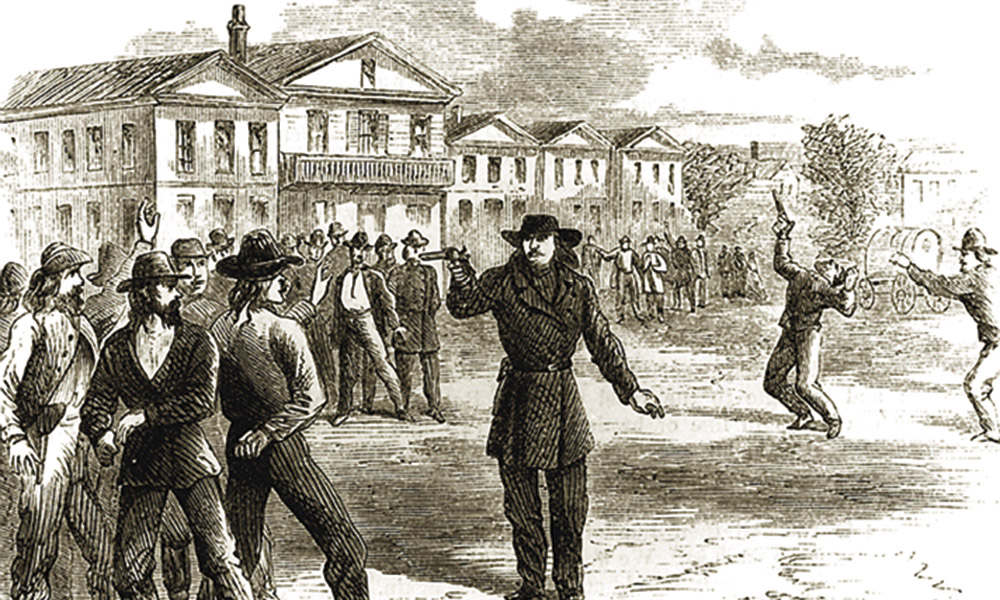
hand, replied that he had shot at a dog. Without further questioning Hickok
drew two revolvers and the two exchanged shots. Coe was mortally wounded while
Hickok was not hit. Mike Williams, hearing the shooting, hurried around to the
front of the saloon to aid the marshal. Bill, without recognizing Williams,
shot him twice, and he died almost instantly. Coe lingered for several days and
died in great agony.
Cattle being loaded by McCoy's stockyard
There
were a lot of high feelings for this incident, both by the Texas cowboys and
the city’s citizens. However, developing the land north of the railroad, away
from the lawless element south of the tracks had already begun. The sentiment
against the cattle trade grew in strength. The cattle season for 1871 was
almost at an end.
So
was the career of “Wild Bill” Hickok as Abilene’s marshal. He was relieved
of his duties less than two months after the accidental shooting.
The
accidental death of Deputy Williams was an event that haunted Hickok for the
remainder of his life. This incident was the last time Hickok was ever involved
in a gunfight.
My recently published book, Abilene Gamble, is mostly set in Abilene, Kansas, in
the summer of 1871—the same time Hickok served as city marshal. While many
books portray Hickok in heroic terms, based on what I learned in my research, I
did not. Here is an excerpt:
 From the look on Ollie’s face, Harry could tell he was
reluctant to be there. He was no doubt torn between his loyalty to his boss and
his friendship with Harry. Once Hickok and Ollie Thompson stood a mere ten feet
away, Harry stepped next to Nathan before he turned and greeted them. “Good
morning, Marshal Hickok, Deputy Marshal Thompson.” He nodded to the two lawmen
before focusing on Hickok. “Kind of early for you to be about, Marshal. We’re
not used to the pleasure of your presence in this part of town.”
From the look on Ollie’s face, Harry could tell he was
reluctant to be there. He was no doubt torn between his loyalty to his boss and
his friendship with Harry. Once Hickok and Ollie Thompson stood a mere ten feet
away, Harry stepped next to Nathan before he turned and greeted them. “Good
morning, Marshal Hickok, Deputy Marshal Thompson.” He nodded to the two lawmen
before focusing on Hickok. “Kind of early for you to be about, Marshal. We’re
not used to the pleasure of your presence in this part of town.”
Ollie Thompson acknowledged the greeting. “Mr. Bradford.
Mrs. Butler. Mrs. Schoenfeld.”
“Mrs.?” His eyebrows raised, Nathan turned to his sister.
“I’ll explain later.” Whispering, Stella stared at her
feet.
Marshal Hickok struck a pose Harry guessed was intended to
intimidate. “Hear-tell you brought a wanted man in with you this morning, Mr.
Bradford. How come he’s not in my jail?”
“Because he’s my responsibility, Marshal. He’s not wanted
in Abilene or in any Kansas town. He and I will be on the train and out of your
hair first thing tomorrow.”
“That’s not how it works.”
“It’s exactly how it works, Marshal. He’s my capture, I’m
taking him in, and I’m the one who has control of him until such time as I turn
him over to the police in Indianapolis. I don’t need him in your jail where one
of your deputies or their friends can help themselves to him and go after the
reward.”
“I consider that an insult.”
“No offense to either of you gentlemen, of course, but I
can’t control everyone who walks through that jail. I consider putting Mr.
Schoenfeld in there a risk I’m not willing to take.”
“And how did you know about him and the five-hundred-dollar
reward, Mr. Bradford?” The marshal drawled out Harry’s name in an insulting
manner.
Harry tried to ignore Stella’s look of dismay. He suspected
she blamed herself, since she had trusted him enough to give him the
information he needed to find her brother.
“I didn’t find no wanted poster for him. Mr. Thompson,
here, said you were looking through the stack just before you left. Did you
take it out of my desk?”
Harry casually reached into the inside pocket of the
trail-dusty vest he had put back on over a clean shirt. He pulled out the
crumpled wanted poster and held it out to the Marshal. “Just borrowed it,
Marshal. I got all the information I needed off of it, so you can have it back.
Might as well toss it, though. Once I return Mr. Schoenfeld to Indianapolis, it
won’t be any good, anymore.”
“I don’t like how you work, Bradford. Never have.”
“Feeling’s mutual, Marshal. But as long as we stay out of
each other’s way, we’ll get along just fine. Once I board the train with my
prisoner tomorrow, you won’t have to worry about me for a while.”
“Your prisoner? I’m the law.”
“You’re a fast gun hired to maintain order, Marshal, and we
both know it. As a member in good standing of the Kansas bar, I’m an officer of
the court. I know what I can legally do, and what I can’t.” And I know I’m stretching it to the limit. Harry
held his breath as he waited for Hickok’s response.
You may find the book description and purchase link for Abilene
Gamble by CLICKING HERE.
In addition, I’m pleased to announce that today is release
day for Indianapolis Justice. The
saga of Harry and Stella, as they seek justice for Nathan, continues. To find
the book description and purchase link, Please CLICK HERE.
Sources:
https://www.kshs.org/p/kansas-historical-quarterly-abilene-first-of-the-kansas-cow-towns/12833
; Cushman, George L.; Kansas
Historical Quarterly - Abilene, First of the Kansas Cow Towns. August
1940 (Vol. 9, No. 3), pages 240 to 258. Transcribed by lhn;digitized with
permission of the Kansas Historical Society.
https://en.wikipedia.org/wiki/Wild_Bill_Hickok
https://truewestmagazine.com/wild-bill-truth/