Showing posts with label Dodge City. Show all posts

Thursday, April 16, 2026

Gun Control in the Old West


  In popular imagination, the Old West of the 1880s is often pictured as a lawless frontier where everyone carried a gun at all times. But for many Western towns trying to establish order and attract families, business, and investment, gun control was not only present--it was taken seriously.  Places like Dodge City, Tombstone, and Deadwood adopted local ordinances that restricted the carrying of firearms within town limits. Visitors were often required to check their weapons with the sheriff or at a saloon upon entering town, a practice that reflected a broader desire to reduce violence in rapidly growing communities.


 These measures weren't driven by abstract political ideology so much as practical necessity. Frontier towns were filled with a mix of cowboys, miners, merchants, and travelers, many of whom were armed and living in close quarters. Disputes could quickly escalate into deadly encounters if weapons were readily at hand. By enforcing gun restrictions in populated areas, local authorities aimed to prevent spur-of-the-moment violence, especially in saloons where alcohol and tempers mixed freely. Lawmen like Wyatt Earp and Bat Masterson became known not just for gunfights, but for enforcing these rules and maintaining a semblance of peace.


For Western readers today, the history of gun control in the Old West offers a more nuanced picture than the myth suggests. Firearms were certainly a part of daily life on the frontier, especially for hunting, ranching, and self-defense in remote areas. Yet within town limits, many communities recognized the need for boundaries. Rather than representing a contradiction, this balance reflected a practical understanding of freedom and responsibility--one shaped by the realities of life in a developing and often unpredictable landscape. 

Till next time.

Sandra


 Available at Amazon
 

Tuesday, March 23, 2021

Welcome to Dodge City

I've been discussing famous marshals in my last few post. However, it's the towns that made the marshals famous. Since most of us grew up around TV, probably the first western town that comes to mind is Dodge City, the home of Marshal Matt Dillon. But, what was Dodge really like?

Dodge City wasn't in the beginning. It was an area that belonged to Mexico in which the Santa Fe Trail meandered through. A U.S. fort - Fort Mann- was established in 1847 and it was the first town or settlement that was no made up of indigenous people. So, it should not be too surprising that no more than a year later (1848) an attack by Native people caused the collapse of the fort. The army sent more men in 1850 and created Fort Atkinson only to abandon it in 1853. It wasn't until the end of the hostilities between North and South that a more robust attempt was made to tame the area. 1865 brought a new fort named Fort Dodge and while the ''Indian Wars" were breaking out, it remained until 1882.

The town itself, began on a cattle ranch owned by Henry J. Sitler, who built a sod home in order to watch over his cattle operation. The area held importance because it was between to means of travel, the Santa Fe Trail and the Arkansas River. Travelers used the home as a place to stop off before venturing toward the west coast. With cattle, travel, and constant movement of people, it wasn't long before the railroads came and Dodge City was a stop. With thousands of head of cattle moving toward the rail lines, it wasn't long before Dodge was considered "Queen of the Cow towns".

With such notoriety, those looking to prosper legally or illegally stepped in. Gunfighters worked the saloons, gambling halls, and brothels. Two of the most famous homes to soiled doves were the Long Branch Saloon and The China Doll brothel. For gentleman's entertainment in 1884 the town boasted two bullfighting rings with specially chosen Longhorns.

But the expansion of the west was continuing toward the coast and by 1886, Dodge became nothing more than a sleepy little dot on the rail line.


Tuesday, November 11, 2014

The Wickedest Cowtown in Kansas

“Abilene was the first, and Dodge City was the last…but Ellsworth was the wickedest cattle town of them all.”


US Army Troops at Fort Harker - 1867

When we think of “the wild west”, we often think of the geographical regions around Wyoming, Montana, Colorado, Texas, and Arizona. Let’s not forget Kansas, though. Located in the center of the continental United States, the state of Kansas was – and is – a major transportation hub for the distribution of goods throughout the country.

Back in the day, of course, that meant cattle, and visitors to the state of Kansas today can still visit the towns that grew up along the railroad lines. Everyone knows of Abilene, and of course, we’ve all heard of Dodge City. But what about Ellsworth, Kansas?

Once the home to several Native American tribes, the area became a dangerous place as the Santa Fe Trail cut through the “Smoky Hills” region. The Cheyenne and other tribes raided wagon trains and stagecoaches, and soon Fort Ellsworth was constructed for the protection of travelers.

Soon, a small town had sprung up around the fort. Although the fort was re-named Fort Harker, the town became known as Ellsworth, and when the railroad completed a line to the fort in July, 1867, the little community boomed, quickly swelling to a population of two thousand.

The early years were marked with difficulties. In addition to continued raids from Indians, the town faced a cholera epidemic, and severe flooding from the Smoky Hill river. Yet it survived.

From 1871 to 1875, Ellsworth served as a thriving cattle market, dominating the other “cowtowns” in Kansas. Along with the rough frontiersmen and hard-working cowboys who called Ellsworth home, a wild and wicked population of gamblers, outlaws, and prostitutes were drawn to the town.

It wasn’t long before Ellsworth had gained a reputation as a “wild and wooly” place.  In addition to drunken cowboys and occasional shoot-outs, the town was subjected to violence and havoc from a gang led by two men, Craig and Johnson. The set out to take over and to establish a “reign of terror” with their desperado deeds. They robbed, they killed, they bullied.

Finally the good folks of Ellsworth set out to put an end to the terror and rid the town of such “vermin”. A vigilante committee was formed, and it was agreed that the best way to solve the problem was to get rid of the gang’s leaders.

Both Craig and Johnson were captured, taken to the Smoky Hill, and strung up on the limbs of an old cottonwood tree growing along the river’s banks.  Their cohorts took note and figured it might be a wise thing to pack up and move on.

Even with the outlaw gang routed, the town of Ellsworth saw its share of excitement. Tales of gunfights, hangings, and fortunes won and lost at the gambling tables are legendary. Wild Texas longhorns were driven through the streets toward the Kansas Pacific stockyards. Cowboys rode hard and played hard, spending their hard-earned wages at one of the many saloons.

The shipping pens closed in 1875, but the reputation Ellsworth had gained has lived on. Today, the area is home to about three thousand residents who live peaceful lives as ranchers and farmers.
Visitors can learn of the town’s rich history at many museums and other tourist attractions, including the Ellsworth jail, built in 1873. Oh, the stories those walls could tell!


Of course, the walls themselves can’t speak, so fortunately today’s western writers are taking pen in hand to tell the tale of Ellsworth, Kansas. Those of us who write romance can’t resist throwing in a little love along with the lust. 

For more information on Ellsworth, you can also make a virtual visit through Facebook: 


I hope you've enjoyed this trip back in time! 

Until next month... Christina                          

Wednesday, April 2, 2014

Dodge City, Kansas


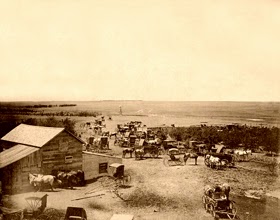
Dodge City Gathering

Dodge City. The name itself conjures up images of saloons, brothels and gun fights in the street. Wyatt Earp and his brothers come to mind. So do Bat Masterson and Bill Tilghman. But long before these men brought law and order to the notorious cowtown, Dodge City started out as nothing more than an army post.

Fort Dodge was established in 1865 along the Santa Fe Trail. The main objectives of the army was to keep wagon trains and the U.S. mail safe from attacking Indians and to serve as a supply base for detachments participating in the Indian wars. The Cheyenne, Kiowa and other tribes populated the area, as buffalo and other wild game were abundant. Six years later, at the foot of a hill west of the fort, Henry L. Sitler built a three-room sod home. Sitler was a cattle rancher and his home quickly became a twenty-four hour stopover for travelers and buffalo hunters.

George M. Hoover arrived shortly after Sitler and opened Dodge’s first business; a saloon. After Hoover, a group of businessmen from Forts Dodge, Riley and Leavenworth organized the Dodge City Town Company. The company began the planning and developing of the town. Originally, they named the settlement Buffalo City, but since a town with that name already existed, they changed the name to Dodge City. The Atchison, Topeka and Santa Fe Railroad arrived in September 1872 and Dodge grew rapidly in size and population over the next few years.

Buffalo hunters, railroad workers, soldiers and drifters came to town, packing the saloons, dance halls and brothels. Laws didn’t exist and the military had no jurisdiction. Gunfights abounded, with men dying in their boots; hence the need for a burial place. Boot Hill Cemetery was developed and remained in use until 1878. Before that, men were buried wherever a hole could be dug, or, if he had friends or money, he was buried in the post cemetery.

Buffalo Hide Yard 1878
Dodge City was known as the Buffalo Capital, until mass slaughters destroyed the herds. By 1875, the Buffalo were gone, and so was the source of income for local farmers who gathered the bones and sold them for profit. The bones were used to make china and fertilizer. Luckily, the cattle trade shifted from Ellsworth and Wichita to Dodge City, keeping Dodge from going belly-up. But along with thousands of Longhorn making their way to Dodge in a ten year span came more lawlessness in the form of cowboys. The mayor contacted Wyatt Earp, who was a lawman in Wichita at the time, and asked him for help, offering an unheard of salary of $250 per month. Wyatt took the job and hired four deputies to assist him; Bat Masterson, Charlie Basset, Bill Tilghman and Neal Brown. 

Peace Keepers
Wyatt Earp and his deputies assessed the layout of Dodge and the best course of action to bring law and order to the town. Earp initiated a ‘Deadline’ north of the railroad yards on Front Street. The area north of the deadline was mainly commercial business and it was his intent to keep this area quiet. South of the ‘Deadline’ consisted of saloons and brothels. A gun ordinance went into effect banning guns from being worn or carried. Those on the south side who didn’t cotton to the new ordinance carried on as usual.
The term ‘red light district’ sprung from here, as railroad men carried their red caboose lanterns at night to visit the brothels. With so many disobeying the new ordinance, Earp soon found his jail cells full.

Earp left Dodge for a while to track famed outlaw Dave Rudabaugh. When he returned, he was made marshal of Dodge City and asked the courts for more severe sentencing. He also organized a committee similar to modern day neighborhood watches to police the streets. Ed Masterson became the assistant marshal in June of 1876. His brother Bat became under-sheriff. In January 1878, Bat became the sheriff, and Wyatt Earp left Dodge in 1879. The Santa Fe rail line reached Santa Fe in 1880, bringing an end to the use of the Santa Fe Trail and to people traveling to Dodge. At the same time, the Indian tribes were housed on reservations and there was no further need for a military presence. Fort Dodge closed in 1882 and the cattle drives ceased in 1886. Today, Dodge City is home to approximately 30,000 people. 

Monday, March 18, 2013

Cowboy Capital

www.laurirobinson.blogspot.com


Cowboys lived, rode, and tamed the entire area west of the Mississippi River, but only one town became known as the Cowboy Capital. 

Dodge City, Kansas, also known as the Queen of Cowtowns was incorporated shortly before the Santa Fe Railroad arrived. At the time, the booming business was buffalo bones and hides. The town also provided a social gathering place for the soldiers from nearby Fort Dodge.  (Fort Dodge was the first fort opened after the Civil War offering protection for wagon trains, mail service, and serving as a supply base for troops engaged in the Indian Wars.)

By 1872 when the building of the Atchison, Topeka, and Santa Fe railroad drew closer, the town was waiting, practically already bursting. It’s said this is where the red light district was born, from the railroad workers carrying their red caboose lanterns with them when visiting the ‘soiled doves’ already well established in Dodge.

The military had no jurisdiction in Dodge, so there was no real law enforcement in the town. Railroad men, buffalo hunters, soldiers and drifters were known to settle their disputes with their guns, and the infamous Boot Hill cemetery was hastily created for those who “died with their boots on.” Others, those with money, friends, or community standing, were buried in the post cemetery at Fort Dodge.

With the only free bridge crossing the Arkansas (pronounced ARE KANAS in Kansas) River many wagon trains and settlers used the route taking them through Dodge while traveling west.  Once the railroad arrived, there wasn’t even time to build a depot (they used a box car as one) before shipping in and out of Dodge reached unbelievable records. Wheat, hides, meat, and flour filled dozens of cars each day, and the streets were packed with those bringing in things to be shipped, or picking up arriving supplies. Not even mining camps could compare to the riches being made in Dodge at the time. Everyone seemed to have money and nothing in town cost less than a quarter. When Governor St. John was visiting Dodge City on one occasion, he heard of a tornado that had devastated a little town near the Nebraska state line. Within two hours he raised over $1,000 from Dodge City residents and immediately wired the money to the other town.

The first jail house in Dodge City wasn’t a building at all. It was a dried up well, fifteen feet deep, in which offenders (mainly those who’d had too much to drink) were lowered into, and once they sobered up, they were allowed to use a ladder to climb out and be on their way. Dodge City was also known for its chivalry to women. All women were held at high esteem. If a man—any man—was witnessed (even unintentionally) jostling a woman, he was instantly ‘brought to his senses’ by a local bystander.
 
In 1875 the cattle days were born and for the next ten years Dodge City became the destination for many. Over five million head of cattle where driven up the Chisholm (western branch), the Great Western, or the Texas trails that all led to Dodge. Records indicate about 1200 people lived in the city proper in 1877, however the population varied, more than doubling as summer drew near the drives arrived. Gamblers, cattle buyers, prostitutes and others picked those opportune times to call Dodge home for a few months, and with nineteen establishments licensed to sell liquor, there was always a place to conduct business. 

Well-known lawmen and gunfighters took their turn in Dodge- Wyatt Earp; Bat, Ed, and Jim Masterson; Doc Holliday; William Tilghman; Clay Allison; Ben and Billy Thompson; Lake Short; to name a few.

Fort Dodge closed in 1882 and a few years later the cattle drives ended, but Dodge City remained strong. Due to its location and the numerous railroads, it continued to be one of the greatest overland freight hubs in the country, serving local cattlemen and farmers as well as many other businesses.

Made famous again by the TV series Gunsmoke, Dodge City has never lost its ability to draw in the curious. Still today, over 100,000 tourists visit Boot Hill and the historic Front Street.

Having grown up in southwestern Kansas, I’ve visited Dodge City many times, and never failed to have a wonderful time. 

All five of The Quinter Bride books—Shotgun Bride, Badland Bride, Boot Hill Bride, Guardian Bride and Wild Cat Bride--which are all currently on sale for just $2.99—were set in and/or around the Dodge City region.