Friday, May 2, 2014

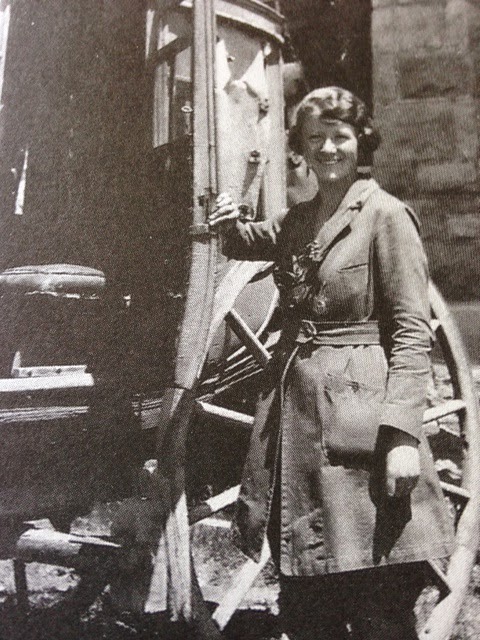
A Girl Ranger!


In 1872, Yellowstone became the nation’s – the world’s – first national park. The concept was so new, Congress had no idea what to do with the park once it was established. For twenty years, people continued to exploit and destroy the features that Washington tried to protect, because there was no one who would protect them. The army was finally called in in the 1880’s to protect the thermal features and the animals. In 1916, the National Park Service was established, and the army handed over control of the park in 1918.
Although women married to National Park Service personnel had assisted their husbands for years as unpaid help (like the military, it came with the territory), the first woman to be “officially” employed by a park was a California school teacher by the name of Claire Marie Hodges. She worked as a seasonal naturalist, and was soon followed by two more women, one of whom would make history in her own right.
Born on October 2, 1901 at Mammoth Hot Springs in Yellowstone National Park, Jane Marguerite Lindsley was destined to help shape the park’s history. She grew up during Yellowstone’s “old army days,” to cannons booming at sunrise and sunset, and yellow stagecoaches pulled by teams of mules taking visitors along the bumpy roads in the park. Always adventurous and daring, Marguerite remembered that her most memorable escapade as a youngster was the thrill of trying to stay on a runaway Indian pony.
Because there was no school at Mammoth for the children of army officers and park employees, she was homeschooled by her mother though the eighth grade. At fourteen, she entered prep school at Montana State College, and finished high school in three years. She continued her studies there and she took four years of pre-med work, majoring in bacteriology.
Marguerite spent her school breaks in Yellowstone, but the summer between her junior and senior year in college was very different. She was going to work as a ranger and get paid for explaining the wonders of Yellowstone to park visitors. In June of 1921, newspapers around the country reported that Miss Marguerite Lindsley had been chosen to teach tourists about Yellowstone, but more importantly that she had been awarded the official title of National Park Ranger. Two other women had been awarded the title previously, but Marguerite would become the first woman, three years later, to attain a full-time ranger position in the park.
She was described as an “honest-to-goodness outdoor girl, and experienced horsewoman, and a master of the technique of camp life,” and did not fit the profile of the average American girl.  She herself once remarked that it must have been a mistake that she was not born a boy. “I love the work of the rangers, and if I were a boy, I would make the park service my life’s work. It was born in me, I know it.
After graduating college, she applied unsuccessfully to medical school in Philadelphia, but was accepted into the Masters Program in Bacteriology. She accepted a position with a research Laboratory, but soon realized that she wanted to return to Yellowstone. “I could almost smell the melting snow and growing things, and feel the thrill of an early morning horseback ride.” So, she returned to Yellowstone, riding her Harley Davidson on a 2600 mile cross-country trip, which she described as “next to the greatest escapade of my life.”
From Harleys to horses, Marguerite made the park her permanent home. One summer, she accompanied “Uncle Howard” Eaton on a three week horseback trip through Yellowstone that included 200 horses and 125 people, 75 of which were tourists. She offered to guide tourists through the Gibbon Paint Pot (now called Artists Paint Pots) area, and broke through the crust of a thermal area where she found herself in boiling clay up to her knee. This experience not only gave her third degree burns, but also the nicknames “Geyser Peg” and “Paint Pot Peg.”
In late December of 1925, she was offered her dream job: the position of permanent ranger. She would assist the park service’s newly formed educational division.
In 1926, however, her dream was nearly shattered. Chief Inspector J.F. Garland, Assistant to the Secretary of the Interior visited the park . His report stated, “We do not believe that a woman is physically suited for the arduous duties of a ranger and that the service, which is already undermanned, suffers by the loss of what a qualified man in her place could perform. It is recommended that women rangers not be employed….
 Lucky for her, Park Superintendent Horace Albright ignored the recommendation.
Ironically, among all this controversy of women rangers, an article was published about Marguerite in the Christian Science Monitor in 1927. “Lady Ranger ‘Makes Good’ in Yellowstone Park Post, Only Girl among 24 men…” While her position was stirring up Washington, her position as “full-fledged park ranger” was making her a celebrity in the news. Obviously impressed by her qualifications as a superb horsewoman, botanist, sometime attendant to orphan antelope, elk, and bear cubs, and all-around outdoor woman, reporters contended that she “fully deserved the commission which had been conferred to her.”
Marguerite was not only adventurous and educated, but she was attractive as well. She had many male admirers throughout the years, most of which she kept under her hat.  Literally. The inside of her wide-brimmed ranger hat held the signatures of at least a dozen hopeful suitors. A fellow ranger recalled that she “could marry anybody she wanted. She could marry any of us.” More than likely, all of her male suitors were well aware that marrying Marguerite also meant having the spirit and vitality to keep up with her.
On April 17, 1928, she did marry – Ranger Everett LeRoy (Ben Arnold), who was stationed at Mammoth. She defied the expected conventions of the traditional wedding day in her own signature style when she “dressed in a blue gown and wore a corsage of roses.”
Because she couldn’t keep her full-time position that would allow her to live in the same location in the park as her new husband, she resigned from her position in Mammoth and opted to work only seasonally.
For the next 25 years, the couple lived and worked in Yellowstone. Marguerite died on May 18, 1952. Throughout her more than fifty years of residency in the park, life in Yellowstone never left her at a loss for entertainment and she firmly believed that the park was the “country’s greatest wilderness playground.” For her, it was a place where a young girl’s as well as a woman’s heart, soul, and imagination could all take wing and soar above the conventions of the day.


Tuesday, April 29, 2014

Check Out Our New Design on CK and New Promo Ideas elsewhere

It's a free day of the month and it appears no one is blogging, so I thought I'd take advantage and share the new background design done by Alison Bruce.  She created the snazzy bookshelves featuring covers of our participants. I'll be updating the video soon, but I'm waiting for more covers.  Today,  I'm also going to share a blog I posted on Dishin' It Out (mizging@blogspot.com) in case anyone has an interest in sharing your work.  The genre doesn't matter.  It's a chance for you to share six paragraphs from your work (published or WIP) on your own blog, but just email me the link so I can compile a list on my blog for readers to visit.

Hope to hear from you.  Drop me at line at mizging@gmail.com if you'd like to be included this coming Friday. Please put Friday Freebits in the subject line.


Monday's Blog on Dishin It Out:

Sadly, I must announce the end of Sunday Snippets.  Although I have some great friends who have willingly participated, the use of the Linky List has been more confusing than helpful.  Yesterday, when I went to comment on blogs, I found the wrong lists added to some people's post, no banners or links, and in some cases, people didn't bother to post.Can't say that I blame them!  I chalk all these mistakes up to my own y inability to figure out how the link works.  As a matter of fact, I thought I had it figured out, and today when I went into the blog, the entire list of those who had signed up last week was missing.  I went into the Linky List Tool and manually added this list back, but even then I found discrepancies.

My second reason is competition.  The recent addition of a new western blog who has also chosen to do 'Saddle Up for Sunday Snippets' will be confusing...as well as another group sharing the same name.  Now I've figured out something else...Friday Freebits.  If you would like to continue sharing six paragraphs of your work for free promo, then let me know.  Instead of using the linky list (for which I have to pay), I'll just ask that you notify me via email each week with your name and link. ADDED:  If you want to be a regular participant, I'll just continue to add you unless I hear differently. Seems I've doing everything manually, anyhow...so I might as well make it legit.  *lol*  If enough of you want to continue...we can use this pretty graphic.


The rules will remain the same.  Share six paragraphs, use the graphic and just post a link back to my blog for the list...this way, there won't be any errors. So...email me at mizging@gmail.com and let me know if you want to have a permanent fixture for your Fridays.  It sure makes things easier for me to plan ahead.  I can schedule the blog and be ready. PLUS...the blog will remain all through the weekend, giving more people the ability to visit.

****
Also, I have places available on Wednesdays only, "A Page Straight From."  On this feature, I asked participants to supply the most enticing page from one of their books to draw the readers in for more, and I need cover art and a buy link.  This one will appear on my blog, but I promote well, and with Triberr, your post will be shared many many times.  Let me know if you're interested at the email listed above....please put A Page Straight From in the subject line so I don't get confused.

Thanks for letting me veer from the norm.

Monday, April 28, 2014

SINGLE WOMEN HOMESTEADERS?


What do you think of when you think of homesteading the West? I think of families or lone men. However, in Marcia Meredith Hensley’s book. STAKING HER CLAIM: WOMEN HOMESTEADING THE WEST, I learned that many lone women became homesteaders.

I read the Women of Paragon Springs series, by Irene Bennett Brown, and loved the stories of women making their way West to set up their homes. What I didn’t realize, though, was how true-to-life Ms Brown’s stories were.

Available from Amazon HERE


Ms Hensley’s book relates many women settling in Wyoming Territory. And why not? Wyoming was far ahead of the rest of America in recognizing a woman’s right to vote and other basic rights. But other of her stories take place in Montana, South Dakota, North Dakota, Idaho, Colorado, and Utah.

As you can imagine, these women set out for the West for various reasons. Some were ill-equipped for the hardships. Others flourished in their new enterprise.  Ms Hensley includes letters written back East by some of the women homesteaders telling of their experiences. Fact or fiction?

On the whole, women who wrote about their experiences homesteading alone told positive stories. . . Although homesteading was difficult, they achieved success and had many enjoyable adventures as well. Women could do most of the work themselves, but, if necessary, they could count on help from neighbors, family, or one of the many men in the vicinity.”

Sod house in Kansas
Only about one in three women who homesteaded actually succeeded. In a 1921 article about her homesteading experience in Utah, Kate Keizer includes a section titled “Not All Roses” in which she cautions that for the typical homesteader without much money “the first two or three years are usually accompanied by privation and hardships.” She lists difficulties such as the high cost of freighting supplies in and having your claim contested if you were absent very long. Her greatest torments were the hordes of rabbits and prairie dogs that destroyed gardens in spite of scarecrows, guns, and poison.

Looking back on her homestead experience, Dr. Bessie Rehwinkle tempered her account of the exhilarating experience of becoming a Wyoming landowner with the admission that “it is not as easy or glamorous as the storybooks about the westward trek of the covered wagon often picture it. It is a slow process and a hard day-to-day struggle, and only the strongest are able to survive.”

Dugout on the Oklahoma Prairie
Do you suppose all six women and
the baby lived in that dugout?
The Homestead Act was in force from 1862 through 1976 (with a ten year extension for Alaska). Statistics provided by the National Homestead Monument suggest two million people attempted to earn a patent on land through the Homestead Act. Ms Hensley theorizes that 200,000 of these were women, of which 67.500 may have proved up on their claim.
I suggest reading Marcia Meredith Hensley’s book for fascinating non-fiction accounts of women homesteaders who were successful. For fictional accounts, nothing beats Irene Bennett Brown’s Women of Paragon Springs series: LONG ROAD TURNING, BLUE HORIZONS, NO OTHER PLACE, and REAP THE SOUTH WIND.


What about you? Would you have attempted to claim you land alone?  

Friday, April 25, 2014

The Good the Bad and the Soapy

By Alison Bruce
He was the very model of a modern major criminal.

Jefferson Randolf Smith II, Jeff to his friends, Soapy to his enemies, came from a family of wealth and privilege. His grandfather was a Georgian plantation owner. His father was a lawyer. Until the Civil War, they had everything. By the end, they had lost it all.

The family moved to Round Rock, Texas in 1876 to start anew. Two years later, Smith was in Fort Worth to see Sam Bass, the infamous train robber, hang. By family accounts, this was a pivotal moment for Smith. When his mother died shortly after, Smith left home to return to Fort Worth and the start of his life of crime. Starting out with the basics - Three Card Monte and the ever popular shell game, soon he was known as the "king of the frontier con men".

Soapy sells in front of the Union Depot 
The con that gave him his nickname was dubbed "The Prize Soap Racket".
Piling ordinary soap cakes onto the keister* top, he began expounding on their wonders. As he spoke to the growing crowd of curious onlookers, he would pull out his wallet and begin wrapping paper money, ranging from one dollar up to one hundred dollars, around a select few of the bars. He then finished each bar by wrapping plain paper around it to hide the money.

He mixed the money-wrapped packages in with wrapped bars containing no money. He then sold the soap to the crowd for one dollar a cake. A shill planted in the crowd would buy a bar, tear it open, and loudly proclaim that he had won some money, waving it around for all to see. This performance had the desired effect of enticing the sale of the packages. More often than not, victims bought several bars before the sale was completed. Midway through the sale, Smith would announce that the hundred-dollar bill yet remained in the pile, unpurchased. He then would auction off the remaining soap bars to the highest bidders. (http://en.wikipedia.org/wiki/Soapy_Smith)
 [* keister: a suitcase, bag, or box for carrying possessions or merchandise. "Tripe and keister", aka tripod and suitcase, were the basic tools of con men and salesmen (sometimes both in the same person). Later the keister came to mean buttocks when "move your keister" and "fell on his keister" shifted into less literal usage.]


Soapy Smith, 1898
Smith had a gift for organization. In Fort Worth, he started gathering his team of bunco artists, each with their own specialties in the art of separating the mark from his money. In Denver, he combined their assets and parlayed them into a criminal empire that included bribed policemen, suborned judges and the best lawyers money could buy. He owned The Trivoli Club, where porters and guides were paid to steer newcomers so they could be fleeced.
As a legal loop-hole for the crooked gambling in the Tivoli Club Soapy placed a sign at the entrance that read CAVEAT EMPTOR, Latin for "Let the buyer beware." It is probable that few of his victims heeded the warning and fewer still could actually read Latin. (http://www.soapysmith.net)
Bribes and legal loopholes weren't the only thing that kept Jefferson Smith going. He might never have earned an honest buck, but he earned the loyalty of his gang and, to a certain extent, the community.
When a member of the Soap Gang needed help Jefferson was always ready to lend a hand, whether it be money or legal aid. The men in the gang grew extremely loyal to their boss. At times the policemen on the beat also sought his aid, in help with situations where they had little power. This often occurred in hard economic times when the poor population grew too large. The police called on the gambler's of Denver to help with feeding the poor and Soapy's name was always at the top of the list and rarely did he let them down. Jefferson had become so well known as a charitable man in Denver that Parson Tom Uzzell of the People's Tabernacle church often sought Jefferson's assistance, even knowing of Soapy's criminal occupation. While giving a tour of the city one day, the parson and his entourage came across Soapy. The good parson introduced Soapy as "The most infamous confidence man in American...and my friend." (http://www.soapysmith.net)

Smith's built three criminal empires. The first was in Denver, Colorado. When he and the Soap Gang were kicked out of Denver, they set up in the mining town of Creede, Colorado, which Smith pretty much took over. Once again, Soapy Smith's influence wasn't all bad.
There was plenty of wild life, hell raising, and general disorder at first glance. Yet there was little violent crime relative to other similar boom-towns of the era. Some historians state that it was Soapy's control over the underworld that helped keep the peace. Trouble makers were sent packing. Even Bob Ford (killer of outlaw Jesse James) and soap gang member Joe Palmer were banned from the town for going on a drinking binge and shooting up the town. After a short period, Soapy had a hand in allowing them to return to the town. (http://www.soapysmith.net)

With the Klondike Gold Rush, Smith and company moved to Skagway where he set up his last, and possibly most colorful criminal empire. This is where I learn of Soapy Smith, first while touring the sites and later in connection with Vicki Delany's historical crime novel Gold Mountain (no relation to my short story of the same name).

Next month: The Slippery Slope of Soap


Wednesday, April 23, 2014

The Plant That Ate The South

I know I promised more from Lakota Woman this week, but I've been sick for three weeks and haven't progressed in my reading, so that will have to wait until I can concentrate.

Although this post isn't purely western-based, I did have to wonder if those who lived in the late 1800s noticed what they had started.

I was stirred to this topic by sharing a video with my husband about a dangerous plant that is overtaking Michigan.  Even touching it can cause blindness or  irritating and scarring skin lesions.  How scary is that? We have another problem in the South so we don't need a dangerous hogweed attacking us as well.

 I recall when we first visited Tennessee, I was so impressed with the different colors of green, specifically the huge vines adhering everywhere.  I later learned that "vine" is called Kudzu.  I've done a little research...as much as a drug-riddled mind can do in my state, and I want to share this interesting information with you.  I'm copying and pasting from Wikipedia, so I credit them with the content of this blog.

Kudzu (Pueraria lobata) is a serious invasive plant in the United States. It has been spreading in the southern U.S. at the rate of 150,000 acres (61,000 ha) annually, "easily outpacing the use of herbicide spraying and mowing, as well increasing the costs of these controls by $6 million annually."Its introduction has produced devastating environmental consequences. This has earned it the nickname, "The vine that ate the South."

The kudzu plant was introduced to the United States in 1876 at the Centennial Exposition in Philadelphia. Kudzu was introduced to the Southeast in 1883 at the New Orleans Exposition. The vine was widely marketed in the Southeast as an ornamental plant to be used to shade porches and in the first half of the 20th century, kudzu was distributed as a high-protein content cattle fodder and as a cover plant to prevent soil erosion. The Soil Erosion Service recommended the use of kudzu to help control erosion of slopes which led to the government-aided distribution of 85 million seedlings and government-funded plantings of kudzu which paid $19.75 per hectare. By 1946, it was estimated that 1,200,000 hectares (3,000,000 acres) of kudzu had been planted. When boll weevil infestations and the failure of cotton crops drove farmers to move from rural to urban districts, kudzu plantings were left unattended.
 The climate and environment of the Southeastern United States allowed the kudzu to grow virtually unchecked. In 1953 the United States Department of Agriculture removed kudzu from a list of suggested cover plants and listed it as a weed in 1970. By 1997, the vine was placed on the “Federal Noxious Weed List”. Today, kudzu is estimated to cover 3,000,000 hectares (7,400,000 acres) of land in the southeastern United States, mostly in AlabamaGeorgiaFlorida, and Mississippi. It has been recorded in Nova ScotiaCanada, in Columbus, Ohio, and in all five boroughs of New York City.  NOTE From Ginger...let me tell you, it's everywhere in TN, too.
Kudzu is a perennial vine native to Southeast Asia, primarily subtropical and temperate regions of ChinaJapan, and Korea, with trifoliate leaves composed of three leaflets. Five species in the genus Pueraria (P. montanaP. lobataP. edulisP. phaseoloides and P. thomsoni) are closely related and kudzu populations in the United States seem to have ancestry from more than one of the species.] Each leaflet is large and ovate with two to three lobes each and hair on the underside. The leaves have the ability to fix atmospheric nitrogen, which can supply up to 95% of leaf nitrogen to the plant in poor soils] Along the vines are nodes, points at which stems or tendrils can propagate to increase support and attach to structures. As a twining vine, kudzu uses stems or tendrils that can extend from any node on the vine to attach to and climb most surfaces. In addition, the nodes of the kudzu vine have the ability to root when exposed to soil, further anchoring the vine to the ground. The roots are tuberous and are high in starch and water content, and the twining of the plant allows for less carbon concentration in the construction of woody stems and greater concentration in roots, which aids root growth. The roots can account for up to 40% of total plant biomass.
Kudzu’s primary method of reproduction is asexual vegetative spread (cloning) which is aided by the ability to root wherever a stem is exposed to soil] For sexual reproduction, kudzu is entirely dependent on pollinators.
Although kudzu prefers forest regrowth and edge habitats with high sun exposure, the plant can survive in full sun or partial shade. These attributes of kudzu made it attractive as an ornamental plant for shading porches in the southeastern US, but they facilitated the growth of kudzu as it became a “structural parasite” of the South, enveloping entire structures when untreated and often referred to as “the vine that ate the south”.


Monday, April 21, 2014

Kansas--The Breadbasket of the Nation


www.laurirobinson.blogspot.com

I hope you all had a wonderful Easter! We had a full house, and lots of fun. And food. I think we ate all day, which is where my idea for today’s blog came from. That and the fact I lived in Kansas for ten years…

Across the state of Kansas you’ll see signs proudly proclaiming Kansas as the number one wheat producer—which is accurate. Since the 1870’s stats have been kept on the wheat production, and the only state closely rivaling Kansas over all the years has been North Dakota.

Wheat is one of the oldest known foods, and is believed to have been derived from wild grasses thousands of years ago. It wasn’t brought to the U.S. until the seventeenth century and not to Kansas until the mid 1800’s. Some early settlers grew wheat, but most grew corn. It wasn’t until a class known as winter wheat proved to thrive in the dry land that the crop really took off. Russian-German immigrants, used to dry land cultivation, started dedicating large portions of their recently acquired Kansas acreage to the plants.

Machinery to harvest the wheat quickly transformed from the hand scythe to horse drawn and steam powered thrashing machines. The railroads criss-crossing the state from the cattle days provided the farmers access to markets and mills. Grain storage also grew rapidly and most every town boasted a grain elevator and mill.

A longtime Kansas farmer was quoted as saying, “Wheat is the crop of first importance. It’s the backbone of our economy, and made Kansas famous around the world.”

Bread was a mainstay, and baked regularly. In some households daily. From a very old family cookbook, here is a basic bread recipe. (My mother used this recipe for years. I cheat and buy the frozen loaves when I have a craving for fresh baked bread.)
  • 1 tea cup milk
  • 2 scoops butter
  • 1/2 teacup warm water
  • 2 spoons active dry yeast
  • 2 big spoons sugar
  • 1 palm of salt (teaspoon)
  • 1 teacup of warm water
  • 6-7 teacups flour
Heat milk and butter until butter melts. Set aside. Mix yeast with the ½ teacup of warm water and stir until well dissolved. Set aside. Put sugar, salt, and 1 teacup of warm water in a large bowl. Mix. Add milk and butter. Add yeast. Add flour one cup at a time until it’s too difficult to mix with spoon. Turn onto floured board and knead in the remaining flour until the dough is smooth, not sticky. (Add flour if needed.) Grease a large bowl with butter. Put the bread dough into the bowl and roll until well coated. Cover the bowl. Let rise. Punch down and knead into loafs. Place in buttered loaf pans. Butter the tops and let rise again. Bake for 45 min at 350.

I have no idea why they signify ‘teacup’, but there truly is nothing like the smell of homemade bread baking! This stove is one my husband bought for me over twenty years ago and sits in my dining room.

One final note...my next book, Never Tempt a Lawman, is set in Kansas and will be released May 1st. 

Western Kansas, 1866

Steady, wealthy and oh-so-safe—that's the kind of husband Bess Trundale wants. Someone like the local banker's son. Someone unlike Sheriff Kirk Landers. The lawman's confident swagger gets right under her skin…and into her fantasies. And though she's tried to ignore the chemistry surging between them, one night is about to change everything.

Kirk isn't planning on being anyone's husband ever again. But months of living under the same boardinghouse roof as quick-witted, feisty Bess have stirred desires he can't ignore. Together they could put their pasts to rest and claim a bold, passionate future—if he can tempt her to break all the rules with him….


Friday, April 18, 2014

Natural Remedies in the 1800's


Happy Friday to you all and so sorry I'm late in posting today. 
I've not been sick like my poor friends, but my children have been battling the flu and you know how that goes. One get's it and then the next and so on. Everyone cannot get sick at the same time that would be too easy.

I've also been busy working on my forth book, a historical and so I've got a bit of brain fog. I love writing historical's for many reasons and one is having the ability to take my reader back to a time and place he or she never knew, the other reason is I get to go there too. 

There is always a lot of research involved and if I can be honest, I only use a quarter of what I've learned in my books. With my last novel, LAKOTA HONOR I needed to know about the Lakota Sioux and I delved into their culture more than I needed to. Ah, yes the plight of a historical writer.  
I learned to love these fascinating people and how they lived. 

With so many of our friends battling sickness I thought I'd share with you what the Lakota Sioux used to ward off most of their ailments. Below are some of the herbs and roots to help cure stomach aches, sore muscles and the common head cold.


PejiHota ape Blaskaska—Flat leaked sage—Wild Sage

Leaves are boiled and drank for upset stomach, and colds.
This plant was also used for religious ceremonies.


Pejuta NatiyaziLya—Incense for head—Purple Mallow|

This was an important plant for the Lakota. When the root was burned the smoke was inhaled for head colds, or used to bathe aching muscles. The patient stands with a blanket over their heads in front of hot coals in which the plant is laid on top. The patient then inhales the smoke into their lungs for relief of their symptoms.
This plant is known to smell like coconut.


Sinkpe tawote—Muskrats food—Sweet Flag or Bitterroot

This is the Lakota’s most traditional medicine. Found in the shallow parts of lakes and rivers. The plant has been used to cure almost every known illness, but its dominant uses are for cold congestion, sore throat, and upset stomach. The root can be chewed or drank.


Pe’ tuntunpa—Slippery Elm

Found in elm trees, the bark is used for numerous illnesses. The bark is ground into a powder and added to water makes a paste to spread onto burns, skin wounds, cold sores, boils, abscesses and toothaches. Placed in a cup of boiling water the Lakota people would drink it to help with ulcers, sore throats and stomach ailments.


Witch Hazel

This was used for inflammation and swelling. Some tribes boiled the leaves and rubbed them onto the legs of tribesmen who were participating in sporting games. The boiled twigs could be used to cure aching muscles as well.


Happy Easter!
Kat