Friday, January 11, 2019

Wild Women Novelists who Achieved Historic Firsts

Historic Firsts for Wild Women Novelists

By Jacqui Nelson

Life is an adventure to write about. Here are three Wild Women Writers who wrote about their lives (and the world that challenged them) and created a first novel that was historic...

Margaret Jewett Smith Bailey 

( born around 1812 in Saugus, Massachusetts ) 


In 1854 (writing as Ruth Rover), Margaret published The Grains, or, Passages in the Life of Ruth Rover, with Occasional Pictures of Oregon, Natural and Moral. Part autobiography, religious testimonial, and history and travelogue—The Grains is also considered a novel and thought to be the first published in Oregon

Margaret wrote The Grains as a social protest criticizing her husband (who she divorced due to his drinking and abuse) and Oregon’s Methodist Mission (for its failures including discriminating against women and pressuring her to marry).

In 1846, she became the first local poet to be published west of the Rocky Mountains when her poem Love appeared in the first issue of the Oregon Spectator newspaper.

In addition to being a novelist, Margaret was a teacher, a missionary (traveling to Oregon to join its Methodist Mission in 1837) and a regular contributor of prose and poetry to the Oregon Spectator.

Sophia Alice Callahan

( born 1868 in Sulphur Springs, Texas )


In 1891 (at the age of 23) Sophia published Wynema, A Child of the Forest which is thought to be the first novel written by a Native American woman and the first novel written in Oklahoma (then Indian Territory).

After being shocked by the Massacre at Wounded Knee (which took place six months before she published her book), she added an account of that event and the 1890 Ghost Dance of the Lakota to her novel.

In addition to being a novelist, Sophia was a teacher. Her father (a one-eighth Muscogee-Creek) was also a teacher. Three years after publishing her first novel, she died of pleurisy at the age of 26.

Lydia Maria Francis Child

( born 1802 in Medford, Massachusetts )

In 1824 (at the age of 22) Lydia wrote (in six weeks) her first novel Hobomok, A Tale of Early Times and became an overnight celebrity. Hobomok is thought to be the first New England historical novel.

Although she wrote continually (fiction and nonfiction in poems, journals, periodicals, essays and pamphlets) she had a period where she didn’t publish a novel for ten years.

She wrote one of the earliest American historical novels, the first comprehensive history of American slavery, and the first comparative history of women. She shocked her audience by including the issues of male dominance and white supremacy.

In addition to being a novelist, Lydia was an abolitionist, women and Native American rights activist, and a journalist.

~ * ~

I haven't written a story about a Wild Woman novelist but...after reading about these ladies I feel inspired to. So many stories, and not enough time to write them all! 

Do you have a favorite story about a 19th-century novelist? 


~ * ~

* CLICK HERE to read more Cowboy Kisses Wild Women blog posts *

Read about my stories on my 

Hope you'll join me on… 
Or follow me on… 

Don't forget to download my FREE story with my Newsletter

Fall in love with a new Old West...
where the men are steadfast & the women are adventurous.

Wednesday, January 9, 2019

Is Western History affected by the Telephone Game?

Copyright Information
I truly hated doing research in college. Hours in a dusty library (remember those), looking for answers to someone else's boring questions. Very rarely did I happen on to anything that awakened my imagination. Yet I fumbled forward through bone dry historical texts, praying something poignant would pop out of a book so I could finally finish my report and join my friends at the university pub.
     It wasn't until I became a writer, much later in life, that I learned how interesting research could be. History is amazing. Every event that occurred before set in motion the cause and effect for our modern world. Everything we know, do, have, want, need, and hear has a history to tell. But here's where it gets a little curious. If we take the willy-nilly subjectivity of human nature and mix it with a little innocent exaggeration, how can we be so sure those recollections are the absolute truth?
     How could those well-intentioned historians remain unaffected by time and circumstance and possibly even social pressures the same as you and me? Even an innocent sugar-coating could skew the facts exponentially. What if we've not been given the actual truth but rather the 'opinion' of the author instead?
     One small example, the fairly well-known idiom, Circle the Wagons. My family used it often when I was a child and sometimes even now. If a loved one needed support or protection, we'd come together to help however we could. We'd Circle the Wagons. But several meanings have evolved since it was first coined in the 1800s.
     I always thought it referred to settlers on an old west wagon train who created a circle of protection from raiding marauders. But further research revealed another meaning. Circle the Wagons was the practice of settlers using a circle of wagons to corral their very expensive cattle. Hah? No way. How did that get so mixed up?
     So, I wondered, how do we know what is fact and what is fudged in all things historical? Does it matter if we've learned the complete truth? Or is it better to carry on the slightly watered-down or worse yet, overly dramatized, version for those who follow in our footsteps? Has the recollection of events evolved into something far from the truth as in the fun, yet revealing Telephone Game suggests?
     This is just me going off on a philosophical journey. It makes me thankful I write fiction, so if I miss a fact or two, I'll be okay. What are your thoughts?

Thanks for listening.
Rhonda Frankhouser
Award-Winning Contemporary and Western Romance Author


Tuesday, January 8, 2019

ARCHETYPES, MYTHS AND THE STORY OF THE WEST: part two -writers and screenwriters


Photo (c) by Doris McCraw
Part two of the discussion of writing stories/novels and screen writing. This section deals with some of the similarities between the two and the underlying importance of engaging your reader/watcher.

For those who would like to review the first part, you can access it here: writers and screenwriters

So here we go.
  • Psychological effect
    • It’s important for writers to understand the human psyche. By doing so the writer can effectively communicate their message to their audience.
      • The best stories include both sides of conflict equally, thus allowing the audience to form their own opinions.
When we start a story, we usually have an idea of where we’d like the story to go. As noted above, some of the best stories have multiple views of what is happening. I’ve heard it said a story is only as good as it’s villain. I don’t know how others feel, but in my first published novella, “Home for His Heart”, I felt I needed a villain who was strong enough to force the hero and heroine out of their respective fears. That the villain felt justified in his actions made him even scarier than just a bad person.

    • Symbolic Linkage – Symbolic links are a handy tool for any writer. Most audiences are smart and are have a common culture; therefore writers can effectively use what some audiences might already have been subjected to.
The story of the West has been told by many authors in many different forms. This is also true of the film industry. As we look back to the early western writers and film makers we see a cleaner delineation of good and bad. We can reference events and most will understand the connection. As time has passed, the stories have become more complex, the line between hero and villain have sometimes been blurred. One of my favorite films is the original ‘3:10 to Yuma’ with Van Johnson and Glen Ford. Although you know who the hero and who the villain are, the story adds the element of good in the bad. The remake with Christian Bale and Russell Crowe added more on screen violence and more of the pieces of good and bad for both the hero and the villain. However, if you really want to see how one story can be told is a myriad of ways, read the original short story by Elmore Leonard. It is a great, yet short read.

photo (c) by Doris McCraw
    • Archetypes – Another way to engage your audience is the use of archetypes. In particular the concept of an archetype reveals recurring mental images and/or themes that encompass many different cultures and societies throughout time. One could say that we as humans innately understand archetypes from birth. Character examples might include: The Hero, The Caregiver, or The Wizard. Story specific examples might include: The Hero or The Rebirth.
If there is a more perfect description of the Cowboy as hero, I don’t know what is might be. We have the archetype right there. The Cowboy is the hero, the caregiver and for some a wizard who is there to save the day. When I was writing “Chasing a Chance” my hero was just a man who wanted to find and help the woman he’d always loved. Through the story he learns just how much he was capable of. In some ways, his journey is one of rebirth into who he always was.

    • Myths – With archetypes also comes the use of Myths. Constructing your own myths, legends and saga can also have a big impact on an audience. Myths help make a connection in the same way that both symbolic links and archetypes do. As a myth story unfolds the audience instinctively understands what’s at stake and instantly realizes this is an epic larger then life adventure ahead.

We as Western and Western Romance writers make use of the myths of the West in our storytelling. It is what has drawn us to the genre and keeps us telling its story.

So as storytellers, what part of myth, archetype and symbolic links do you use? I realize I love telling stories of people who come to understand what they are capable of and of making peace with their past. The stories of the West, the journeys and new starts fit so well with the men and women I come to love as I strive to tell their stories.


Doris Gardner-McCraw -

Author, Speaker, Historian-specializing in
Colorado and Women's History
writing fiction as
Angela Raines - author: Where Love & History Meet
For a list of Angela Raines Books: Here 
Angela Raines FaceBook: Click Here


Monday, January 7, 2019

A Brief History Of Cocaine


By Kristy McCaffrey


Indigenous people in Bolivia, Colombia, and Peru have long chewed coca leaves for their mildly stimulating effect. A coca-leaf chewing native could suppress his appetite and work more hours at higher altitudes.


When the Spanish came to South America in search of riches, they focused on the gold and silver deposits in Peru and Bolivia, and soon forced the native population to constantly chew the leaves to make the mining operations more profitable. But until a way could be found to transport the leaves to Europe without them deteriorating, the use of coca leaves was restricted to South America.


In the 1800s, Albert Niemann—a German—was able to isolate the active ingredient, and it was he who named it “cocaine.” In 1860, he noted, “its solutions have an alkaline reaction, a bitter taste, promote the flow of saliva and leave a peculiar numbness, followed by a sense of cold when applied to the tongue.”

On a side note, Niemann died the following year after his experiments in developing mustard gas as a war weapon had caused fatal damage to his lungs.


In 1863, a Corsican chemist named Angela Mariani created a mixture of wine and cocaine that he called Vin Mariani. It was sold as a stomach stimulant, pain reliever, appetite suppressant, and anemia treatment. Each ounce of the product contained 6 mg of cocaine. Later, he released Elixir Mariani, which had three times the amount of cocaine.


Mariani collected testimonials from the likes of H.G. Wells, Jules Verne, Thomas Edison, the Queen of Portugal, the King of Spain, Pope Leo XIII, President William McKinley, and many others. In 1885, President Ulysses S. Grant was reported to be sipping Vin Mariani as he wrote his memoirs while dying from throat cancer.

Many copied Mariani’s wine-cocaine mix, including John Pemberton, a pharmacist in the U.S. He sold a blend he called French Coca Wine until the Ku Klux Klan demanded that alcohol be banned from Atlanta. In 1885, Pemberton was forced to remove the alcohol and replaced it with soda water. He called his new drink Coca-Cola, and he upped the cocaine content from 6 mg to 7.2 mg per ounce.


Just after the turn of the century, the dangers of cocaine were becoming more apparent, and in 1906 both Vin Mariani and Coca-Cola were required to remove it from their drinks.

Friday, January 4, 2019

Wolf-Dogs and Leaping Buffalo


There was a time when the grasslands of the Great Plains were thick with buffalo, an important resource to the nomadic Native American tribes for centuries. When you think about Indians hunting buffalo this is the image that comes to mind, right?

Indians Hunting Buffalo, by Charles Marion Russell 

A mounted rider, skillfully chasing down a single beast and taking aim with bow and arrow. And that happened...but not until sometime after the introduction of the horse by Spaniards in the 16th c.
And it wasn't until the mid 18th c that the horse became fully part of Great Plains Indian culture, changing their lifestyle.

And yet, before that time there was this...

Pack Dog Pulling Travois 


And this...

Driving the Herd Over a Cliff

In the 1970's during construction of Interstate 90, engineers encountered a problem in the form of a hole. A big hole that would need filling before roadwork could begin. Fortunately, a few exploratory digs revealed that the hole was filled with bones, and archaeologists from the University of Wyoming were called in. A significant find was discovered and Interstate 90 was slightly rerouted.

Somewhere between the Black Hills of South Dakota and the Devils Tower in Wyoming is The Vore Buffalo Jump, one of many such natural kill sites in north central America and Canada.
The Vore Buffalo Jump, named after the Vore family ranch it sits on, is a sink hole 40 feet deep and 200 feet in diameter.

It was used as a kill and butchering site from about 1500 AD to 1800 AD by the Kiowa, Apache, Shoshone, Hidatsa, Crow, and Cheyenne tribes, who every fall harvested the buffalo for their meat and hides in preparation for winter. The sinkhole contains the bones of approximately 20,000 buffalo who plunged to their death.


Excavation at Vore Buffalo Jump (author's photo)

How do you convince a herd of buffalo to leap headlong off a cliff? One way is to deck out your fastest runner in a buffalo robe and headdress. Then while others harass the animals into running, the decoy "buffalo" positioned between the cliff edge and the herd, lures them in his direction. Then the decoy jumps out of the way (hopefully) into a safe cranny while the buffaloes in the rear push the buffaloes in the front of the herd over the cliff.

But it wasn't only buffalo bones that have been found (the site is only 5% excavated, by the way) but projectile points, stone tools, and five canid skulls. And because the silt washes down periodically it covers and preserves the aftermath of each separate event like a snapshot of the mayhem that took place on a day so long ago.

I was fortunate enough to visit the Vore Buffalo Jump in our trip west in 2017. It was supposed to be closed for cleaning but they let us in for an informal tour. Among other things of interest, the five canid skulls, or wolf-dogs caught my attention because they tell of a time before horse-culture took over the Plains.

Looking down into the sinkhole. The roofed structure covers active archaeological work. (Author's photo)
Before horses, there were no beasts of burden on the plains other than dogs. It was common for the dogs to breed with wolves who were in proximity to the camp, and in fact this breeding was often facilitated by humans in order to get a bigger dog. The five skulls found at the Vore site were large hybrid wolf-dogs, and their canine teeth were purposely broken or filed off, making them less threatening to humans and each other. But breaking the long canine teeth put more stress on the back teeth, which were worn down and in the end compromised the health of the dogs.

The wolf-dogs weren't used in the buffalo hunt itself as their tendency to chase would interfere with an organized herding effort. They would have been tethered back at camp. So how did the wolf-dogs skulls end up in the pit? It's likely that after the Indians had butchered and taken their gains back for a communal celebration, they let the dogs have a free-for-all amid the scraps. The dogs found in the pit may have been killed competing with other predators, where without their canine teeth, they wouldn't be able to defend themselves properly.

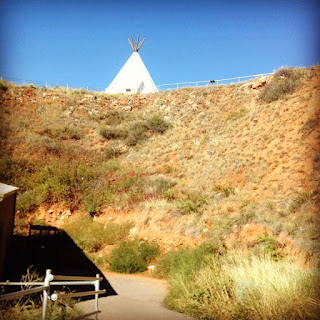
Standing at the bottom, looking up. The tepee-like building on rim is the Interpretative Center (Author's photo)
If you're headed west, the Vore Buffalo Jump is easy to miss, but equally easy to find! It's almost throwing distance from the Wyoming Welcome Center visitor center when you cross the state line. It's an active archaeology site and well worth a visit to anyone interested in Native American history as well as a chance to see archaeologists at work.

If you made it this far, you're almost there! Vore Buffalo Jump.
For more information on the Vore Buffalo Jump:
https://www.vorebuffalojump.org/content/

Images not the author's own are courtesy Wiki Commons

Fans of historical western tales, don't miss this collection of six full-length novels from Prairie Rose Publications. Still only $0.99


Wednesday, January 2, 2019

Welcome 2019

Greetings! Can you believe another year has ended? 2018 kept the Cowboy Kisses authors busy publishing blogs on a variety of topics related to the western genre. Some of our authors were also busy celebrating the release of a new western romance. And, as in previous years, Cowboy Kisses bid farewell to old friends and said hello to new comrades. Please give a warm welcome to Maggie Carpenter, Ginger Chambers, Rhonda Frankhouser, Doris McCraw, Jacqui Nelson, Danni Roan, and Wilhelmina Stolen. Each are talented and well-known authors within the western romance community and are sure to strike a connection with you via the blogs they write. I invite you to get to know them better by visiting their author pages located on the right toolbar.   
2018 also saw a few other changes to our routine. Due to personal reasons needing my attention throughout the year, this was the 1st year since I’ve taken over the reins that I was unable to host the annual Facebook party. Not to worry, we will have one this year! Also, I spent a few months away from the blog and the Facebook group and extend my heartfelt gratitude to Shann Hatfield and Kristy McCaffrey for taking over in my absence. I also thank Andrea, Paty, Robyn, Patti, Nan, Lauri, and Stephanie for their continued support of me and Cowboy Kisses. Cowboy Kisses is a group effort and I couldn’t do it without any of them. Lastly, I thank you, our followers. Without you Cowboy Kisses wouldn’t exist.
As 2019 unfolds, I wish our authors continued success in their endeavors, to, no doubt, include more sexy, handsome cowboys for everyone to swoon over. And I wish all of you health, happiness and prosperity. Happy New Year Cowboy Kisses!

Julie      

Tuesday, January 1, 2019

Happy New Year!

from Shanna Hatfield


Wow! It's hard to believe today is the start of a new year, but I'm wishing each one of you a beautiful, bright beginning to 2019!

How do you plan to spend this first day of the year? 

I'll be working on putting goals on paper, hanging out with Captain Cavedweller, and hopefully getting in some reading. 

If you're looking for something to read, I have two new books out, one a sweet holiday historical and one a sweet contemporary time-travel romance! 

He needs a holiday miracle. . .

She’s prepared to deliver one
Claire Baker does nothing halfway. She makes it a point to follow her heart, even when it leads her to a small Eastern Oregon town to stay with relatives. In truth, she loves Hardman and the people there. Which is why she wants a recluse she met in the woods and his adorable daughter to join in the community holiday celebrations. The more time they spend together, the more she realizes she’s fallen hopelessly in love with both of them.
All Grayson Carter wants is to be left alone. That’s why he built his cabin in the middle of more than a thousand acres of woods, seeking to disappear from the world and keep his daughter, Maddie, safe.  Then a beautiful interloper appears and becomes quite determined in her efforts of drawing him back into the land of the living. As she brings him and Maddie Christmas cheer, he realizes falling in love with her could be the best and worst thing he’s ever done.
With Christmas fast approaching, a mystery to be solved, and old-fashioned holiday fun, this sweet historical romance will fill your heart with the joys of the season.
The Christmas Melody, available now on Amazon.


Can true love endure across the constraints of time?

 Prepare to have your heart captured in this time-travel romance.

Archaeologist Hannah Clayton has the unique talent of clearly imagining the past as she unearths artifacts in the present. When she stumbles across a cave with a wall of hidden petroglyphs, she’s giddy with excitement. At least until a man dressed like a caveman appears out of nowhere and scares her witless.

Inexplicably drawn to the cavedweller who calls himself Thor, Hannah has to decide if he’s involved in an elaborate hoax or if he’s a walking miracle. Thor is unlike any man she’s ever encountered. From the moment they meet, she knows nothing will ever be the same.

He acts as though he adores her, makes her laugh, and fills her world with more joy than her heart can hold. But are the bonds they share strong enough to keep Thor beside her and prevent his return to the past?

A sweet romance, Capturing the Cavedweller’s Heart takes readers on a lighthearted journey sprinkled with tidbits of history and wrapped in the hope of lasting love.


Happy, Happy New Year!