Thursday, July 14, 2022

There Really Was a Long Branch Saloon


There Really Was a Long Branch Saloon


Remember Miss Kitty and the Long Branch Saloon? Well, I don’t know about Miss Kitty but there really was a Long Branch Saloon.  It came about because of a bet placed between soldiers and cowboys. The cowboys and soldiers were playing ball. If the soldiers lost to the cowboys, they agreed to provide materials to build a saloon. They lost. Hence the building of the Long Branch in 1874.


Unlike the rowdy, free-wheeling establishments that most saloons are portrayed as, the Long Branch was a tasteful institution with a five-piece orchestra that played every night. Besides beer (Anheuser Busch) and whiskey, it also served champagne, milk, sarsaparilla and lemonade.  


     Though a classy establishment, the Long Branch saw its share of fights. The most famous: the gunfight between Levi Richardson and Frank Loving (both gamblers and gunmen), over Loving’s wife, resulting in Richardson’s death. 

There were fifteen other saloons in Dodge during the cattle drive era’s hay-day, but none nearly so well known or popular.

Today you can find a replica of the Long Branch in the historical Boot Hill Museum located at the site of the original Boot Hill Cemetery in Dodge City, KS. 


Live entertainment includes: gunfights, Miss Kitty singing and Can-Can girls dancing. Besides the Long Branch, there’s a gift shop and general store in the museum.

Sounds like a fun place to visit, doesn’t it? Maybe I’ll see you there.


For more cowboy trivia: cowboytrivia.blogspot.com.


Coop Malloy receives a telegram that his sister and brother-in-law have died and his ten-year-old niece is on her way to Texas to live with him. 

Still reeling from the loss of his sister, he receives another shock when his childhood friend Randa Lockhart steps off the stage with his niece Kallie. He's stunned to see that the little pigtailed nuisance that tagged after him and his best friend years ago has turned into a beautiful young woman. 

Randa and Kallie have barely settled in when Coop finds buffalo hunter Marvin Doolin beating the local blacksmith within an inch of his life for laming is horse. Coop steps in and when the buffalo hunter tries to kill him, shoots him. Now Doolin's four brothers are out to even the score.

When they go after Randa, they cross the line. They're about to find out that there's nothing Coop won't do, and no one he won't track down to protect the two females that have burrowed hard and fast into his heart.


Available at Amazon.


Tuesday, July 12, 2022

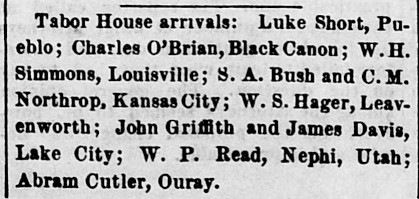
Luke Short, Wild West Bad Man?

 Post by Doris McCraw aka Angela Raines


I've been reading "Famous Gunfighters of the Western Frontier" by W.B. (Bat) Masterson, written in 1907 as a series of articles for the 'Human Life Magazine'. One of the men he wrote about was Luke Short. Since Mr. Short had been in Colorado, I thought it might be interesting to share some of the articles the older newspapers shared about him. Below are three such pieces. 


The Gunnison Daily New-Democrat Jan 21, 1882
(Gunnison, CO)


The Meeker Herald July 3, 1886 (Meeker, CO)


Luke Short
photo from Wikipedia


The Herald Democrat December 25, 1890 (Leadville, CO)

What I find so fascinating is how these 'gunfighters' are portrayed. I can just imagine doing a biography and deciphering truth from fiction. 

Luke Short, in fact, died in 1893 from what would now be called nephritis, a kidney disease, at the age of 39. 

The one thing that is clear, Mr. Masterson seemed to think highly of Short and what he'd accomplished in his short lifetime. He was impressed with Short's change from a 'white Indian' as a young man to a well-educated, well-spoken man at the time of his passing. 

Until next time, happy reading and writing.


Doris McCraw


Monday, July 11, 2022

Dreams can come true by Jan Scarbrough

It happened Saturday, May 4, 2013, when Stuart Janney III and Phipps Stable's favored Orb charged to the lead in the stretch of a sloppy Churchill Downs strip to win the Kentucky Derby Presented by Yum! Brands.


"It means everything to me," trainer Shug McGaughey said. "It's a race I've always wanted to win, a race I've always wanted to compete in if I thought I had the right horse, and finally today we had the right horse."

 
The two owners (cousins) and their families have been racing thoroughbreds for decades without winning the most sought-after race in the world, the Kentucky Derby. In fact, in 1969 because of a coin toss, the father of Orb co-owner Ogden Mills Phipps lost the rights to a foal out of the mare Somethingroyal. The mare had been bred to the Phipps’ stallion Bold Ruler. Penny Chenery, on behalf of her father, won the coin toss, and the resulting foal, a chestnut colt, became Secretariat, the 1973 Triple Crown Winner. 
 
Like Shug McGaughey, my dreams have come true many times. One that stands out is the first time I became a horse owner. My bay gelding was not a champion thoroughbred, but an American Saddlebred, the grandson of legendary champion Wing Commander. Trained as a five-gaited pony, my daughter rode Mr. Too Little in pleasure pony classes.
 
Selling my first book to Kensington Publishing was a dream come true. Continuing to write and publish books is also a dream fulfilled. Here is the revised version of my first book with 30,000 words added.


What about you? Do you dream? If so, what about? Do you set a goal and go after your dreams? Do you make them come true? 
 
"If you can dream it, you can do it" Walt Disney 

Friday, July 8, 2022

Glimpses of the past

Something that's long been on my list of things to do is visit historical sites with live demonstrations. 

Before my kids left home, we made a trip to the George Ranch in Richmond, Texas. There was a lot to see, and we had a good time. 

Two of our favorite activities were the blacksmith demonstration and the chuck wagon lunch. (We went pre-covid.) The young man working in the blacksmith shop was not only talented, he was an engaging showman.

The tour of the Davis House, a Victorian era mansion, was particularly interesting to me. I learned a lot, including that fainting couches were a real thing. Growing up in Texas, I can't imagine wearing multiple layers and long sleeves in the summer, but ladies did!


The hogs at the 1830s Jones Stock Farm had the right idea. They wallow in the dirt to beat the heat.

The George Ranch Historical Park, which is located 30 minutes from Houston, opened in 1988 as an educational partnership between The George Foundation and the Fort Bend History Association. The Park features four historic home sites: the 1830s Jones Stock Farm, 1860s Ryon Prairie Home, 1890s Davis Victorian Mansion and 1930s George Ranch Home and Cattle Complex.

The Park accommodates pre-booked school and group tours Tuesday through Friday (including a day set aside for homeschoolers), and is open to the general public on Saturdays and other special weeks throughout the year, except during the month of August.

A place I wanted to visit with my kids but never did is the Texas Cotton Gin Museum in Burton, Texas. My family owns farmland near the King Ranch, and when my brother and I were kids, we used to watch the huge combines harvesting cotton and the bits of white fluff blow off the trucks as they'd haul it away. 

Whenever we went to see my paternal grandmother, my father would point out the cotton fields along the way and explain about the shriveled leaves on the plants after the defoliator had been applied. 

Once, he pulled the car over and picked a couple of cotton bolls. He let us feel of it, and he pulled the cotton apart so we could see the seeds. They are not easy to remove. I'd love to see how cotton was refined before the advent of modern machinery.

The Lyndon B. Johnson State Park, which lies between Austin and Fredericksburg, looks mighty tempting, too. And, best I can tell, the tours are free.

Have you visited any working farms or historical sites with live history demonstrations? Tell me, so I can add them to my bucket list!

###


I put my Forging America series into the Kindle Unlimited library. 

If you subscribe to KU, you can now read them for free! 

Wednesday, July 6, 2022

History of the Pikes Peak or Bust Rodeo ~ Julie Lence

courtesy of Pinterest

 Last month, I introduced you to Spencer Penrose, a successful businessman in the mining industry who helped to shape Colorado Springs as a town and community. Besides erecting a road to the top of Pikes Peak, building the world famous Broadmoor Hotel, and the first hospital in Colorado Springs, Spencer Penrose was detrimental in bringing the rodeo to town.  


Will Roger Stadium

The history of the rodeo in Colorado Springs dates back to 1911 when rodeo events took place in Sportsman Park located between North Nevada Avenue and North Cascade Avenue, but by the late 1920’s, the rodeo had died out. Penrose brought back the excitement, the skill, and the fun in 1937 by developing and building the Will Rogers Stadium at the Broadmoor Hotel and founding the Pikes Peak or Bust Rodeo. The 1st Pikes Peak or Bust Rodeo was held in 1938 and continues today in mid-July. To promote the rodeo, Penrose enlisted the help of his longtime business partner and friend Charles L. Tutt and Jasper Ackerman, also a friend. The stadium at the Broadmoor was home to the rodeo for many years, and after World War ll was dedicated to the men and women of the military who sacrificed their lives for our country. (This tradition continues today, with one night of the weekend-long rodeo dedicated to military members. The Ft. Carson Color Guard is also present at the rodeo. They ride in the parades hosted by Colorado Springs, with their horses stabled on Ft. Carson and their army job titles reflecting their equestrian work.)               


Norris-Penrose Event Center
El Pomar Foundation

During the 1970’s, the Broadmoor needed the land the stadium sat on for expansion. With parking also a growing problem during rodeo week, then Mayor Eugene McCleary joined forces with William T. Tutt, Russell Tutt, and rancher Robert Norris to build a new stadium on Lower Gold Camp Road. Bearing the name, Norris-Penrose Event center, one of Spencer Penrose’s foundations, El Pomar, donated $1.25 million to help reduce contractors’ cost in the building of the stadium. Today, the Norris-Penrose Event center is still home to the Pikes Peak or Bust Rodeo. As for the Will Rogers Stadium,  it was cut into sections and moved to the new stadium one piece at a time. The land on which it sat currently houses boarding barns. The horseshoe opening was enclosed to make a new entryway and renamed the Spencer Penrose Stadium.  

Spencer Penrose at the rodeo
El Pomar Foundation


Tuesday, July 5, 2022

Ice Cream


On a hot summer day, there's nothing like cool, creamy ice cream.

Ice cream can be traced all the way back to the 4th century B.C. Roman emperor Nero (A.D. 37-68) ordered ice to be brought down from the mountains and mixed with fruit toppings. 

 King Tang (A.D. 618-97) of Shang, China had a method of creating ice and milk mixtures. 

 Ice cream was more than likely brought over to America from Europe. After the dessert was imported to the United States, it was served by several famous Americans, including George Washington and Thomas Jefferson. 

 The first ice cream parlor in the United States was opened in New York City in 1776. American colonists were the first to use the term “ice cream” which came from the phrase “iced cream” but later shortened to ice cream.

Since ice cream uses such few ingredients it is important to use premium ingredients to ensure the best frozen treats!

Here's one of our favorite recipes for homemade ice cream! Enjoy!


Banana Ice Cream
5 eggs
2 1/2 cups sugar
4cups whipping cream
1 tsp. salt
2 tsp. vanilla
2 tsp. banana flavoring
4 cups milk
4 ripe bananas, mashed

* Warning! Consuming raw eggs may increase your risk of food borne illness. If you do decide to make this and use the raw eggs, please choose eggs that are fresh with no cracks in the shell.

Start by beating the eggs until they are foamy and light. I let mine go about six minutes.

 Add in sugar and continue mixing. Slow the speed on the mixer and add in the cream followed by the salt, vanilla and banana flavoring. 

Continue mixing and add in the milk, blending in the bananas last.

 Pour into your ice cream freezer and freeze according to machine directions.

If you have any leftovers, freeze for up to a week.

Happy July (which also happens to be Ice Cream Month! Yum!)


USA Today bestselling author Shanna Hatfield is a farm girl who loves to write. Her sweet historical and contemporary romances are filled with sarcasm, humor, hope, and hunky heroes. When Shanna isn’t dreaming up unforgettable characters, twisting plots, or covertly seeking dark, decadent chocolate, she hangs out with her beloved husband, Captain Cavedweller.

Shanna loves to hear from readers. Follow her online at:

ShannaHatfield | Facebook | Newsletter


Monday, July 4, 2022

Frederic Remington


By Kristy McCaffrey

Frederic Remington is best known for his art depicting the cowboys, U.S. Cavalry, and Native Americans of the Old West. He was a painter, illustrator, sculptor, and writer.


A Dash for the Timber, 1889.

Born in Canton, New York, in 1861, his family had hoped he would have a military career, but his love of drawing revealed itself early. His goal was to become a journalist, while doing his art on the side. At 17, he wrote to his uncle of his modest ambitions, “I never intend to do any great amount of labor. I have but one short life and do not aspire to wealth or fame in a degree which could only be obtained by an extraordinary effort on my part.”


The Herd Boy

He attended art school at Yale University, preferring action drawing rather than still life objects. At 19, he made his first trip west when he traveled to Montana, and he quickly grew to love the frontier and the heroic cowboys and soldiers he met there. He went on to work for several magazines, creating images that helped shape the world’s perception of the American west.


The Broncho Buster, 1895

While he produced over 3,000 paintings and drawings, he’s best known for his sculptures, which he began in 1895 with “The Broncho Buster.”

* * *

In my upcoming novel, THE STARLING, a mystery surrounds the western painter J. Montgomery.


Colorado 1899 

Kate Ryan has always had a streak of justice in her. When she decides to apply to the Pinkerton Detective Agency, nothing will stand in her way. Initially hired in a clerical position, she quickly works her way up to field agent with the help of her mentor, Louise Foster. When Louise is injured, Kate gets her first assignment and the opportunity of a lifetime. 

Henry Maguire has been undercover in the household of wealthy entrepreneur Arthur Wingate. Employed as a ghostwriter to pen the man’s memoir, Henry is also searching for clues to a lucrative counterfeiting scheme. When Henry’s “wife” shows up, he’s taken aback by the attractive woman who isn’t Louise. Now he must work with a female agent he doesn’t know and doesn’t necessarily trust. And because he has another reason for coming into Wingate’s world, Kate Ryan is unavoidably in his way.

Kate Ryan is the daughter of Matt and Molly from THE WREN, and THE STARLING is the first of five novels featuring the second generation of Ryans in the Wings of the West series.

Coming August 2, 2022

Read Chapter One and Pre-Order Now