Showing posts with label fashion. Show all posts

Wednesday, August 4, 2021

Simple 1800's Fashion ~ Julie Lence


Blogging is often fun. In researching a subject, I learn something new, or, as in the case from last year’s blog regarding Bill Tibbetts, I find someone’s life story fascinating and am excited to share with you. But sometimes, I like to step away from research and do something different. Today’s blog is more of a visual than paragraphs of text, and helps me as much as it entertains you. In crafting characters, not only do I need to know their facial features and hair color, I also want to know what they’re wearing, especially the women. Most of my girls dress simply in plain skirts and shirts for ranch work or the day-to-day chores that come with running a business. Below are outfits I chose for each of my heroines. I hope you like them as much as I do.


Paige Morgan (Luck of the Draw) I see her in something as simple as this skirt and shirt while she's cleaning the ranch house and cooking three meals a day. 


Missy Morgan (Lady Luck) For running a gaming house, Missy needs something daring to catch a man's eye and make him part with his money.  


Racine Weston (No Luck At All) Born into a wealthy family, Racine is now married to a rancher and spends her days the same as Paige, cooking and cleaning). She needs something simple yer elegance. 


Rachael Weston (bring Me Luck) Born into a family of ranchers, Rachael knows the best way to tackle a hard day's work is by wearing something comfortable.    


Suzanna Reynolds (Zanna's Outlaw) A former soiled dove now running a boarding house, Suzanna is another women who needs something comfortable yet a bit stylish to get her through a day of chores. 


Lydia Tyler (Lydia's Gunslinger) is my only heroine who doesn't cook and clean. In fact, it's better she stays out of the kitchen, and coming from a wealthy family, she enjoys her stylish clothes.     


Debra Moore (Debra's Bandit) is a former female outlaw managing the mercantile. Waiting on customers by day and cooking at night, she needs simply with a bit of pizazz.   


Jill Prescott (Slade) grew up on the farm she now runs. From patching roofs to cleaning out the chicken coop, Jill needs something
practical that doesn't tangle around her ankles.  


Nadine Harper (Landry) Raised on a Pennsylvania and now traveling by wagon with her father, Nadine is another female who needs something practical and sturdy to get her through the day.   

Friday, September 22, 2017

FROU-FROU HAIR by Zina Abbott


Whoa! 

What, you say? 

This is a Western blog. Out west, people, including the ladies, weren't big into frou-frou like they were back east. 
1880's Fall Outdoors Fashion Plate

In the West, women had to be tough. They had to work hard. They had to be practical.

They also were the civilizers of the West. Many of them came from the East. They brought their religious and character values, and their social skills, and their fashions with them.

In the 1870's and 1880's, that included not only bustles, but frou-frou.

Frou-frou, as in lace and buttons and ribbons and feathers and ruffles and ruching and pleats and fancy hair combs and a host of other gew-gaws -- personal decorations to boggle the Western male mind.

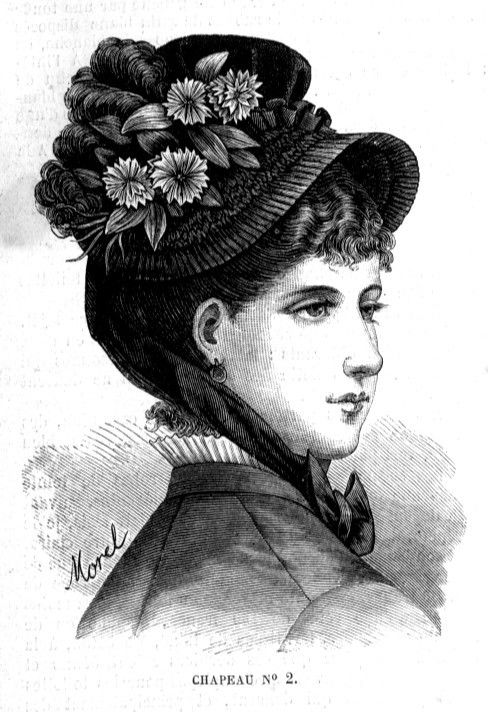
In the 1870's and 1880's, they brought frou-frou hair. Not just hair piled up on their head in curls or braids, but also covered with a hat intended to entertain the eye of the beholder for hours. Please notice the hair curled in a high chignon behind the lovely bonnet:


And for special occasions, such as a dinner with the town mayor--whether he wore a stylish plaid business suit and derby, or dusty cowboy boots and a Stetson--the piled-up hair of the hostess emulated Eastern designs found in the latest issue of Godey's Magazine, and was decorated with frou-frou. 

 
What prompted my interest in hair and all its frou-frou was the cover reveal of my latest novel that will be released next week, Dead Set Delphinia:

I received many positive comments about the cover, although a couple of readers noted the dress looks like it is from the 60's. Actually, as a ballroom gown, it's not far off for being typical of either the 1860's or 1960's. Yes, it is on the cover of a book set in 1881. However, in order for an author to not use an image of the same model wearing the same outfit you see on every other historical western romance book, sometimes an author has to fudge a little.

The hair drew the most negative comments: "Disconcerting." 
"Helmet hair."

Yup! It does look a little like the good ol' beehive of my salad years. Not really late 1870's-early 1880's style. 

Or is it? 
1870-1880 hair accessories


Add some frou-frou, and whallah! Period-correct hair.

I pay attention to constructive criticism. After doing a little photoshopping and pulling from the frou-frou on my heroine's skirt, here is my REVISED cover reveal:

No more helmet hair. No more looking like a football landed on her head.

This fancy outfit, complete with frou-frou from her hair to her toes, is just right for my recently "from back East" Delphinia who shows up at the harvest dance held in Jubilee Springs, a backwoods Western mining town, especially when she thinks she has deliberately worn an outdated and understated gown to the event.

Dead Set Delphinia is not on preorder, but is scheduled to be released next Tuesday, September 26th. On that day it will be available at the release day price of $.99. After release day, the price will be raised to its usual amount. It will also be available for Kindle Unlimited. This is Book 11, and my fourth book, in the Sweethearts of Jubilee Springs series.

Here is an excerpt:


         Bennett raised his eyes from her boots with their two inch high heels to her face only to discover her attention had focused on him. “Good morning, ma’am. May I help you with something?”
         “It’s Miss. This store has some lovely pieces. Too bad your employer has not required you to better maintain the showroom. These sets would be far more appealing to potential buyers if they were arranged by wood type and style in a manner that would allow a person to visualize them in a home setting. And although I’ve noticed there is an inordinate amount of dust in this town, perhaps more frequent use of a broom and dusting cloth would also help.”
         Bennett tipped his head and raised an eyebrow as he watched her once again focus on a dining room sideboard made of walnut and stained dark. He knew all these things. He had particularly been painfully aware of every failing she had mentioned, especially once Gerald Shumaker had warned him he would be bringing in his wife to look at dining sets in the next few days. However, who did this woman he had never seen around town until now think she was, waltzing into his store and telling him how to manage this showroom?
         “I’m not the clerk; I’m the owner, Bennett Nighy.


I have three novellas in the Sweethearts of Jubilee Springs series available.
 

Book 6:  Cat's Meow
Book 7:  Bargain Bessie
  ~o0o~ 
To read and enjoy all of the books in the Sweethearts of Jubilee Springs series, please sign up and follow us on Amazon by CLICKING HERE.


Wednesday, September 7, 2016

Women's Knickers


Thong

In today’s society, women have it easy when it comes to fashion compared to women from the 1800’s. When it’s cold, we have jeans and thick sweaters to keep us warm. Shorts and tank tops keep us cool on hot summer days while capris and short-sleeved shirts are perfect for a fall day. And when it comes to undergarments, design and comfort have come a long way from what women used to wear.
Chemise
Before the 1800’s, the only undergarments women wore were a knee-length linen chemise, a corset, a petticoat or two depending on the season, and long skirts. During the colder months, quilted petticoats and skirts made of heavier material were worn to keep the lower part of the body warm. Knickers came into existence at the end of the 18th century. Lighter fabrics of lawn and sheer silk replaced the heavier materials and made it easier for women to cover their lower region to keep warm. Knickers were two leg pieces laced together at the waist and baggy to accommodate the split at the crotch. By the 1820’s, most women were wearing this style of underwear, also known as pantalettes or pantaloons. Women’s pantaloons were nude in color and reached to just below the knee or all the way to the ankle. The bottom of each leg was trimmed in lace.     
Open crotch drawers caption
Queen Victoria often set the stage for what was fashionable. She favored knickers and ensured they became a staple to every woman’s wardrobe, unless a woman was poor and couldn’t afford the extra cost. By 1876, the two separate legs were merged together and the crotch closed. Material used for knickers now included flannel.
Around 1877, knickers shifted to a new look referred to as the combinations garment. The combination was one piece consisting of a camisole top attached to drawers. Popular materials for the combinations were linen, silk, merino, calico, cambric or nainsook in flesh pink tones or cream colors. Later, knickers underwent another change and became wide around the knee. The 1900’s brought more changes such as the skirt knicker and the Directoire knicker which fit closer to the body. 
The Directiore
 
Changes to outer garments brought about changes to undergarments. Just as shirts and skirts were being fashioned from lighter materials, so were undergarments. In the 1920’s, the name knickers was changed to panties, and again to panty briefs in the 1930’s as knickers were shortened from the knee to just below the crotch. Chemises eventually gave way to the bra, and each decade saw a new change to undergarments, such as the pointed bra, the panty leg roll, nylon tricot briefs and the nylon lace bouffant net petticoat of the 1960’s.
Lace bouffant net petticoat
 
Today women have a variety of knickers to choose from; the bikini, the brief, and the thong. Cotton and lace are some of the materials we enjoy, but whatever your preference, thank the fashion industry for the simple, form-fitting, light weight knickers that cover a small portion of the body instead of the entire leg down to the ankle. I think I’d never come out of the air conditioning on a summer day if the 1820’s knickers were still the rage of today.