Tuesday, March 12, 2019

WHAT IS YOUR INSPIRATION? #writing #creativity

Post by Doris McCraw
writing as Angela Raine

As I put the finishing touches to a first draft, I thought about what inspired me to write the story in the first place.

Wooden Headstone - SilveCliff Cemetery
photo copywriten and property of the author
First. I am a compulsive reader. I have been since a very early age. If it is printed, then I pretty much have to read it.

Second, I love history. This goes along with the compulsive reading. Add to that a ridiculous joy in digging through old books, researching ancestors, and the lives of people who lived way back when and you might get a small glimpse of what whirls around in this head of mine.

Third, I am an avid movie watcher, especially the old black and whites. Give me a film noir and I'm  a pretty happy camper. A good B-Western or early Western TV show can also be great fun. How many of you ever saw the short lived Tony Young 1961 TV western 'Gunslinger'? I used to stay up and watch that show. (I had very understanding parents.) Boy did that show fuel my imagination back then.

After moving west in my twenties, all things western history took over. My friends and I, in those early days, would take off in the truck and head into all parts of the state. One of my early trips was to the Taylor Park area and the ghost towns located there. Imagine doing the polka at 9,000+ feet in the town of Tin Cup. I later did research and found out that small little 'ghost' town at one time had the distinction of being one of the roughest towns in Colorado. The story is, seven marshals were killed there in just a few months time.
Stacks Image 36
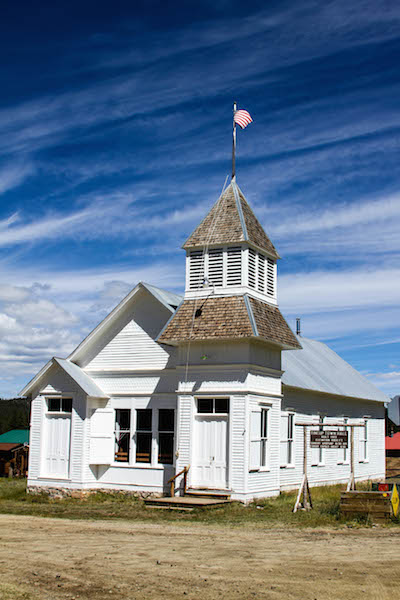
Tin Cup town hall where the author went
to a dance. from TinCupCo.com
Now, I spend time reading books about the ghost towns of Colorado, both in the mountains and on the plains. I've researched early settlements, the fur trade forts, railroad history and the lives of some of the early residents.

Perhaps my greatest pleasure and constant source of research and fun is the story of early women, especially the women doctors who were practicing medicine prior to 1900. Theirs is a story that I will continue to research and write about until I can write no more.

All of these pieces come together in the stories I write and the non-fiction papers.

I've told you some of what inspires me. I can still enjoy 'The Cisco Kid', 'Have Gun Will Travel'. If an old Rocky Lane movie comes on I will try to catch it. Of the singing cowboys, I'll take Eddie Dean over any of the others. He may not have been a compelling actor, but his voice was pure gold.
Eddie Dean - Cool Water

I've re-read Louis L'Amour's "Flint" at least six times and Elmore Leonard's "Three-Ten to Yuma" story is a must.

What is your inspiration? What is your favorite TV show, favorite B-Western, or novel?

Watch for the latest Kiowa Wells story coming in April.


Doris Gardner-McCraw -
Author, Speaker, Historian-specializing in
Colorado and Women's History
Angela Raines - author: Where Love & History Meet
For a list of Angela Raines Books: Here 
Angela Raines FaceBook: Click Here

Monday, March 11, 2019

Bison - the Heart of the American West


by Laura Drake

I wrote last month about a research trip I took to learn about bull riding and bull fighting (if you missed it, you can read it here.)

Since then, I've taken another research trip - for the next series I'm proposing to by editor - to a Bison Ranch!

I just Googled the closest Bison Ranch to me (how did we live before the internet?) and it turned out, it's outside Bryan, Texas, about 400 miles from me. ROAD TRIP!  I got in touch with Beverly Brown, the amazing woman behind the Lucky B Bison Ranch, and she was amazingly helpful. She invited me down to tour the ranch, and agreed to answer my questions.


We were lucky enough to get there just before they were going out to supplement feed the herd, and we rode in the bed of the pickup. Here's a short (1 min) film clip of the amazing experience:


 They came over the hill, and you could literally hear the thunder of their hooves. I thought westerns made that up with sound effects, but it's true!  I was thinking how darned cute they were - until I looked into their eyes. Instant respect - there is no doubt that these are wild animals.

Background I learned from Beverly:

  • We use the terms 'buffalo' and 'bison' interchangeably, but actually, bison reside in North and South America - buffalo are in Africa and Asia. We have the American or Plains Bison - Alaska has the Wood Bison, which are larger. 
  • Bison are the largest land mammal in the Americas, and has received the designation as the National Mammal of the U.S.
  • There were once millions here. They were hunted almost to extinction to starve out the Native tribes, and for sport. At the end of the 1800's, it's estimated there were only 1,000 left.
  • Many of the bison today have bovine DNA thanks to breeding to increase the genetic pool - the herd in Yellowstone is pure.
  • Ted Turner has the largest herd, scattered over several of his ranches - he's a huge proponent of conserving the species. Today there are 1/2 million bison in the U.S. and Canada
  • Their low heads and large necks are  powerful so they can sweep snow away to get to grasses in the winter
  • They can run 30 mph, turn on a dime, and jump 6 feet from a standstill
Beverly has a friendly bison, Reaganne. When its mother died, the vet took the calf by C-section. Beverly bottle-fed it four times a day for months. Reaganne imprinted on her, and to this day, Beverly can walk into the pen and scratch her. She suggested I stay a bit farther away for this photo.


Why does Beverly do this? Aside from falling in love with bison because she's a huge fan of underdogs, the ranch keeps bison for:
  • Breeding 
  • Selling meat to grocery stores and restaurants
  • Ecotourism - she has a sweet cabin you can rent, right on her ranch!
  • Education - she has children and adult groups out for lectures
  • Fundraising - she has funded a legacy scholarship for Native youth
And look how much healthier Bison meat is! I know my local HEB carries it. I'm going to get some and check out recipes!


For more info on the bison industry, check out http://luckybbison.com/  

Tell Beverly I sent you!


Friday, March 8, 2019

The Wild Woman Librarian who became the first California Poet Laureate


By Jacqui Nelson

Life's an adventure in a library. Meet the Wild Woman Librarian who became Jack London's "literary mother" and a Poet Laureate...

Josephine Donna Coolbrith Smith 

aka Ina Coolbrith

( born 1841 in Nauvoo, Illinois ) 

Ina in the 1850s

In 1851, at the age of 10, Josephine traveled west with her family in a wagon train. She entered California riding with the famous scout Jim Beckwourth.

Her family settled in Los Angeles, and she began writing poems and was first published in a newspaper in 1856. At the age of 17, she married an iron-worker and part-time actor. When he abused her, she divorced him in a sensational public trial.

In 1862, to ward off depression, she moved with her mother, stepfather, and twin half-brothers to San Francisco. She changed her name from Josephine to Ina and worked as an English teacher. For a decade, she supplied one poem for each new issue of San Francisco’s Overland Monthly.

Ina in 1871 (at age 29 or 30)

In 1874, to further support her family, she took the position of librarian for the Oakland Library Association. She earned $80 per month and worked 6 days a week, 12 hours a day. Her poetry suffered as a result and she published sporadically during the next 19 years. At the library, she discussed her patrons' interests and then selected books for them.

In 1886, she befriended and mentored a 10-year-old Jack London who later called her his "literary mother."

Ina in the 1880s

In 1892, she was given three days' notice to clear her desk and be replaced as Oakland’s librarian by her nephew Henry Frank Peterson. Two years later, her good friend John Muir wanted her to fill the recently vacated position of San Francisco's librarian, which she could not do because San Francisco required that their librarian be a man.

Seven years later, her artist and writer friends were able to obtain her a part-time librarian position at the Bohemian Club. Her salary was $50 per month and her duties were light enough that she could continue writing.

In 1906, the fire that followed the San Francisco earthquake consumed her house, 3,000 of her books, and her nearly complete manuscript – that was part autobiography and part history of California's early literary scene. Her Bohemian Club friends helped set her up in a new house where she resumed writing and holding literary salons.

On June 30, 1915, at the age of 74, Ina Coolbrith was named the first California Poet Laureate and the first poet laureate of any American state. She continued writing poetry for eight more years.

Ina in 1924 (at age 83)

~ * ~ 

I always wanted to be a librarian, but the closest I came was working in a bookstore - a wonderful job, but no matter how wonderful I couldn't imagine working there 12 hour days for 6 days a week - like Ina Coolbrith did at her library. 

Do you have a favorite librarian from the past or the present? 


~ * ~

* CLICK HERE to read more Cowboy Kisses Wild Women blog posts *

Read about my stories on my 

Hope you'll join me on… 
Or follow me on… 

Don't forget to download my FREE story with my Newsletter

Fall in love with a new Old West...
where the men are steadfast & the women are adventurous.

Wednesday, March 6, 2019

Women of Western Television


We all have our heroes from western television; Matt Dillon, Joe Cartwright, and Seth Bullock to name a few. Aiding these swoon-worthy men are heroines who are often over-looked or forgotten after the series has ended. Here are a few I have admired for their spot-on portrayal of women living in the wild west.         

Barbara Stanwyck: Born Ruby Stevens on July 16, 1907 in Brooklyn. Stanwyck is best known for portraying Victoria Barkley on The Big Valley. Barbara played the matriarch of the Barkley family; a strong-willed, compassionate mother who loved her children and ranch dearly. Before taking on the role of Victoria Barkley, Stanwyck appeared in over 80 movies, most notably Stella Dallas and Double Indemnity.  
Stanwyck did not have an easy childhood. At the age of 4, her mother was killed when pushed off of a moving streetcar. Her father couldn’t cope with the loss and left much of her upbringing to her older sister, who was a showgirl. Stanwyck began smoking at 9 years of age, quit school early and made her way into showbiz.  Shortly after changing her name to Barbara Stanwyck, she made her Broadway debut in 1926 playing a chorus girl in The Noose. By 1930, she was married, had bid farewell to Broadway and moved to Hollywood to pursue a career in the movies. Her first 2 films flopped, nearly ruining her career before it really began, but she convinced Frank Capra to give her a role in his production, Ladies of Leisure. The movie gained her the recognition she desired and helped launch her career.
Along with actresses such as Bette Davis, Stanwyck played a hand in redefining the typical roles women played in films. Instead of females in distress or the typical housewife, Stanwyck portrayed women with their own motives and ideals. She never won an Oscar for her work in film, including for her role as seductress and murderess Phyllis Dietrichson in Double Indemnity, but she did receive an honorary Oscar in 1982.
As she aged, Stanwyck steered away from film toward television. She appeared on The Jack Benny Program and hosted her own show, The Barbara Stanwyck Show, before taking the role as Victoria Barkley. Stanwyck also appeared on The Thorn Birds for which she won a Golden Globe and an Emmy. Unlike many of the characters she played, she was a social recluse, though she did form a lasting bond with Linda Evans (also from The Big Valley) after Evans’ mother passed away. Stanwyck was married and divorced twice, and passed away in 1990 from congestive heart failure.  
I’ve had the pleasure of watching Ms. Stanwyck in some of her films, but to me she will forever be Victoria Barkley from one of my favorite childhood television shows.


Linda Cristal: Born Marta Victoria Moya Burges on February 2, 19 in Buenos Aires, Argentina, Linda Cristal is best known in the United States for her role as Victoria Buchanan on The High Chaparral, for which she won a Golden Globe award. Victoria was patriarch John Buchanan’s wife. Somewhat strong-willed, she loved her husband and strived for some common ground with her grown stepson.
Cristal was born to a French father and an Italian mother. She lost her parents in 1947 in a road accident. Before coming to the United States, she was a movie star in Mexico and Italy. One of her first roles in the United States was in the movie Comanche. Afterward, she met up with John Wayne, who asked her to asked her to take on the role of Flaca in his movie, The Alamo. Afterward, she went on to co-star with Jimmy Stewart in Two Rode Together.
Cristal appeared in other westerns before briefly retiring in the mid 1960’s to raise her 2 young sons. She was coaxed out of retirement to play Victoria on the High Chaparral in 1967. After the show ended, she appeared in the movie Mr. Majestyk opposite Charles Bronsan before starring in the Argentine television series, Rossé..  At the time of writing this blog, Ms. Cristal is retired and residing in California.  
The High Chaparral was a favorite childhood show. I especially liked the character of Uncle Buck since he was funny and always made me laugh. I will forever remember Cristal as the beautiful Victoria with the pretty clothes who supported her family and fought for peace alongside her husband.     
  

Paula Malcolmson: Born June 1, 1970 in Belfast, North Ireland, Malcolmson played soiled dove, Trixie, on Deadwood. Before landing the role, she appeared in several television shows and movie, including Tombstone as Allie Earp.
   Malcolmson began her acting career in theater. Her 1st movie role was in 1992’s Another Girl Another Planet. From there was cast in Tombstone and Dunston Checks In. She has appeared on television in The Practice and Ray Donavan, but her most notable role is still Trixie from Deadwood.     
Malcolmson is sometimes known and credited as Paula Williams. She is extremely secretive about her personal life, so much so no one knows for certain if she is married. Rumors have swirled regarding a husband, but since nothing could be proven, her bio lists her as single. Currently, she lives in Los Angeles and will co-star in the revival net year.
I was a huge fan of Deadwood, and Malcolmson in particular. She brought to light the hardships of Trixie’s life as a soiled dove, (and saloon owner Al Swearengen’s girlfriend) but she also gave Trixie strength and heart and soul. Living with a dangerous man, in a dangerous town, she was a strong woman who carefully navigated a path between right and wrong and always championed lawman Sol. Of all the characters who have come and gone through the years, Malcolmson’s Trixie is one of the ones I miss the most.         


Tuesday, March 5, 2019

Old Feed Store

by Shanna Hatfield

My soon-to-release sweet contemporary romance, Easter Bride, is set in a small town. Several scenes from the story take place in a feed store that's been around for more than 100 years.


Piper Peterson manages the feed store that's owned by her grandfather. His grandfather was the one who founded the store from what was originally a blacksmith shop and livery. 

I had such fun imagining what that store might look like, especially remaining in the same family for more than a century. 


Can't you just envision how the store must have evolved as the world around it changed? 


I could picture bags of feed and bins of nails and a whole section of tack.


And since the family never throws away anything that might come in handy someday, Piper discovers any number of old treasures, like vintage advertisements and signs.


The store even has the original scales that are still in use.

I thought about the feed store I used to go to with my dad when I was a young. It was old and had been around for a long time. The hardwood floors gave testament to that fact.  In the story, Piper's favorite place in the store is where she creates displays on the original hardwood floor. She loves to incorporate antiques she unearths in the massive storage warehouse. 

Back in the old days, many feed stores painted their buildings to match the brand of feed they carried. For example, a store carrying Purina products might have been painted the trademark checkerboard red and white.

But as communities evolved, the world changed, and agricultural needs shifted, feed stores had to adapt to serve their customers. 

Today, most feed stores are so much more than just a place to buy feed. The stores might sell clothing and tack, pet supplies, hardware, housewares, and have a garden center. 

And in the spring, they still carry a selection of seeds along with baby chicks. I love going to our local store to see the chicks each year. In fact, those sweet little chicks inspired a fun scene in the story.


Here's an excerpt: 

With a charming smile in place and thoughts of how much he wanted to kiss Piper again swirling through his head, Colt pushed open the door to the feed store. Chaos greeted him in the form of fuzzy chicks and squealing children.

Three little girls giggled and screeched as they ran up and down the aisles, chasing half-grown chicks while a handful of adults tried to herd what seemed like a thousand little chickens toward the back of the store.

Piper and her assistant manager, Jason, were catching birds and placing them in a big stock tank as fast as they could. Each time they disappeared down an aisle to capture more, a pair of rascally boys lifted the birds out and turned them free again...


Piper Peterson loves the small community of Holiday, Oregon. She resides there at a beautiful, old farm where she’s surrounded by animals she’s rescued. And she manages the feed store that’s been in her family for more than a hundred years. Despite her contentment with life, her grandfather’s plans to sell the store and farm leave her future up in the air. When a sly matchmaker works to set Grandpa up with the perfect woman, Piper jumps at the chance to lend a hand. But the last thing she expects is to fall in love while helping her grandpa find happiness.

Stuck at a crossroads in his life, Colton Ford can’t decide which direction to head. Then an invitation to stay at his brother’s ranch in Holiday provides an opportunity Colt can’t pass up. He hopes time spent at the Flying B Ranch will help him clear his head and sort out his life. Before long, he finds himself entangled in a matchmaking plot involving his widowed aunt and a charismatic old gent. When he agrees to give the budding romance a nudge, he has no idea the man’s delightful granddaughter will capture his heart.

A heartwarming story filled with country charm, laughter, and hope, Easter Bride is sure to bring readers the joys of budding spring and sweet romance.


After spending her formative years on a farm in eastern Oregon, hopeless romantic Shanna Hatfield turns her rural experiences into sweet historical and contemporary romances filled with sarcasm, humor, and hunky heroes.
When this USA Today bestselling author isn’t writing or covertly hiding decadent chocolate from the other occupants of her home, Shanna hangs out with her beloved husband, Captain Cavedweller.
Shanna loves to hear from readers. Follow her online at:
Find Shanna’s books at:


Monday, March 4, 2019

Old Spanish Mines

By Kristy McCaffrey

Long before the westward expansion of the United States, the Spanish were present. Markings on a canyon wall in central Utah consisting of a cross symbol bear the date ‘1667’. Hieroglyphics and pictographs originally thought to be placed by Native Americans are actually markers along the Spanish Trail, which led from Mexico to the Uinta Mountains (in Utah) and beyond. This trail was the main link between Mexican and Spanish outposts, and it’s posited that they were religious outposts. The Spanish presence lasted well into the 1800’s, when packs of Mexicans were reportedly leaving the Uinta Mountains laden with gold.

The Uinta Mountains of Utah.

Until the 1800’s, the tales of the Spanish gold mines were the subject of Native American history, with few white men knowing of the mines. The Spaniards used the Native Americans as slave labor, and after many years of oppression it’s believed that they revolted and killed most of their Spanish captors. Supposedly the Native Americans returned the gold bullion to the earth and sealed it in the very mines from which it had come.

Thomas Rhoades

Thomas Rhoades, a close assistant to Mormon Church leader Brigham Young, was one of the first white men to fully understand the implications of the Spanish mines. Young had become a religious mentor to a Ute Indian named Chief Walkara, who spoke of a secret cache of gold in the Uinta Mountains. The chief agreed to give the gold to the church, and Rhoades was selected to transport it to Salt Lake City.

Unfortunately, the Indians refused to remove the gold, believing it to be cursed. But it was easy for Rhoades to transport since it was already mined and left in bullion form. His first trip was said to have lasted two weeks, yielding more than sixty pounds of pure gold. For several years, Rhoades continued to transfer gold until, in 1887, he discovered additional mines located off Indian ground. This spurred interest in the lost Spanish gold mines, since it appeared there wasn’t just one mine to be found but many.


Searching for the mines could be deadly. In the early years, stories circulated of prospectors being shot and killed, often by Native Americans protecting the sacred mines. Even as recently as 1990 there have been reports of modern-day prospectors being fired upon as a warning by Native Americans who protect the land near historic mining operations.

Old-timers in the Uinta Mountains have claimed there are seven mines lined with pure gold that supplied the Aztecs, serving as the basis for the seven golden cities of Cibola sought by early Spanish explorers.


In ROSEMARY, Book 11 of the Widows of Wildcat Ridge Series, Rosemary goes in search of the fabled Floriana mine in the wilderness of the Utah Territory in 1884. While The Floriana is a fictitious mine, I based it on tales of the time.


Rosemary Brennan is recovering from the loss of her husband five months prior in a devastating mine accident that took the lives of nearly all the men in Wildcat Ridge. The mine owner, Mortimer Crane, has given the widows an ultimatum—find husbands or he will evict them from their homes and businesses. Desperate to keep the assay office that her deceased husband had managed, she heads into the hills in search of an old Spanish mine called The Floriana in the hope she can lay claim to a bonanza of gold.

Ex-U.S. Deputy Marshal Miles McGinty arrives in Wildcat Ridge to pay his respects to Jack Brennan’s widow. He and Jack had a history, and Miles is heartsick over the loss of the young man he had come to think of as a brother. When he learns of Rosemary’s problems with the piggish Crane, he will do anything to help her—even offering marriage. But when it becomes clear that Crane knew of Jack’s criminal past and was blackmailing him over it, Miles must decide whether to tell Rosemary the truth, because doing so may drive her away. And to his surprise, Miles has fallen in love with his new wife.

A sweet romance set in 1884 Utah Territory.

Available at Amazon and in Kindle Unlimited.


Connect with Kristy


Friday, March 1, 2019

Wanted! by Patti Sherry-Crews


"Sulky bulldog appearance: looks rather like a blacksmith coming from work; wears cap pulled well down over face."

I came across this wanted poster some time ago and thought it was fake. But, no, Dan Breen was a member of the IRA during the Irish War of Independence and later a major player in Irish politics. This was the poster issued seeking his arrest. 
Curious, I wondered if such hyperbole on a wanted poster was an Irish thing (because, you know...the Irish like to use their words to embellish), but after looking further, I found similarly descriptive Wanted posters in early American criminal history.
I suppose in a time before TV coverage and video recordings, the authorities had to provide the details the best they could, though I expect even the Irish in the early 20th century were scratching their heads over the description, "looks rather like a blacksmith coming home from work."  (by the way, I love the quantifying word "rather" thrown in that sentence.)
I live across the street from a commuter train station, and if someone was described as looking like a "patent lawyer after a grueling week, coming home and looking forward to a G&T," I doubt I'd be able to nab the miscreant.
With the innovation of photography, the police were able to drag the criminal off to the local photographer to have his or her mug shot taken before throwing them in the cell; and thus ending many a criminal career. Newspapers, telegraphs, and now their faces plastered in quick order all over the country!
One incident to illustrate the point is the famous Fort Worth Five Photograph taken in 1900 by John Schwartz, which put an end to Butch Cassidy's Wild Bunch.

Infamous "Fort Worth Five" Photograph of the Wild Bunch

Butch and the boys had gathered together in Fort Worth, TX for the occasion of  Will "News" Carver to Lille Davis, a prostitute he met at Madame Fanny Porter's brothel (spoiler alert: not a long and happy union). Someone had the bright idea that it would be a hoot to get dressed up like dudes and have their picture taken. Huge mistake!
One version of the story is that Schwartz was so proud of his work he put the photo in the window of his shop, and when the local law next brought in a criminal for a mugshot, he recognized some the gang. Keep in mind that at this time the law still wasn't clear on who was in the Wild Bunch. So, this was an important development. 
Bam! The Fort Worth Five portrait went directly onto a wanted poster. Go directly to jail, do not pass go. 


To make matters worse, Wanted posters could be churned out and disturbed so quickly, an outlaw had to be almost constantly on the move. There was one incident where "News" Carver had an unfortunate encounter with a skunk. Immediately, posters went out adding the detail that one of the gang stunk like a skunk.

Though some of the gang were slow to realize it, the days of train robbing was over for the Wild Bunch, and in fact for all the gangs. 

Butch and  the Sundance Kid along with Etta Place definitely got the memo saying the game was up and escaped to South America to start a new life.
But....

"Wedding" (if they were legally married) Photo of Harry Longabaugh, AKA, The Sundance Kid and Etta Place (if that was even her name).

...before embarking on their fresh start, Sundance and Etta had their picture taken in New York, even sending copies to friends and relatives. And, you guessed it, the picture was used on Wanted posters traveling even as far as South America. Now the Pinkertons had Etta as well.

Spanish language poster provided by Pinkerton detectives to local authorities in South America (photo courtesy of True West)

I note with amusement the following description on one of the Wanted poster for the Sundance Kid:

"Complexion, dark (Looks like a quarter breed Indian)
Eyes, Black
Features, Grecian type"

There are so many things wrong about this description, I hardly know where to begin. Okay, let's begin with "black eyes." Unless he has two shiners, I doubt "black" eye color is an accurate description. And then I picture folks in the old west puzzling over Grecian features while they are comparing various skin tones. This description seems more likely to confuse than aid the good citizens.
In any case, this exposure spelled the end for their brief experiment in going straight. They went back to a life of crime on the run--even Etta at times. She eventually had enough of it and went back to the states to disappear from history. Butch and Sundance, depending on which version of history you subscribe to, either were killed in Bolivia or went on to live peaceful lives under assumed names.  But whatever their fate the Wanted posters certainly contributed to their end as train and bank robbers.

Just like the Wanted poster helped end the careers of many a notorious outlaw in the Old West, it is a wanted poster that brought down a character in my new release, Den of Thieves. 

Blurb:
When his identical twin brother is arrested, the Pinkerton Detective Agency enlists Wynne Palmatier to go undercover and impersonate his outlaw brother, Ennis. His mission is to infiltrate his brother’s gang. Ennis tells Wynne everything he needs to know. Except for one thing: there are two women with the outlaws, and one of them is his wife. 

Lucy House is still paying for the day she strayed away from decency. Now the handsome outlaw she ran away with has lost his appeal and she longs to get away from this life. As the danger mounts, can Wynne and Lucy escape this den of thieves?

Excerpt:

Wynne tied up his horse at the hitching rail and walked in. The sheriff sat with his boots up on his desk. He dropped his boots back down to the floor with a dull thunk when Wynne filled the doorway.
“Sheriff Holden? I’m—”
 The other man stood up, fingers looped in his belt. “I know who you are.” He studied him a good long moment. “Incredible. You look just like him.” The sheriff pointed over Wynne’s shoulder.
“Yeah, that’s one of the defining aspects of identical twins,” he said, turning to see what the sheriff had pointed at.
He gasped. It was a shock to see his visage on a wanted poster.
Mesmerized, he wandered across the room to come face to face with the mugshot. His stomach dropped at the sight. It was one thing to know your brother was an outlaw, but it was another thing entirely to see his face on a poster. “So this is the poster that brought him down.”
Flashes of that same face in more innocent times. Flirting with girls at dances. Singing along with everyone else while Dad played the guitar. Wrestling with a younger cousin and laughing when he pretended to be pinned down by the much smaller boy.
“Yep. He was in Fort Worth having himself a good old time at a faro table when somebody recognized him as one of the gang who robbed a train the week before. They took him into custody without a struggle.”
Listening to the sheriff, he studied the details on the poster. Wanted. Notorious Outlaw Ennis Green. Six foot tall. 165 pounds. Auburn hair. Green eyes. Reward $500.
 “And then, he escaped. Tricked a deputy into thinking he was having a heart attack and then took the man’s gun off of him when he went to his aid.”
“Nice fellow, my brother.”
“He escaped, but now the Pinkertons have a face to put to his name.”
“Yes, I heard. Someone from our hometown happened to see a copy of the wanted posters and recognized Ennis Green was the Ennis Palmatier who he grew up with. A Pinkerton detective came knocking on our door. Gave my mother quite a shock.”
“Didn’t she know he was an outlaw?”
Always burned in his memory was that day his nephew ran into the store and told him to lock up and come directly home. Then, walking in the parlor to see his mother, her face drained of color and her lips pinched tight as she twisted a handkerchief in her hands. A stranger in the room turned when he came in, his mouth falling open with surprise. “You look exactly like him.” The man, it turned out, was with the Pinkerton’s Detective Agency.
“We weren’t sure if he was even alive. The last thing my father did before he died was kick him out. We knew whatever he was up to, it probably involved being on the wrong side of the law. But we didn’t know how successful he become in his chosen profession.”
What he didn’t add was that he never thought his brother was dead. He knew he’d sense it if he died. Even with the intervening years and miles, he had a feeling in his gut he was out there somewhere, much like the man who loses an arm can still feel it. Right now, with only a floor separating them, he felt a peculiar buzzing in his body.
Available on Amazon