Friday, January 10, 2020

The Wild Woman who Championed the Rescue of Trafficked Women


By Jacqui Nelson

Brave and determined spirits always changed the Wild West. Meet the Wild Woman journalist who fought for change by championing the rescue of trafficked women in California and everywhere. 

Mary Grace Charlton Edholm
( born 1854 in Freeport, Illinois ) 


Mary Charlton’s passion for journalism was inherited from her father and mother who wrote about the temperance movement, women's suffrage, and the abolition of slavery. 

At Illinois’ Monmouth College her exhibition essay on the subject "Shall our Women Vote?" was published in the Woman's Journal of Boston. After this, she wrote continuously and her articles appeared in the New York World, the Chicago Tribune, St. Louis Post-Dispatch, Republican, and Chicago Inter Ocean. In 1878, she married fellow journalist Osborn L. Edholm.

In 1886, Mary and her husband moved to Oakland, California where she was unanimously elected official reporter for the Woman's Christian Temperance Union (WCTU). In 1891, she was named superintendent of press. 

Annually, Mary wrote about 250 columns of original temperance matter for over 200 papers, including the dailies of San Francisco, Oakland, Portland, New Orleans, Boston, and New York City. She also conducted three WCTU excursions across the United States, served as secretary for the International Federation Women's Press League, and was editor of Oakland's The Christian Home

For years, Mary championed the rescue of trafficked women. She wrote hundreds of articles in the Woman's Journal, the Women's Tribune, and the California Illustrated Magazine revealing the horrors of the slave traffic in Chinese women for immoral purposes. During an evangelistic meeting in Oakland, she met the millionaire evangelist, Charles Nelson Crittenton (the founder of Florence Crittenton Missions for the rescue of trafficked women) and began writing articles about the Florence Crittenton Missions' work with such enthusiasm that Mr. Crittenton made her a reporter for the missions. 

In 1893, Mary's book The Traffic in Girls and Florence Crittenton Missions (about the horrors of the traffic in women and their redemption through the missions) was published under the name Charlton Edholm. In 1895, Mary was made superintendent of the Florence Crittenton Missions. 

In 1901, Mary used her own home in Oakland to create the Lucy Charlton Memorial (named after her mother) as a home for unfortunate women and children. She supported the charity from the proceeds of her lectures and the sale of her book. 

~ * ~ 

After I read about Mary's life I was reminded of an Orpah Winfrey quote that I recently shared on Instagram. "Cheers to a New Year and another chance for us to get it right."


I think Mary Charlton Edholm was a true champion for getting it right. She spent her life reporting what she saw and standing up for others. 

For me, being an author means writing about characters trying to "get it right" not just for themselves but those around them. Their struggle is never perfect because that's life. We often try only to fail. But as long as we keep trying, isn't that what truly matters?

Time to seize the day and every chance to try to do better. Wishing you all the best this new year ❤️

~ * ~ 

Join me on… 
Follow me on… 

Don't forget to download my FREE story Rescuing Raven (Raven & Charlie's story in Deadwood 1876) 

Thursday, January 9, 2020

Cowboy Kisses News


Please join me and the cowgirls in welcoming 3 new authors to the blog:
Sable Hunter
Kathleen Lawless
Ruthie L. Manier

Each writes in the western romance genre and will make a fantastic addition to the group. To get to know a little more about them and their days to blog, please check the right side tool bar for websites and the blog schedule, and look for their upcoming author pages. 

Welcome Ladies! I’m so happy to have you as part of the team.
Julie

Wednesday, January 8, 2020

Making Resolutions You Won’t Regret by Rhonda Frankhouser

Copyright

My 2019 New Year’s Resolutions
1.      Lose 50 pounds - failed
2.      Exercise more - failed
3.      Save money - failed
4.      Eat better - failed
5.      Stop drinking soda - failed
6.      Visit family more - failed

Does this list look familiar? Are you, like me, one of the 65% of people who set unattainable resolutions every new year? Why do we do this to ourselves? Where did this wicked tradition come from, anyway?

A little history…
Resolutions made at the new year originated nearly 4000 years ago in ancient Babylonia. Making promises such as resolving debt and returning borrowed items, were thought to gain the favor of the gods. Babylonian’s set such goals as a way to honor and reaffirm their loyalty to god and king.

For most, resolutions have evolved from the original ideal of appeasing the gods to self-improvement. There’s nothing wrong with that, per se. We all need encouragement to live our best life, but what happens when we set our goals too high?  

The reality of setting lofty goals…
I heard a statistic that proclaimed 80% of New Year’s Resolutions will fail by February. If we KNOW these lifestyle changes will help us in the long run, why do we fall off the wagon so quickly? Do we expect too much of ourselves or are we focusing on the wrong things?

As I grow older, I realize resolutions shouldn’t be so negative and punishing. Why not strive for personal growth and calmness, instead? Being at peace and nurturing your soul, generally breeds a sense of health and wellness, does it not? If we take a more spiritual approach to choosing resolutions, maybe some of the physical goals from the original, lofty list will come to us, not because of some unreasonable demand, but rather as a happy consequence of living a more fulfilled life.

So, I’ve decided to concentrate on different things this year. My list now reads as follows…

My 2020 New Year’s Resolutions
1.      Cherish my husband & be thankful for our life together.
2.      Take 20 deep breaths every morning, overlooking the Georgia pines in my backyard.
3.      Read new authors and connect with writer’s groups in Gwinnett County.
4.      Explore nature and visit more historical sites – Maybe hike Stone Mountain?
5.      Have some ‘no phone time’ every single day.
6.      Journal about new adventures exploring the South.
7.      Sample new foods – Atlanta, and the surrounding cities, host amazing restaurants with foods from all around the world!
8.      Hand write letters to family and friends!
9.      Donate unused items to a favorite charity. Mine is any animal shelter or homeless center.
10.  Give undivided attention to my dogs every day. They are a gift!
11.  Host a social gathering each month to reconnect with friends and neighbors.

Now these New Year’s resolutions, I can keep. They encourage a sense of gratitude and a way to learn more about myself, without the self-loathing that comes along with failed goals. 

Life is too short to treat yourself poorly. Why not try a new approach? What do you have to lose? I wish you and yours a fabulous 2020, filled with positive, enlightening experiences and unconditional love.

Rhonda Frankhouser is an award-winning novelist, now living in the beautiful state of Georgia.  Follow her at www.rhondafrankhouserbooks.com.


Tuesday, January 7, 2020

Lost towns of Oregon

by Shanna Hatfield

One of the things I most enjoy about writing historical romance is researching the details. It's such fun to dig up little tidbits and historical nuggets.

Many times, there isn't much information available and my active imagination creates its own story.

Such was the case when I happened upon an old Rand, McNally & Co atlas map of Oregon from 1891.

Originally, I was interested in studying the area around the setting of the story I was working on at the time - Hardman, Oregon.

Hardman is now considered a ghost town,  but was once a bustling little town along a stage route.


Those traveling to Hardman often took the train to Heppner (located twenty miles to the north) then rode the stage to Hardman.

As I studied this map, I saw the names of many towns I'd never heard of before. 

I loved the name of Gooseberry for a town and had to work it into my story. Cattlemen in the area gave the community the name Gooseberry Spring as early as 1872, after a large wild gooseberry bush growing near a spring. A post office operated there from 1884 through 1918. Today, the community is unincorporated.

Another town name that caught my eye was Igo. From what I can find, nothing but an old cemetery exists of what was once a thriving community. I did find a few newspaper articles that mentioned Igo. In May, 1910, the Igo Telephone Company was preparing to install telephone line from Igo to Condon.  And in December 1910, the Igo Granger Hall was advertising their annual holiday bazaar.

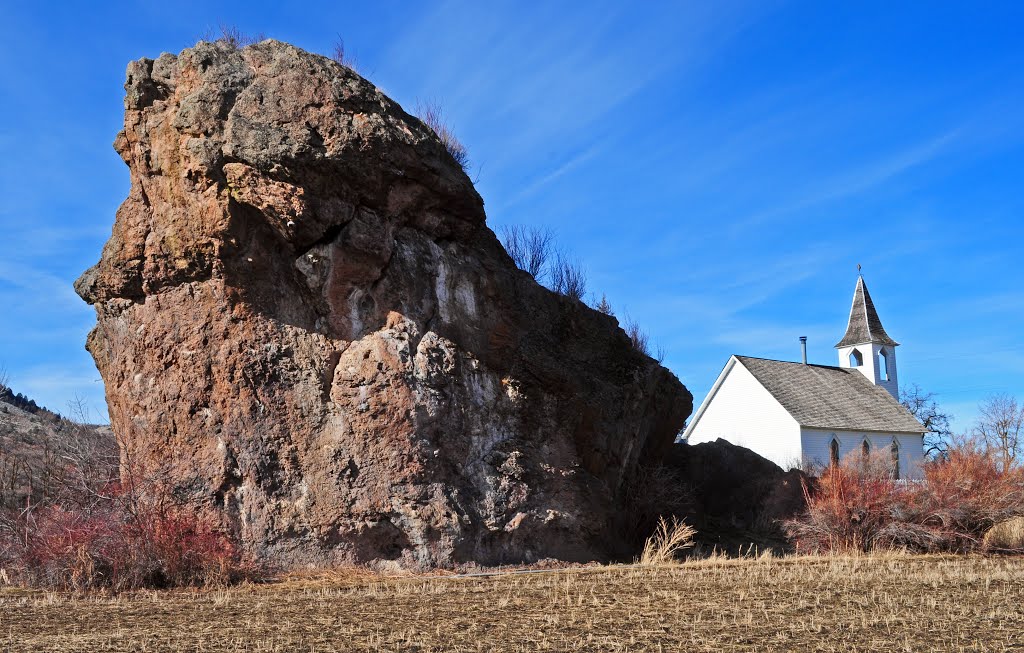
Lone Rock (located southwest of Hardman on the map) is another town that has all but disappeared. My Dad had been to this one, though, and mentioned the big rock the town was named after.


It was the first town in Gilliam County and was named for a lone, large rock. A post office was established there in 1875 and named Lone rock. Later, the name was combined into one word. A townsite was platted in 1882 and incorporated in 1901. Primarily a sheep-ranching community, the town had about 100 residents in the early 1900s. Businesses included a mercantile, a blacksmith shop, a hotel, a boarding house, a livery stable, a lawyer's office, two saloons and two churches. There were wooden boardwalks and two wooden bridges that were eventually washed away by a flood and replaced with concrete structures. 
The population began to decline. In 1960, the school closed, followed by the post office in 1963. Today, only a few residents remain, even though that big lone rock is still there for passersby to see.

To read more about Hardman and some of the fun little towns around it, take a trip into the past with The Christmas Ring, the latest in my Hardman Holidays series.


She’s desperate to forget her past
He’s determined to give her a future. . . 

Victoria Carter flees from the gossip that dogs her every step. She hopes to embark on a new chapter of her life at her brother’s home in eastern Oregon. What she didn’t plan on was the stagecoach being robbed on the way there, or the immediate attraction she feels to one of the outlaws. Then she meets a telephone lineman she finds charming, witty, and kind. Despite her intentions to avoid all members of the male species, her affections are torn between the two men.

A man of many secrets and talents, Trace Travers knows he has to stay focused on his work. Yet, the lovely sister of one of his friends threatens to capture not just his attention but also his heart. 
Resolved to ignoring Victoria and the emotions she stirs in him, he discovers she is a difficult woman to overlook, especially when she keeps popping up in the most unexpected places.

Trace and Victoria are swept into the town’s festivities as they ring in the holiday season. But will Christmas bring the forgiveness they both need if they hope to have a future together?

Enjoy this sweet holiday romance, rich with history, laughter, and heartwarming Christmas cheer.


USA Today bestselling author Shanna Hatfield is a farm girl who loves to write. Her sweet historical and contemporary romances are filled with sarcasm, humor, hope, and hunky heroes. When Shanna isn’t dreaming up unforgettable characters, twisting plots, or covertly seeking dark, decadent chocolate, she hangs out with her beloved husband, Captain Cavedweller.

Shanna loves to hear from readers. Follow her online at:

Find Shanna’s books at:


Monday, January 6, 2020

Gratitude


By Kristy McCaffrey


What you focus on grows.

As we move into a new year and a new decade, with a world that has and will continue to push against us in every way possible, how do we ground ourselves?

One simple thing we can do is to cultivate gratitude.

“To be grateful means to allow oneself to be placed in the position of recipient – to feel indebted and aware of one’s dependence on others,” says UC Davis psychology professor Robert Emmons. Gratitude is “an acknowledgement of debt,” and ingratitude “the refusal to admit one’s debt to others.”


A study out of the University of Oregon found that keeping a gratitude journal may change our brains. The part of the brain that supports feelings of reward is flexible. “When we are counting our blessings, this part of the brain is giving us this neural currency that makes us literally richer,” says Christina Karns, director of the Emotions and Neuroplasticity Project.

Happiness researcher Shawn Achor, author of “The Happiness Advantage,” says that at the end of every day take a few minutes to think of three new things you’re grateful for and why. Write them down so you can look at them again at the end of the week. By doing this, you can train your brain to be more optimistic. If you do this for 21 days in a row, you’ll start to see more meaning in your life.


What am I grateful for as I ring in the New Year?

My husband – my best friend.
My children and their significant others.
My dogs, Lily and Marley, a source of so much unconditional love.
My extended family, friends, fellow authors, and my awesome readers.
My work – it’s a privilege to explore my curiosity about the world in my stories.

I wish all my Cowboy Kisses pals a wonderful 2020!


Connect with Kristy

Friday, January 3, 2020

Dress Like a Cowboy

by Patti Sherry-Crews

Happy New Year to all the followers and my fellows authors over at Cowboy Kisses! 2020. I'll be honest with you my first Friday of the month posting sneaked up on my while I had my back turned this time around. We're still getting back to routine here after the holidays, and I'm going to blame a late Thanksgiving  for shortening my prep time and putting me behind the eight ball. I'm going to fall back on that late 2019 Thanksgiving excuse for the remainder of 2020.
Anyway, I am looking  forward to this coming new year. I have a full length historical western romance coming out for the series Women of Destiny for Prairie Rose Publications. Expect this story to be released in July. I had fun creating the characters for this one and I think it's a good read. Besides that, I have a few ideas taking shape in my head for other possible stories, so look for future blog post perhaps inspired by my research and endeavors in that direction. 
In the meantime, enjoy an old post from September, 2017: Dress Like a Cowboy! 

What's in your fifth pocket?

That little pocket on your jeans. Have you wondered what the heck it's for? If you're like me you thought that pocket was to store your emergency quarter in the event you got in trouble and needed to phone home--back in the day before cell phones. Turns out this pocket is called the watch pocket. When Jacob Davis and Levi Strauss patented the design for jeans in 1873 with miners in mind, they included a handy place to keep a size 16 pocket watch. They also put in rivets at stress points so heavy tools didn't ruin the pants. Even today the belt loops are spaced to take the watch clip. This style of pants designed for miners was quickly picked up by ranchers. Why dark blue? The color does the best job hiding dirt.

Learning I've been walking around with a watch pocket for decades made me wonder what other vestiges of bygone days are hidden in my wardrobe. It also got me curious about western wear in general. I did a little research on some of the mainstays of this fashion and discovered it's a marriage of function and style, which has not only lent much to the fashion of future generations of non-cowboys, but it's also a style with an interesting history.

If western wear had a family tree, it's roots would originate with the cattle herders of 12th c Spain, the old Castille region to be specific. Low-crowned, wide-brimmed hats, spurred boots, tight pants, bolero jackets, and a sash were the herders costume.

Vaquero in Spanish California, 1830's

When the practice of cattle herding moved to the new world, the costume changed to adapt to new landscapes. In the American west, slabs of cowhide were hung from the saddle to protect the rider's legs from brush and cactus--and so chaps were born. Chaps with the hair left on are called "woolies."

Chilling in his woolie chaps

Every piece of a cowboy's wardrobe has a function story as well as a style story. Because he had to travel light, articles of clothing had to prove its worth. Take for instance the bandana. This square piece of cloth used to keep dust and sun off the neck can also be used as a potholder, a first aid item, ear muffs, a filter to strain the bugs and dirt out of your water, and if you're up to no good, a disguise. Bandana comes from the Hindi word bandhnu, meaning a tied cloth. Martha Washington, our first, first lady introduced the bandana to America when she commissioned one to be made with the image of her husband on horseback, starting a popular souvenir trend. The most recognizable bandana pattern which is still made today is a paisley design from Kashmir called by cowboys, the "Persian Pickle". The paisley pattern comes in every color under the sun, but red is probably the most popular.


The "Persian Pickle" pattern
The cowboy shirt as we know it today with its pearl snaps, pocket flaps, and triangular yoke is largely the design of tailor Jack Weil in the 1940's. Seeing that cowboys often function one-handed, Weil came up with the brainstorm of using snaps instead buttons (what a cowboy is doing with one hand while he needs to rip his shirt off in a hurry, I do not know). He reinforced the parts of the shirt that take the most strain by adding the distinctive yoke. He put flaps on the pockets so all your hoofs picks and what have you don't fall out when you bend over. We can also thank Weil for making the shirts form-fitting to prevent them from getting caught on things. Thank you, Mr. Weil.

The western style shirt has some interesting antecedents. As well as having roots in the vaquero tradition, the cowboy shirt gives a nod to Civil War uniforms. The bib or shield front, which I associate with John Wayne, comes from a Union battle shirt designed by Custer, who in turn borrowed the design from early firefighters' uniforms.

The Duke in a Bib or Shield Front Shirt 

And from the other side of the Mason Dixon line comes some of the more flamboyant features of the cowboy shirt. The fancy piping, contrasting yokes, ruffles, plaids, and decorative embroidery draw from the Confederate battle shirt. Yes, that's right. I was surprised by that too, but after spelunking into the depths of the Cave of Pinterest for a good part of the afternoon, I saw some amazing designs. The ladies who sewed the shirts for their loved ones going off to fight, sent them off in style.

Example of a Confederate Battle Shirt
In the early days, western headgear was no different than what folks covered their heads with elsewhere in the country. Picture the cowboy in a bowler hat, for instance. Then in 1870 John Stetson moved to the west for his health. He noticed the wide-brimmed Spanish style hats worn in the area and fashioned a hat for himself. Stetson further looked to the Union Calvary's blue kepi for design elements to complete his protype. When a cowboy admired Stetson's hat, he sold it to him for $5. Hello cowboys in Stetsons!

Ad for Stetson Hat

Like other items in the cowboy's wardrobe, the Stetson isn't just for looks. The hat is multi-functional. Stetsons are made of such a tight weave they can even be used as a bucket. The wide brim afforded protection from rain, sun, and snow. The high crown provides an air pocket that helps insulate the head in cold weather, and in hot weather the hat can be soaked in water to cool the hot cowboy. The v-shaped dip in front of the brim shields the eyes when riding into direct sunlight at certain times of the day, while leaving vision clear either side of it. And in the days of limited means of communication, waving your big hat was a way to signal across vast spaces. 

And, finally, speaking of buckets, the term Ten Gallon Hat doesn't have anything to do with how much water a hat can hold. Can you imagine how large a hat that holds ten gallons would be? Try walking around with ten jugs of milk stacked on your head. The term probably comes from the corruption of the Spanish phrase tan galán, meaning something like "so handsome". Or more likely the name comes from the braids on Spanish-style called galóns. A hat with a brim wide enough for ten braids was a ten galón hat.

P.S., I'm not forgetting cowboy boots and belt buckles. I'm deliberately avoiding them for the moment.

Find my books, both historical and contemporary at http://pattisherrycrews16.wix.com/author-blog

Wednesday, January 1, 2020

Welcome to 2020 By: Julie Lence


Hello & Welcome to Cowboy Kisses 2020. I hope everyone had a blessed Christmas celebration and a joyful New Year’s Eve celebration. Both of mine were quietly spent with hubby, kiddo, and Harley, who enjoyed the treats Santa left in his Christmas stocking. With today marking the beginning of a new year, and decade, it’s time for me to bring you up to date with the Cowboy Kisses team.
First off, you’ll notice our mascot has a new banner. I love the blue hues and think the scenery represents all of the Cowboy Kisses authors' stories.
Second, you’ll notice we’ve said goodbye to Maggie Carpenter and Lauri Robinson. The team and I wish them all the best in their future endeavors. Lauri was alternating months with Paty Jager. Danni Roan will now take over Lauri’s shared spot with Paty beginning this month. As soon as Danni’s old slot and Maggie’s slot are filled, I will let you know.   
We do have a new author to Cowboy Kisses. Please welcome Sable Hunter to the team. She’ll begin blogging this month. I invite you to get to know more about Sable by visiting her website. The link is located on the right side bar.  
In addition to recruiting authors, I’ve updated this page to reflect our Twitter feed, so be sure to see what the Cowgirls are Tweeting each day. Excerpt Sunday has been incorporated into the Facebook group and readers like stepping into the pages of the Cowgirls’ stories. And as always, the Facebook group has prompts for everyone to participate on Tuesday, Wednesday & Thursday.
This year we will host our 6th annual Round-Up. Time and date will be announced later in the year, but I’m thinking some time in November. To let you know, this past year Facebook was very wonky with allowing folks to post comments to the party. And it just wasn’t the Cowboy Kisses party that had this problems. Others did, too, and I’m hoping Facebook corrects the issue before this year’s round-up.
In closing, I thank the Cowboy Kisses Team for their continued support of the blog and group pages and me. Without them, Cowboy Kisses would’ve ceased to exist a long time ago. I also thank each and every one of You for your continued support of the Cowboy Kisses blog and its authors. Hugs to everyone and all the best in 2020!
Julie