Wednesday, June 14, 2023

Sneak peek by Rhonda Lee Carver


PreOrder Here!


Sneek Peek:


The best thing to do in the rain is to learn to dance wet.

Raven Ryder chuckled as he remembered how his mom would tell him this in her sing-song voice. Years had passed and he still didn’t enjoy getting wet.

He shifted atop his mare and the saddle creaked under his weight. Yellow Bee pawed at the mud following the distant rumble of thunder. “Yeah, I don’t like it either, girl.” He patted her neck which seemed to calm her some, but it wouldn’t last. The search and rescue horses were trained to handle the worst conditions, but the brewing storm unsettled even the best of them. Hell, the weather disconcerted Raven too. Stuck between a rock wall and a deep ravine into the rushing waters of Wildflower River, one wrong move could be fatal.

Dragging off his Stetson, he shook water off the rim then used his gloved fingers to wipe away the dampness from his forehead, little good it did though. At least the wool-lined jacket kept his torso dry but his jeans were heavy and soaked.

Reaching for his thermos, he unscrewed the lid and drained the last remaining dregs of coffee.

Great. Now he’d be wet and coffee deprived.

Placing the empty thermos back into the saddlebag, he scanned ahead at the uneven terrain on the most dangerous trail on Snowbleed Mountain. Devil’s Fork. They had about a ten-foot range of visibility with the fog settling in like a blanket. Dean’s horse, Juniper, gave a low whinny because she too sensed the danger. Raven and Dean were sitting ducks against both nature and the suspect who’d fled onto the mountain that morning. Usually, the Ryders could navigate the mountain without pause and find their target within hours, but any tracks or clues had been washed away by the flowing water and debris that had created a stream on the bumpy path. 

The only lead came from a witness who had been hiking early that morning and spotted a suspicious man wearing all black heading up on the mountain. Later, Raven found a partial track near Devil’s Fork, the single one that had survived the torrential downpour.

Every search and rescue mission was considered important, but this particular one hit close to home. They wanted to catch the bastard who attacked Farrah outside of her apartment late last night. They also believed he’d attacked Shelby outside of Crew and Brew last month. Luckily, both women had successfully fought the assailant off, but they needed to bring the perpetrator in to give Second Chance some peace of mind.

Bend had several suspects who checked out and had solid alibis so that put him back to square one in the investigation.

Today was the closest they’d been to catching the suspect so abandoning the search didn’t seem plausible.


Tuesday, June 13, 2023

Pioneer Homesteader - Adeline Hornbeck

Post (c) Doris McCraw 

aka Angela Raines

Behind these mountains lies the homestead of
Adeline Hornbeck
Photo (c) Doris McCraw

In 1878, Adeline Hornbeck purchased property west of Colorado Springs in what was known as the Florrisant Valley. Here the widow, with her four children, carved out a livelihood for themselves. Not only did the property have a well-constructed home, but had many outbuildings including a milk and chicken house. The home itself was a marvel, the first two-story home in the area when it was completed in 1878. It still stands today and was in use as a home up until the 1960s.

Adeline's journey began with her birth in July of 1833 in Massachusetts. It was there she met and married Simon A. Harker. They had three children, Franklin, Anna, and George. According to 1860, the couple were in Creek Nation, Indian Land, Arkansas (Oklahoma) where Simon was an Indian agent, according to one record. By 1861 they moved to the Denver area and filed on 160 acres. Then in 1864 Simon died, he may have been sickly and moved to the area for his health, leaving Adeline to fend for herself and the children. Showing her business sense she purchased 80 acres of the homestead, using a clause in the act, for $100.

In September of 1866, she married Elliot Hornbeck. They had a child together, Elliot Jr. Things, however, did not remain calm. Elliot disappeared in 1875. There is speculation he may have been married to another woman back east, or he may have died, but no one seems to know. Adeline was not done yet. She accumulated enough cash to purchase the land in Florrisant Valley. From this base, she built her 'empire', although when starting out she worked in the mercantile in the new town of Florrisant.


Photo property of the author

Adeline chose well. Her homestead was on the route to the gold and silver fields in the South Park area. Sitting on one of the tributaries of the South Platte River it had good pasture land, pine trees, and water. She was also an astute businesswoman and was active in the community, holding social gatherings at her home and serving on the school board. By the time she paid off her homestead claim, in 1885, the property value was at least five times more than the original.

Adeline was still not done. Around 1900, at the age of 66, she married 47-year-old Frederick Sticksel, an immigrant who came to the U.S. in 1882. Five years later, Adeline passed away at age 71 from 'paralysis'. 

The land where Adeline Warfield Harker Hornbeck Sticksel built her home for herself and her children is now part of the Florissant National Fossil Beds and is on the National Register of Historic Places. Adeline is buried in the Four Mile Cemetery, Florissant, Colorado. 

Look for upcoming announcements for my two-month birthday celebration on Facebook or my newsletter Dori's Thoughts and Tips

Until Next Time: Stay safe, Stay happy, and Stay healthy.

Doris


Monday, June 12, 2023

1923—How true is the Paramount+ series by Jan Scarbrough

Maybe you’ve watched “Yellowstone.” Maybe you’re one of its big fans.

An article in Variety says: “Yellowstone” ended the season as the only non-sports show to average over 10 million viewers a week — at 11.6 million. (CBS’ “NCIS,” next in line, is just shy of that, at 9.8 million).

I must admit I got lost in Yellowstone and didn’t follow it after the first season. I tried its popular prequel “1883,” but stopped watching after a while. I didn’t care for one of the characters. However, I did watch all the next Yellowstone prequel “1923,” an American Western drama television series that premiered on December 18, 2022, on Paramount+.

It was often over the top violent. But the love story between Spencer Dutton and Alexandra kept me watching. Now HE was a true romantic hero!

The setting was Montana in 1923. How true was the history the show portrayed?

It was very true.

From ‘1923’: Why the Great Depression Is Already Underway in Montana

Those who paid attention in history class may recall that the Great Depression in the United States officially took place between 1929 and 1939. The stock market crash of 1929 kicked off this era, sending Wall Street into a panic. By 1933, an estimated 15 million Americans were unemployed, and close to half the country’s banks had failed.

Historic Montana says: The Great Depression came early to Montana, beginning in 1918 while the rest of the country thrived. Drought and reduced demand for agricultural products following World War I forced many farmers to default on wartime loans, causing widespread bank failure.

From Montana.gov: Cattle and sheep ranches continued to take advantage of Montana's abundant grasslands. Passage of the Enlarged Homestead Act in 1909 brought tens of thousands of homestead farmers into the state looking for inexpensive land. Wheat farming was popular until an extended drought, and a drop in market prices after World War I, ruined many farmers. The homestead "bust" forced many farmers to abandon Montana.

Montana's post-World War I depression extended through the 1920s and right into the Great Depression of the 1930s.

Even the horrible portrayal of the Indian boarding school rings with truth.

From '1923': How Realistic Are the Brutal Boarding School Scenes?  In taking viewers inside Native American boarding schools, creator Taylor Sheridan is shining a light on government-sanctioned abuse in the late 19th and early 20th century. Yes, Indian boarding schools were real and yes, they were as brutal as the one depicted in 1923.

If you enjoyed the series, you might want to look at where it was filmed in Where was 1923 filmed? Guide to all the filming locations in Montana & Africa

I have romances and romantic mystery series set in Montana. Check them out! 

Ghost Mountain Ranch Box Set 

Dawsons of Montana:
Brody 
Mercer 
Liz 
Ben 

Friday, June 9, 2023

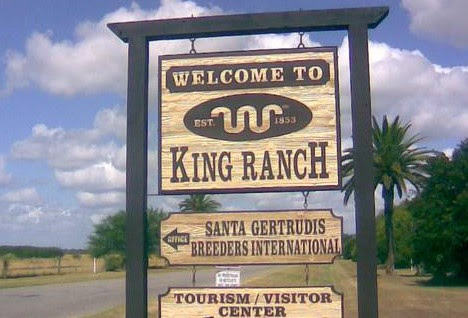
The King Ranch

My late father grew up in South Texas, near the King Ranch. I've never visited the ranch proper, but we used to pass by it all the time. I've eaten at King's Inn (yum!) and fished Baffin Bay. When I hear the ranch mentioned, it puts me in mind of dry grassy plains and prickly pear cactus. 

You can test me if you don't believe me. I know how to pronounce both Refugio and Riviera (Hint: it isn't the same as the French one). *grin*

The ranch is located in South Texas, between Corpus Christi and Brownsville, and adjacent to Kingsville. It was founded in 1853 by Captain Richard King and Gideon K. Lewis. 

The ranch is divided into four large sections and, though small portions border each other, does not consist of one contiguous plot of land. To give you an idea of the size, it covers portions of six Texas counties; most of Kleberg and much of Kenedy, with portions extending into Brooks, Jim Wells, Nueces, and Willacy.

In 1869, the ranch registered its "Running W" brand, which remains the King Ranch's official mark today. At the time, the ranch grazed cattle, horses, sheep and goats. By the mid-1870s, the ranch's hallmark stock had become the hardy Texas Longhorn. The ranch also had some South Asian Brahman bulls, which were well adapted to thrive in South Texas' hot climate. They were crossed with Beef Shorthorns to produce the ranch's own trademark stock, the Santa Gertrudis cattle.

During a terrible drought in the early days of the ranch, King purchased all the cattle from the people of the Mexican town of Cruillas, to help them. He realized he'd taken away their long-term means of survival, so he turned his horse around and asked them to come work for him. Many did, and they became know as Los Kineños - King's People. Some of their descendants still work the ranch today.

If you'd like to read more about the history of the ranch, you can find its timeline here.

Have you ever been to the King Ranch?

###

Personal update: 

My checkups went well, and I'm cleared to return to work next week. God kept me safe through a very big surgery and has provided for all my needs while I recovered. I am very blessed. 💗

Wednesday, June 7, 2023

Denver Madame Jennie Rogers ~ Julie Lence


activerain.com

   Back in the day of guns, gambling, and girls, Jennie Rogers was one of Denver’s most popular and richest madams. Alongside friend and rival Mattie Silks, men seeking a break from panning for gold or just wanting female company would seek out one of the two famous houses along Holladay street. Located in downtown Denver and named after Ben Holladay, the street’s name was changed to Market Street after Holladay’s heirs petitioned city council for the change as the street had gained an unsavory reputation throughout the west.  


Described as the most beautiful of all the madams on Holladay Street, Jennie hailed from Pennsylvania. Born on July 4th in Allegheny, her given name is thought to be Leah Weaver or Leah Tehme. Her father was farmer John Weaver and she aided the family’s income by selling produce in Pittsburgh’s market area.  It was there that she caught the eye of Doctor G. Fries. The two married but with Fries’ job keeping him from home too many instances, Jennie eventually left the marriage and took to traveling the waterways in Pennsylvania and Ohio where she met a steamship captain. She tired of that relationship, and around  circa 1870 she took a position as maid to Pittsburgh’s mayor, but when rumors began to circulate regarding her unsavory past, the mayor, though he liked Jennie, was forced to let her go, lending her a large amount of money so she could start her own business. She did, opening her first parlor house in St. Louis.    

Jennie’s house in St. Louis was a success, but she eventually heard of the gold and silver rushes happening in Colorado and moved to Denver. Her first house on Holladay Street she purchased from Mattie Silks for $4,600. She made that money back in less than a month, but Jennie’s house wasn’t run as cleanly as Mattie’s. Customers were arrested for smoking opium, some of her girls were arrested for the same and for stealing, and with society women in an uproar over the red light district, 1886 saw the law cracking down on the parlor houses. Unfathomed by this, Jennie went on to improve her house. Hating the stench hanging in the air of her home from stale perfume and cigars, Jennie was the first madame to open her windows and let in the fresh air, installing bars over the windows so her girls couldn’t admit a man they favored for free. She added fresh wall paper and paint and went on to purchase the house next door, where she joined the two by having a walk knocked out.   

Jennie was involved in numerous scandals, most of which are attributed to gossip, with her most famous one involving her wanting to purchase an even bigger house. It was said she had a boyfriend in St. Louis who was the police chief. When Jennie was ready to buy a larger house, wealthy Denver businessman George Splevin was running for governor. Splevin gained his wealth from taking over the company he currently owned and by marrying the former owner’s wife. Rumors abounded regarding Splevin’s first wife as she just seemed to disappear, so Jennie’s boyfriend concocted a blackmail scheme where he buried a skull in Splevin’s backyard and had the ‘D.A.’ dig it up, claiming it to belonged to Splevin’s first wife. In exchange for the charges being dropped, Splevin gave Jennie the $17,000 she need to buy her new house.       


denvercenter.org

 Jennie furnished the inside of her new home with oriental rugs, paintings, plush furniture, eye maple tables with mother-of-pearl inlay and a walnut staircase in the entry way leading to the girls’ rooms. She also had a parlor of mirrors and furnished the ballroom’s ceiling with a sixteen foot mirror, but those weren’t the parlor’s only claim to fame. Outside, at the top of the grey stone building’s 3rd story a face was carved in the stone. Most believed this was Jennie’s face. Along the top of the 2nd floor were the faces of 2 men and 2 women. Many thought they represented Jennie’s boyfriend, George Splevin and his 2 wives. Finished with this house, Jennie again bought the house next door and had a door cut into the wall to join the two, making her parlor rival those in San Francisco.

 In her personal life, Jennie’s relationship with the police chief fizzled out and she went on to marry John Wood, a bartender from the Brown Palace Hotel. She set him up in his own saloon in Salt Lake City, with folks speculating she wanted to keep her personal life and business separate, and for a time she was happy until she caught him cheating on her. She shot and wounded  him and then divorced him.  Upon returning to Denver, she expanded her business and holdings, including buying land in the northern area of the city and buying several shares in an irrigation and reservoir project in Logan County. In 1889, she learned her former husband was in Omaha running a saloon. They corresponded, married again in August 1889, and stayed together until John died 8 years later.   

 Jennie played a crucial role during the Panic of 1893 by supporting hundreds of destitute women. Instead of installing them in parlor houses, she set them up in respectable boarding houses until she could send them home. She also organized a retaliation when Denver’s city council passed an ordinance requiring soiled doves to wear yellow ribbons in their hair when strolling around town so respectable women could avoid them. Jennie had all of the soiled doves walk down the street outfitted in yellow from head to toe and the ordinance was soon revoked.   


hmdb.org

    As savvy as she was as a business woman, Jennie also loved horses and owned her own stable. She was an exceptional horsewoman and could handle a team better than professional drivers. Often she could be seen driving her matching team of grey horses along the streets of Denver. In 1904 she married again, this time to unsavory Archie Fitzgerald, a man rumored to be a Chicago politician. Their marriage lasted a few years, with Jennie thinking to divorce him after he encouraged her to spend her money on trivial matters such as vacations and after learning he was married to a woman in Kansas City and another on the other side of town. She never did, and stayed with him until her death in October 1909. Once her estate was settled, her parlor was sold to Mattie Silks and still stands today.         


hmdb.org


Tuesday, June 6, 2023

A Cowboy and His Pickup


What's a cowboy without a pickup? 

It tows his horse trailer. Hauls his equipment. Takes him to rodeos or bounces over cattle guards and across ruts on back roads. His pickup is more than just a vehicle. It's part of who he is.

General Motors Corporation has a long and successful history in pickup design. It started in 1941 with the Chevrolet AK-Series, continued with the Chevrolet and GMC 1955 Task Force, building a legacy of dependable, beautifully designed vehicles that worked for blue-collar business, farms, and ranches across the US. 

A new generation that offered four-wheel drive as a factory-built option arrived with the first C/K Series was produced from 1960-1965.  The Task Force series influenced the design of the C/K with wrap-around windshield and rear window, power steering and brakes, as well as a 12-volt electrical system. The C/K improved further on that design by offering the first drop-center ladder frame, making the cab of the truck sit lower. It was also the first pickup to offer an independent front suspension. It offered a more car-like ride and handing than the competition of the time. 

 The second generation of the series, marketed by both Chevrolet and GMC was produced from 1967 to 1972, under the "Action Line" moniker. 


As with its predecessor, the second generation C/K included full-size pickup trucks, chassis cab trucks, and medium-duty commercial trucks. The C/K’s body design was modernized and given the squarer look enthusiasts are more familiar with today. 

My oldest brother bought a C/K 10 in 1971. My dad liked it so much, he bought one in 1972.

Ol' Orange, as the pickup was dubbed, wasn't a vehicle that was kept polished and shined. It was a work truck. It hauled hay and kids and bags of feed. (Sometimes all at the same time!).  At any given moment, you could look in the bed of the truck and find a WWII era bucket full of fencing supplies, gopher traps, a shovel and pitch fork, hay leaves, and a tow chain. 

Some of my earliest memories are riding in that pickup with my dad. It was the first highway-legal vehicle (unless farm trucks and tractors count) I was allowed to drive all by myself (we won't talk about the age I was when that happened). 


Last fall, we were visiting Dad and he thought it might be fun to take Ol' Orange for a spin. Captain Cavedweler (my hubby) had to drop a new battery in it before we could get it up and going, but we drove the pickup out to my brother's place. I drove Dad there (with CC following behind in our pickup in the event we had a breakdown, which we didn't. On the way back to town, CC drove and I snapped this photo of him and Dad in Ol' Orange. I can't even begin to tell you how happy it makes my heart to see it. 

When I began writing Lucky Shot (part of the Pink Pistol Sisterhood series), and set the book in 1972, I knew the hero of the book, Levi, needed his own orange and white pickup to drive. 


What’s a girl to do when her aim is true?

As a registered nurse at the Boise VA Hospital, Grace Marshall is devoted to her patients, but some wounds require more than medical care. A patient too stubborn and angry to accept the help he needs storms out of her exam room, ruffling her feathers. Yet, when the man returns to apologize, something about him tugs at her heart.

Levi Gibson left for war young and idealistic but returned from Vietnam with physical scars and a haunted soul. He tries to banish the darkness brewing inside him with hard work on his family's potato farm, but it’s a young nurse’s kindness that brings unexpected light and joy into his life. If Levi can open up to Grace and let her see his pain, could she be the key that unlocks a future full of hope instead of mere survival?

After her father sends Grace a legendary pistol, target practice provides an excuse to spend time with Levi during the summer of 1972. As his shadows overwhelm him, it will take far more than a lucky shot for Grace to hit love's mark.


USA Today Bestselling Author Shanna Hatfield is a farm girl who loves to write character-driven romances with relatable heroes and heroines. Her sweet historical and contemporary romances are filled with sarcasm, humor, hope, and hunky heroes.

When Shanna isn’t dreaming up unforgettable characters, twisting plots, or covertly seeking dark, decadent chocolate, she hangs out with her beloved husband, Captain Cavedweller.

Connect with her online at shannahatfield.com

Monday, June 5, 2023

Coelophysis: Dinosaur of the Old West


By Kristy McCaffrey

When you think of dinosaurs, Tyrannosaurus rex comes to mind but there were many types of theropod that came before it. Coelophysis was a small bipedal carnivore and was one of the earliest dinosaurs to walk the earth. It was also an ancestor of T. rex.

Coelophysis, a small dinosaur from the
Triassic Period (considered to be
the Dawn of the Dinosaurs)

Dinosaurs lived during the Mesozoic Era (sometimes called “the Age of Reptiles”), which spanned from 252 million years ago to 66 million years ago. It was comprised of the Triassic, Jurassic, and Cretaceous Periods. Early dinosaurs (such as Coelophysis) emerged in the Triassic, but they were quite small. Giants such as T. rex and enormous sauropods such as Brontosaurus and Diplodocus lived during the late Jurassic and Cretaceous.

A Coelophysis fossil at the
Museum of Northern Arizona

In 1889, Edward Drinker Cope was the first to identify and name Coelophysis. The first remains were found by David Baldwin, an amateur fossil collector working for Cope, in 1881 in northwestern New Mexico. These first finds were too poorly preserved to give a full picture of the dinosaur, but in 1947 a massive graveyard of fossils was found in New Mexico containing many well-preserved and fully articulated specimens.

It is theorized that Coelophysis may have
run in packs, although no direct
evidence supports this

There is wide consensus today that birds descended from theropods such as Coelophysis. (T. rex has more in common with the modern-day chicken than to a crocodile.) Both birds and theropods shared wishbones, likely incubated their eggs, had hollow bones, and were covered in feathers.

In my upcoming book, THE CANARY, Dr. Jack Brenner and Sarah Ryan are on the hunt in the Arizona desert for Jack’s father, the esteemed paleontologist Dr. Allan Brenner. And Allan is on the hunt for Coelophysis.

Coming July 25, 2023. Pre-order a copy today!!


Read an excerpt

Jack and Sarah have entered a marriage of convenience for various reasons, one being her difficult relationship with one of her professors, Dr. Everett Pierce. Isaac is a Comanche friend and paleontology assistant of Jack’s father.

“And why are you here, Dr. Pierce?” Sarah asked, sitting up straight and looking him in the eye. Either she was a very good actress, or her animosity was real. Jack at least had to concede that it was likely the latter. 

“I’ve been contracted to explore the area,” he said.

“By whom?” Isaac cut in.

“Roderick Melton.”

That Pierce was still tied to Melton shouldn’t have surprised Jack, but it did, despite that it was no secret Pierce’s father pulled strings wherever he could for his son. It had been a topic of gossip in paleontological circles that the elder Pierce had been trying to establish business relations with Roderick Melton. And then there’d been the business with Betsy. Unbeknownst to Jack, he’d been in a romantic triangle with her and Pierce, and while he blamed Pierce wholeheartedly for being an unethical ass, Betsy had decisively left Jack despite that he’d protected her from possibly going to jail, which probably wouldn’t have happened considering Roderick’s wealth.

But Pierce had never won Betsy’s hand—she had later married someone else—and it had been the one bright spot in an otherwise painful period of Jack’s life.

He kept his reaction to himself by raising his glass—the whiskey this time and not the beer—and nursing a long drink.

Isaac folded his hands together on the table. “Selling out, are you?”

“Don’t give me the holier than thou speech,” Pierce replied with a smirk. “We’re all in it for the money. Private collectors have as much right to house collections as museums.”

“At least we know now for certain,” Isaac said.

Pierce raised a brow. “What’s that?”

“You have zero ethics.”

Unethical ass echoed in Jack’s head.

“Ethics don’t pay the bills,” Everett said. “And what about Allan Brenner? Who’s paying his bills?”

Jack and Isaac didn’t respond, so Sarah filled the empty space. “Yale University,” she said. “And Helen Parks, I would assume.”

“Yes, of course,” Pierce said conversationally, leaning forward. “And she’s the one who hired you, right Sarah?”

Jack didn’t like the proprietary tone in Pierce’s voice as he said her first name.

“You know,” Pierce continued. “If you’d wanted a dig, you could have come to me. I could’ve introduced you to Melton.”

“Like you did with Jane?” she countered.

Pierce’s eyes narrowed and he swallowed nervously, his Adam’s apple bobbing noticeably. “Jane quit school, a reminder that women really don’t have what it takes to be out here.”

“I’ve heard that could be said of some men, as well.” Sarah offered a polite smile while sipping her drink.

Jack tried not to laugh, but his lips twitched anyway.

Pierce rose to his feet. “I look forward to seeing you in class in the fall, Mrs. Brenner. I’m sure you’ll have much to share with the other students after your summer here.” He adjusted his jacket. “Gentlemen. I expect I’ll see you out there.”

“Not if I can help it,” Jack said plainly.

Pierce snatched the bottle of whiskey, clearly unwilling to leave the remainder with them. “Allan Brenner thinks he’s some sort of god out here. He’s not. 

“I get it now,” Isaac said with a knowing nod. “You’re here to outshine him. How exactly do you propose to do that?”

“He’s pinned so many of his theories on Coelophysis,” Pierce said, “but he’s yet to find a full skeleton. And when I find one, I’ll debunk every hypothesis he’s put forward.”

Learn more about Kristy's books at kristymccaffrey.com