Showing posts with label Buffalo. Show all posts

Wednesday, November 5, 2025

Pioneer Meals ~ Julie Lence


Courtesy Modern Pioneer Mom

 ‘What’s for dinner?’ It’s the phrase everyone across the globe utters daily. Italians are mostly likely serving pasta. The night’s menu in Mexico might include tamales, while over in the Caribbean, folks could be frying fish. In the U.S., dinner ranges anywhere from fast food to chicken & dumplings, to steak & potatoes. At the end of this month, most Americans will sit down to a feast of turkey, ham, potatoes, gravy, and stuffing. With today’s modern stoves,  microwave ovens, gas grills, and deep fryers, preparing a large meal isn’t too difficult or time consuming. Back in the day, it was both. Pioneer women and chuck wagon cooks stood over the fire from sun-up to sun-down cooking the day’s meals. They kneaded dough and churned butter without the help of today’s appliances, and woke early the next morning to start all over again.

Ever wonder what those women and chuck wagon cooks were serving up?

With flour, sugar, corn meal, potatoes, beans, and fruits and vegetables such as pears, squash, corn, and pumpkin filling home larders, pioneer women served a breakfast of coffee, bread & butter, cold meat from the day before, and corn cakes. Lunch was the main meal and included dried pumpkin, beans & butter, turnips, fruit, and some sort of meat (deer, rabbit, turkey, pork, beef, buffalo, and chicken). Supper was a lighter fare of porridge or bread and milk. Molasses or sweetened water was used if milk wasn’t available.   

courtesy YouTube
Chuck wagon cooks dished up meals of beans, fresh beef, dried fruit, biscuits, bacon, potatoes, eggs, and salt pork to cowboys. Saloons served pork & beans with bacon, pickled eggs, and pretzels. And in those lunch pails children carried to school were cornbread and syrup sandwiches, bread with lard, or bread and bacon. To keep meat from spoiling, pioneers often had a smokehouse on their property where early November they would erect a low-burning fire and hang meats to cure. (This process took several weeks and once complete, the meat kept well into the following summer.) Vegetables were canned and fruits were dried.

Cooking and storing food to last throughout the year wasn’t easy. As much as I adore the wild west, I prefer cooking on my electric stove and gas grill and having a refrigerator to keep fruits and vegetables from spoiling.   
Wednesday, April 2, 2014

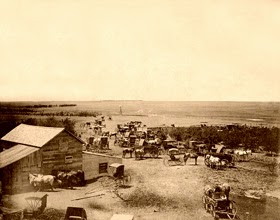
Dodge City, Kansas


Dodge City Gathering

Dodge City. The name itself conjures up images of saloons, brothels and gun fights in the street. Wyatt Earp and his brothers come to mind. So do Bat Masterson and Bill Tilghman. But long before these men brought law and order to the notorious cowtown, Dodge City started out as nothing more than an army post.

Fort Dodge was established in 1865 along the Santa Fe Trail. The main objectives of the army was to keep wagon trains and the U.S. mail safe from attacking Indians and to serve as a supply base for detachments participating in the Indian wars. The Cheyenne, Kiowa and other tribes populated the area, as buffalo and other wild game were abundant. Six years later, at the foot of a hill west of the fort, Henry L. Sitler built a three-room sod home. Sitler was a cattle rancher and his home quickly became a twenty-four hour stopover for travelers and buffalo hunters.

George M. Hoover arrived shortly after Sitler and opened Dodge’s first business; a saloon. After Hoover, a group of businessmen from Forts Dodge, Riley and Leavenworth organized the Dodge City Town Company. The company began the planning and developing of the town. Originally, they named the settlement Buffalo City, but since a town with that name already existed, they changed the name to Dodge City. The Atchison, Topeka and Santa Fe Railroad arrived in September 1872 and Dodge grew rapidly in size and population over the next few years.

Buffalo hunters, railroad workers, soldiers and drifters came to town, packing the saloons, dance halls and brothels. Laws didn’t exist and the military had no jurisdiction. Gunfights abounded, with men dying in their boots; hence the need for a burial place. Boot Hill Cemetery was developed and remained in use until 1878. Before that, men were buried wherever a hole could be dug, or, if he had friends or money, he was buried in the post cemetery.

Buffalo Hide Yard 1878
Dodge City was known as the Buffalo Capital, until mass slaughters destroyed the herds. By 1875, the Buffalo were gone, and so was the source of income for local farmers who gathered the bones and sold them for profit. The bones were used to make china and fertilizer. Luckily, the cattle trade shifted from Ellsworth and Wichita to Dodge City, keeping Dodge from going belly-up. But along with thousands of Longhorn making their way to Dodge in a ten year span came more lawlessness in the form of cowboys. The mayor contacted Wyatt Earp, who was a lawman in Wichita at the time, and asked him for help, offering an unheard of salary of $250 per month. Wyatt took the job and hired four deputies to assist him; Bat Masterson, Charlie Basset, Bill Tilghman and Neal Brown. 

Peace Keepers
Wyatt Earp and his deputies assessed the layout of Dodge and the best course of action to bring law and order to the town. Earp initiated a ‘Deadline’ north of the railroad yards on Front Street. The area north of the deadline was mainly commercial business and it was his intent to keep this area quiet. South of the ‘Deadline’ consisted of saloons and brothels. A gun ordinance went into effect banning guns from being worn or carried. Those on the south side who didn’t cotton to the new ordinance carried on as usual.
The term ‘red light district’ sprung from here, as railroad men carried their red caboose lanterns at night to visit the brothels. With so many disobeying the new ordinance, Earp soon found his jail cells full.

Earp left Dodge for a while to track famed outlaw Dave Rudabaugh. When he returned, he was made marshal of Dodge City and asked the courts for more severe sentencing. He also organized a committee similar to modern day neighborhood watches to police the streets. Ed Masterson became the assistant marshal in June of 1876. His brother Bat became under-sheriff. In January 1878, Bat became the sheriff, and Wyatt Earp left Dodge in 1879. The Santa Fe rail line reached Santa Fe in 1880, bringing an end to the use of the Santa Fe Trail and to people traveling to Dodge. At the same time, the Indian tribes were housed on reservations and there was no further need for a military presence. Fort Dodge closed in 1882 and the cattle drives ceased in 1886. Today, Dodge City is home to approximately 30,000 people. 

Friday, June 14, 2013

Energy Efficiency in the Old West by Ginger Simpson

Jacquie Rogers usually posts on the 2nd Friday, but she's accompanying a friend to an out-of-state funeral so I thought I would recycle a blog from my personal site to share here.  

In an age where we are concerning about rising fuels costs, going green and saving energy and the earth's resources, I often wonder why builders continue to construct such huge homes.  Does a family a four really need a 4000 square-foot home?  Or is the size of a person's home these days symbolic of their success or failure in life?  I, for one, have decided that I don't need the extra space and much prefer a small home now compared to my 2500 sq. ft. one of 25 years ago.  At the time I had two children living at home, but with just Hubby and me most of the time, I'm happy with a lot less room.  So, let's look at how a family of four might have lived had they been Lakota Sioux back in the 1800s.

For the Plain's Indians, portability was a must.  They migrated from summer to winter camps, following the buffalo herds. Everything the tribe owned was easily packed and readied for travel by horseback.  The poles used to create the tepee structure were used over and over again, and also served as the travois on which personal belongs were loaded, much like a trailer today, and pulled behind the animal.  Upon construction, the tepee usually faced east and had a slight slant in that direction to combat the sometimes prevalent prairie winds.  The door--a flap that when closed, signaled a desire for privacy.  Back in the day, there wasn't a Walmart close by where you could pick up a new rug or liven up the decor, or a Target where you might replace a broken dish.  Since toilet practices aren't discussed in most historical research books, I can't image having my own "on suite" which is now called the adjoining bathroom, thought I definitely would have the open concept so many seek. Alas, no stainless appliances or separate play room for the kids.  Back then it was called outdoors, and it served the purpose all year long.

Buffalo served many purposes for the tribe.  Usually as many as twenty hides covered the pyramid structure, and were held together by wooden lodge pins.  Furry and warm hides also served as bedding and were rolled and stored during the day.  A smoke flap at the top of the tepee could be adjusted to ventilate or retain heat, depending on the season.  Bags known as parfleches and made from animal skins, served as closets and drawers.    Heated stones kept the interior warm, but firewood was kept close at hand when readily available. Carrying wood wasn't just a chore needed for warmth, but as fuel for meals prepared daily.

During the winter months, more skins, sometimes brightly painted to reflect family or tribal history, were added along the bottom to hold in the heat. Tepees were viewed by the Indians as *"a good mother who sheltered and protected her children."

Backrests made from woven willow bark or other materials served as chairs for the family.  Bows, arrows, medicine bags, and other belongings might be suspended on the interior walls.  The woman's sewing bag usually held sinew thread and needle shaped bones, made from the buffalo, and her cooking was done in a buffalo paunch pot.

Unlike the white trappers and traders who killed buffalo for sport and their pelts, the American Indian prized everything about nature and nothing was wasted from their kills.  Every part of the animal served some function necessary to life. Everything from the string on their bows, the fur that sheltered them from cold winter winds and snow, and the bladder in which they toted their water came from one shaggy beast.  When the herds began to disappear, so began the tribe's sojourn into oblivion.    

So, how would you fare living in the 1800s when the heat outside was unbearable or the cold air nipped at your nose even inside your home?  I wonder what Al Gore would have said back then.  Perhaps burning buffalo chips was bad for the ozone, but I guess we'll never know.


*I learned my historical facts from a Reader's Digest book entitled, America's Fascinating Indian Heritage and I've woven some of these facts into a few of my historical novels. There's so much more to share, so stay tuned.

Wednesday, May 15, 2013

A Day In The Life of a Squaw by Ginger Simpson

First, I'd like to offer the definition of "squaw" as found on Wikipedia:  "Squaw" is an English language word, used as a noun or adjective  whose present meaning is an indigenous woman of North America.  It is derived from the eastern Algonquian morpheme meaning 'woman' that appears in numerous Algonquian languages variously spelled squa, skwa, esqua, sqeh, skwe, que, kwa, ikwe, exkwew, xkwe, etc. At present, the term is often held to be offensive.

I'd like to note that my use of the term in my title is in no way intended to be offensive, rather to pay tribute to the hard-working Indian women of the 1800s as shown by my research as relates to the plains Indians, more specifically, the Sioux.


Imagine the creature comforts we enjoy today...the chores we hate, like cleaning toilets, dusting, grocery shopping, and then imagine yourself a Lakota Woman living in a lodge for which you are solely responsible.  Yes, the men killed the buffalo, but once the animal carcasses littered the land,  the women were charged with butchering the meat and remains into every salvageable piece. 

The buffalo supplied almost all the necessities of the tribe.  As well as being a main source of food, other parts of the animal were utilized as well.  For example, the bladder served as water containers, the bones were fashioned into eating utensils.  The skins were used for a wide variety of purposes.  When a baby was born into the tribe, they were often swaddled in a soft calf skin, and in death, a hide served as a shroud.  


Women sewed hides together to make tepee covers, while others were scraped and softened and used as blankets and clothing.  Drums heads, shields, and rattles came from the thick pelt from the neck, and rawhide was made into ropes and sinew for bow strings.  Even the thread used to sew came from the buffalo. 


 A difference between summer kills and winter kills determined the usage as the animal's fur was longer and thicker during the colder period of time.  Butchering and salvaging the animal was no easy feat, but the constant wetting, drying, stretching, and smoking of the hides to soften them took days and wore many blisters onto a woman's hands.  Weaving the hair provided stuffing for cradleboards, moccasins, and other apparel.  Virtually, nothing was wasted.  This might explain why when the white men started slaughtering the animals for sport, the Indian way of life didn't last much longer.

The tepee belonged to the woman.  She created it, put it together, dissembled it for moving and re-erected it many times.  The amount of skins necessary to construct the lodge depended upon the size...often somewhere between six and twenty-eight pelts.  That's a lot of scraping and preparation.  My little bit of dusting is starting to look good.

Unless a "chore" was befitting a warrior, women were responsible for most of the work.  She wasn't just the person who created the clothing, she also adorned dresses and shirts with beads and quills.  She watched the children, made the meals, pounded the clothing clean on river rocks, and was subservient to her husband.  Divorce in those days came as easy as beating a drum and declaring a man was throwing away his wife, and it wasn't uncommon for polygamy... usually sisters married to the same man because it was believed they got along better than two women from separate families.  


I think the only break an Indian woman got was during the monthly time when the males believed a bleeding woman could zap their spiritual energies and strength.  For this reason, a wife was sent to what was commonly called the "women's hut" until her menses had passed.  Men didn't share a part in the of the birthing of a child either.  The responsibility usually fell to the medicine woman and female relatives of the mother-to-be.  Think giving birth today is difficult?  Imagine squatting over a trough dug into the ground while you labor to deliver your baby.  Of course, a stake was driven into the ground to help the woman maintain her balance and squeeze when the pain became intolerable.  Boy, that doesn't sound like fun, does it?  Give me drugs!

I'm sure I've omitted a lot of what the Indian women lived through, but I can hardly go a day without my curling brush and eye glasses.  I can only imagine the dimmed vision of the elderly who didn't have the modern improvements we enjoy.  Beauty had to be in the eye of the beholder, because skin creams, mascara, and blush were decades away.  Think we have it rough?  Think again.  The Indians were a hardy breed until the white man invaded their land and life and brought along diseases likes small pox and diphtheria. Harken back to all the lies the government told and the acreage they stole.  Next time you're pondering which ethnic race was truly treated unfairly....think about the American Indian.   

I've written a few books about the Indian life:
Destiny's Bride
White Heart, Lakota Spirit
Sarah's Heart/Sarah's Passion (past and present day story) and I'm currently working on Yellow Moon which will relay the story of a young Lakota woman.

I think I was a squaw in another life because of my fascination with the Lakota tribe. You can find my work on Amazon, most available both in print and for your Kindle. Little by little, my offerings are being found on various other sites as well, so if you prefer All Romance eBooks, I'm pretty sure you can find my work there, too.


Wednesday, October 17, 2012

Ginger sings...Oh Give Me a Home Where the Buffalo Roam...


This title to this post contains a familiar line from a famous old song...one which might have been more appropriately sang by the plains Indian tribes, among which the Sioux counted. Their very lives depended upon the shaggy beast that gradually disappeared from the prairies as white men took sport in killing this poor-sighted animal.

 Ritualistic in thought and deed, each year throngs from the nomadic Indian tribes gathered for what was known as a Summer Sun Dance to pray, make offerings, visit, and prepare for a buffalo hunt.  Stripped down to breechclouts and moccasins, and riding downwind because of the animals superior sense of smell,  mounted warriors darted in and out of the herd, trying to drive a major number into a circle so they could easily be picked off with their bows and arrows.  Many men lost their lives in pursuit of the massive prey.

Returning to to the camp with an ample kill was cause for celebration.  While the women did the majority of butchering and readied meat for the cooking racks, the man often ate  raw organs such a livers and kidneys...a sign of strength and virility.  The tongue and hump were favorites upon which the majority of the tribe feasted, but nothing was wasted. 

The scraped skins served a variety of purposes:  swaddling for the young, shrouds for the dead, and anywhere from six to 28 pelts sewn together to cover a tepee.  Once tanned and softened the hides were made into shirts, leggings, dresses and moccasins.  During autumn hunts, the longer haired pelts served the people well as blankets and robes.  The animal was revered and thanks always given to the Great Spirit for prosperity in a hunt.

Even the sinew for bows and sewing came from buffalo tendons and rawhide.  Woven hair served as strong rope, cradleboard stuffing, pillows and horse blankets.  Horns were fashioned into spoons and vessels from which to drink, while even the bladder became a pouch sufficient for hauling water and the paunch, a cooking pot.  Suspended over a fire on four sticks and filled with water heated by hot rocks, the stomach made a fine cooking kettle.

What meat left over from the celebratory feasts was dried into jerky or pounded together with fat and berries into something called pemmican which sustained the families through the winter months or nourished warriors who journeyed away from the village.

While the majority of animal parts belonged to the tribe, the tepee itself was considered the property of the woman.  She made it, erected it and took it down when the tribe migrated.  We often see and read about the bravery of the warriors in movies and books, but the true workforce behind the American Indian had to have been the women.  Take about heroines...

I'd be lost without my research source purchased years ago:  America's Fascinating Indian Heritage.  I've learned so much from this book from Reader's Digest and authored by James A. Maxwell, I've practically memorized it.

My love for the American Indian is endless.  I can't explain the fascination or adoration, but I do know that my next book will be about an Indian heroine.  You had to have been strong to have survived as a female, facing the hardships, expectations, and tribulations of what we know as the old west.  There's just so much to tell.

Monday, May 7, 2012

Indian Heritage


Ciara Gold is normally slated to appear today, but I'm going to step in for her as she's a busy lady, and preparing for a trip to Italy.  I don't mind at all, because I'm a big fan of America's Indian heritage and love to blog about it.  Since I love writing western historical, readers shouldn't be surprised to see an Indian hero pop up now and then in one of my novels .  I'm fascinated by the lore and legends of the various tribes.  Today, I'm going to share with you perhaps some facts you might not know or have forgotten since H.S. History.  *smile*

Tribes were generally sorted into one of three categories, based on where and how they lived:
1.  Hunting and gathering
2.  Agriculture
3.  Fishing


According to my main research book, America's Fascinating Indian Heritage, during the turn of the sixteenth century, most of the tribes living in the east, midwest, and part of the southwest settled there and became, primarily, farmers who raised a wide variety of crops.

Along the northwest coast and the coastal areas of the southeast, Indians lived mainly in settled villages and depended upon food from the rivers, streams and oceans. Of course they're methods depended upon their tribal affiliations, netting, spearing, canoes.  You get the idea.

The majority of North American Indians were considered hunter/gatherers who were nomadic in nature and charted their travels to coincide with the movement of game or the harvesting pattern of crops planted by Mother Nature.

As weather patterns changed, different areas of North America became more settled, and "area" dominated the manner in which the tribes were classified.  For example, the Plains Indians were broken into Language groups as they migrated from places where droughts and other life-altering events made living impossible:


Siouan
Kowan
Caddoan
Algonquian
Shoshean
Athabascan

The tribes falling within these categories were primarily:  Sioux, Cheyennes, Kiowas, Blackfeet, Sarcee, Cree, Gros Venture, Assinboin, Hidatsa, Mandan, Arikara, Ponca, Iowa
Omaha, Quapaw, Caddo, Comanche, Oto, Kansa, Arapaho and Pawnee.

With the introduction of the horse in the seventeenth and eighteenth centuries, more of the tribes switched from the sedentary agricultural lifestyle to a nomadic one centered around the buffalo.  My favorite tribe, The Sioux (specifically the Dakota tribe) became one, and I've continued to be fascinated by how much this animal contributed to their survival.


So as not to overload your brain, I'm going to stop now with a promise to continue with more of the interesting history of our Native American Indians at another time.  Thanks to Ciara, for letting me fill in for her today, and thanks for visiting.  If you enjoyed my post, I'd love to know it.   Sending you "Cowboy Kisses."