 |
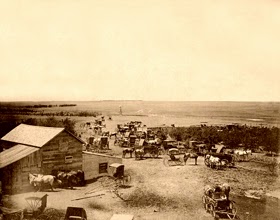
| Dodge City Gathering |
Dodge City. The name itself conjures up images of saloons,
brothels and gun fights in the street. Wyatt Earp and his brothers come to
mind. So do Bat Masterson and Bill Tilghman. But long before these men brought
law and order to the notorious cowtown, Dodge City
started out as nothing more than an army post.
Fort Dodge was
established in 1865 along the Santa Fe Trail. The main
objectives of the army was to keep wagon trains and the U.S. mail safe from
attacking Indians and to serve as a supply base for detachments participating
in the Indian wars. The Cheyenne,
Kiowa and other tribes populated the area, as buffalo and other wild game were
abundant. Six years later, at the foot of a hill west of the fort, Henry L.
Sitler built a three-room sod home. Sitler was a cattle rancher and his home
quickly became a twenty-four hour stopover for travelers and buffalo hunters.
George M. Hoover arrived shortly after Sitler and opened
Dodge’s first business; a saloon. After Hoover,
a group of businessmen from Forts Dodge, Riley and Leavenworth
organized the Dodge City Town Company. The company began the planning and
developing of the town. Originally, they named the settlement Buffalo
City, but since a town with that
name already existed, they changed the name to Dodge City.
The Atchison, Topeka
and Santa Fe Railroad arrived in September 1872 and Dodge grew rapidly in size
and population over the next few years.
Buffalo hunters,
railroad workers, soldiers and drifters came to town, packing the saloons,
dance halls and brothels. Laws didn’t exist and the military had no
jurisdiction. Gunfights abounded, with men dying in their boots; hence the need
for a burial place. Boot Hill
Cemetery was developed and remained
in use until 1878. Before that, men were buried wherever a hole could be dug,
or, if he had friends or money, he was buried in the post cemetery.
 |
| Buffalo Hide Yard 1878 |
Dodge City was
known as the Buffalo Capital, until mass slaughters destroyed the herds. By
1875, the Buffalo were gone, and so
was the source of income for local farmers who gathered the bones and sold them
for profit. The bones were used to make china and fertilizer. Luckily, the
cattle trade shifted from Ellsworth and Wichita
to Dodge City, keeping Dodge from
going belly-up. But along with thousands of Longhorn making their way to Dodge
in a ten year span came more lawlessness in the form of cowboys. The mayor
contacted Wyatt Earp, who was a lawman in Wichita
at the time, and asked him for help, offering an unheard of salary of $250 per
month. Wyatt took the job and hired four deputies to assist him; Bat Masterson,
Charlie Basset, Bill Tilghman and Neal Brown.
 |
| Peace Keepers |
Wyatt Earp and his deputies assessed the layout of Dodge and
the best course of action to bring law and order to the town. Earp initiated a
‘Deadline’ north of the railroad yards on Front Street.
The area north of the deadline was mainly commercial business and it was his
intent to keep this area quiet. South of the ‘Deadline’ consisted of saloons
and brothels. A gun ordinance went into effect banning guns from being worn or
carried. Those on the south side who didn’t cotton to the new ordinance carried
on as usual.
The term ‘red light district’ sprung from here, as railroad
men carried their red caboose lanterns at night to visit the brothels. With so
many disobeying the new ordinance, Earp soon found his jail cells full.
Earp left Dodge for a while to track famed outlaw Dave
Rudabaugh. When he returned, he was made marshal of Dodge City and asked the courts for more severe sentencing. He
also organized a committee similar to modern day neighborhood watches to police
the streets. Ed Masterson became the assistant marshal in June of 1876. His
brother Bat became under-sheriff. In January 1878, Bat became the sheriff, and
Wyatt Earp left Dodge in 1879. The Santa Fe rail line reached Santa Fe in 1880, bringing an end to the use of the Santa Fe Trail and to people traveling to Dodge. At the same time,
the Indian tribes were housed on reservations and there was no further need for
a military presence. Fort
Dodge closed in 1882 and
the cattle drives ceased in 1886. Today, Dodge City is home to approximately 30,000 people.


