Showing posts with label western movies. Show all posts

Tuesday, August 13, 2024

Have you Seen Brisco County Jr.?

 Post by Doris McCraw

aka Angela Raines


Those who know me know I love Westerns. Western stories, Western movies, and Western TV shows.

Of the early westerns, "Ox-Box Incident" with Henry Fonda and Harry Morgan, and "3:10 to Yuma" with Glenn Ford and Van Heflin are probably my favorites.

Of the "B' Western, any Hoppy movie, or one with Alan 'Rocky' Lane are at the top of the list. Of course, Tim Holt movies are worth a look.

Alan 'Rocky' Lane
Image from Wikipedia

TV shows - "Gunslinger", "Laramie", and "Cheyenne" are tops. However, a late arrival in the Westerns is a show called "The Adventures of Brisco County Jr." I loved that show.

It was a unique take on the Western genre. There were some supernatural elements, a horse who was smarter than almost anyone else, along with a villain and hero who were just plain fun.

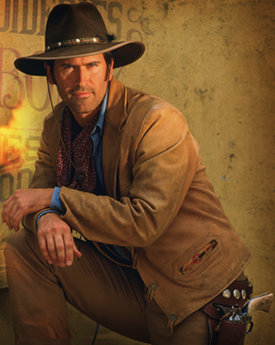
Bruce Campbell as Brisco County Jr.
 Image from Wikipedia

The cast, composed of Bruce Campbell, Julius Carry, and Christian Clemenson as, and get this character name, Socrates Poole.  

I made it a point to see every episode and even bought the DVD series when it became available.

If you get the chance and want a good laugh, check it out. 

Trailer for '3:10 to Yuma'

Trailer for 'Ox-Bow Incident"

Trailer for 'Brisco County Jr.'


Until Next Time: Stay safe, Stay happy, and Stay healthy. 

Doris


Tuesday, December 10, 2019

Secondary Characters and Villains

Post by Doris McCraw
writing as Angela Raines


December, the time of Holiday cheer, parties and family. Of course, for authors, it's still writing time. For me, the longer nights sometimes translate into more writing or at least more reading. It is definitely watching DVDs and streaming old Westerns time.

I am a huge fan of the old B Westerns and older TV Westerns. When I say B Westerns and Old TV Westerns I'm talking about the movies from the 1930s to about 1950 and TV shows from 1950 to 1962. I have many of them on DVD or stream them. There is nothing quite so much fun as watching episodes of "The Cisco Kid", "The Rebel" or "Yancy Derringer". Of course, anything with Alan 'Rocky' Lane or Charles Starrett is quite fun. I will also point out, I'm always watching to see who wrote the stories for the episodes or film. Many of the early pulp authors who later became well-known did stints as scriptwriters.

Charles Starrett 1940.jpg
Charles Starrett - 1940
from Wikipedia
Looking back at these various works brought home how important villains are to a story, but the secondary characters also. In "The Encyclopedia of Feature Players in Hollywood", Jim Goldrup, one of the authors says this in his introduction about secondary characters: "Principle characters are bound by hero or heroine rules, “the others” aren’t, and they of necessity must not be, in order for the good guys to look good, in order for them to play their parts."

For me, as an author, I try to have a strong villain, and additional characters that enhance the story I'm trying to tell. Additionally, because of my background in theater, my villains have to believe in what they are doing as much as the hero/heroine does in their actions. Their misguided humanness can be some of the most powerful storytelling. Some of the best scenes happen when the two clash over their viewpoints. The movie, "The Ox-bow Incident" is so powerful because of that clash and the reactions of the secondary players.

Would "The Magnificent Seven" and it's predecessor "The Seven Samurai" be the powerhouses they are if the villain were not a strong as the leads?

I confess, even though I write romance, with the happy ever after, I am at heart an action-oriented writer. I love the hero who is strong enough to save the day, but his partner, the heroine has to be his equal in strength of character. They both have to be strong enough to survive the dangers of the Western landscape along with the depth to understand what the other is going through. It can sometimes be a fine line between strength and overbearing. That is where the secondary characters add so much. Many times the leads need someone as a sounding board, someone who can listen without judgment and give advice when needed.

Villain, secondary characters, heroes, and heroines can create a world where the author can tell their story, and the reader gets to live the lives written on the pages. So this Holiday season, enjoy family, friends, books, and movies. Then authors, if you so desire, write a few more lines on that story. Readers, look to see how the storyteller combines the pieces to create the world you are enjoying.

For those how would like to check out some of the old shows, The Cisco Kid - YouTube,
Yancy Derringer - YouTube, Alan 'Rocky' Lane movies - YouTube


Doris Gardner-McCraw -
Author, Speaker, Historian-specializing in
Colorado and Women's History
Angela Raines - author: Where Love & History Meet
Angela Raines FaceBook: Click Here


Tuesday, February 12, 2019

WRITING- WESTERNS & THREE ACT STRUCTURE

Photo property of Doris McCraw
This is the third in the series of screenwriting, novel/story writing. You can read parts one and two here:


In screenwriting, a majority of films, especially the older films, are based on the three act structure. Below is an overview of the concept.
    The three act structure:
    • The great Greek philosopher Aristotle was the first to concluded, in his works "the Poetics", that stories should have a single whole action or a story arc.
      • Beginning – There must be a motivating event that kicks a story off. The purpose is to get the attention of the audience.
      • Middle – There must be trials and tribulations for the story to move through. Done correctly the purpose will build an emotional roller coaster connection with the audience.
      • End – This is the climax and resolution. Once the audience has built an emotional bond they expect a logical outcome.
    • Concerning the three act structure, Aristotle is only concluding that most individuals respond and comprehend the three act structure.

Think of your favorite story or movie. Does it fit the three act structure? I love the B Western movies with stars such as Allan ‘Rocky’ Lane, Bob Steele, and early John Wayne. Do they follow the three act structure? It begins with the conflict/ set up, then the stakes rise/rising action which eventually leads to resolution. If you study them, yes they do. To view 'Rocky' Lane on YouTube: Death Valley Gunfighter

Allan 'Rocky' Lane
How about the novel? Probably most of your favorite stories will follow this structure. Take a look and do your own examination.

So as we write our stories or screenplays, what that story arc is what we call plot.

  • Plot composition can be viewed as:
    • The “Arch plot” is the most common plot composition, and the obvious reason for that is that it’s generally build around a three act structure. As stated by Aristotle the audience typically wants a single whole action or a story arc to happen. The audience builds empathy or sympathy for the characters and would prefer those characters learn something on their journey from point “A” to point “B”.
    • Other plot structures include Mini Plot, Anti Plot, and Non Plot. These generally fall into the concept of shattering expectations.
  • Shattering expectations:
    • As stated a few times writing is NOT a list of rules, but a list of principles. Once mastering the art of writing the Arch plot three act structure story, one might want to venture into the unknown. This is where breaking the mold of the Arch plot can be enjoyable and hazardous to one’s career. If you plan to venture into Mini Plot, Anti Plot or Non Plot, be prepared for possible backlash and audience drop off. Most patrons have story expectations that are commonly found in Arch Plot / Three Act Structure stories. Taking those folks out of their comfort zones typically has undesirable effects. But these stories can also be very fulfilling to those people who enjoy different types of story.

So as you follow your dream of writing or as you are reading your favorite stories, think about the principles discussed in this series. For those who would like to delve deeper into this subject, below is some suggested reading.

  • Suggested Readings
    • Robert McKee – Story: Style, Structure, Substance, and the Principles of Screenwriting
    • Carl Jung – The Archetypes and The Collective Unconscious, (Collected Works of C.G. Jung Vol.9 Part 1)
    • Jennifer Van Bergen – Archetypes for Writers: Using the Power of your Subconscious
    • Joseph Campbell – The Hero With a Thousand Faces
    • Christopher Vogler – The Writers Journey: Mythic Structure for Writers, 3rd Edition
    • Michael Tierno – Aristotle’s Poetics for Screenwriters: Storytelling secrets from the Greatest Mind in Western Civilization


Doris Gardner-McCraw -
Author, Speaker, Historian-specializing in
Colorado and Women's History
Angela Raines - author: Where Love & History Meet
For a list of Angela Raines Books: Here 
Angela Raines FaceBook: Click Here

Tuesday, October 23, 2018

Every good western needs a sidekick.

Growing up, I loved westerns. It didn't matter if it was a television show or a movie. It just had to be a western. I needed a hero on a horse, a heroine to save, and a sidekick.

Sidekicks are extremely important. As a reoccurring character he or she had many jobs. They often defined the hero's purpose by adding morals to the story. Their words to the plucky heroine often give insight into the hero's wounds and frailties. Sidekicks also allude to key events in the hero's past for the good or for the bad.

For those of you who think sidekicks are over rated, just remember, how many times a hero needs to be motivated. Dialogue can recall a memory, or deliver news that spurs the hero to the climatic rescue or to the dramatic kiss after the heroine is rescued.

Sidekicks can also be the ultimate cause of comic relief. Imagine, the story staying so serious. We, the viewers or readers would become so exhausted that we might get up and walk out or stop reading. Our beloved sidekick allows us to laugh, to groan, to watch the hero come to that Jesus Moment when he knows its all or nothing.

So as you are reading or watching your favorite flick, remember to give a little love to the sidekick.

Do you remember these famous sidekicks.

Gabby Hayes


Ward Bond  with John Wayne in the Searchers


Andy Devine in the old TV show Adventures of Wild Bill Hickok

                                                                                Jay Silverheels, who really needs no introduction

Buddy Ebsen as Davy Crocket's Friend, George Russell


                                                                                              Doug McClure as Trampas in the Virginian


Ken Curtis as Festus Haggen


Dennis Weaver is the tall drink of water in the back. All three of these actors were memorable sidekicks for Matt Dillon.


Until next time, Happy Trails

Nan


Thursday, October 8, 2015

Great Lines from the Westerns

By Alison Bruce

This is just a sampling of great movie western lines. I would be up all night digging them all up and I can't do that two nights in a row. Now, if you'd like to share some of your favorite quotes in the comments, I reckon I'd be right grateful.

"They're making me run. I've never run from anybody before."
Will Kane, High Noon (1952)

In some ways, High Noon is the Hamlet of westerns. It has been quoted, excerpted and paid homage to so many times, you don't have to watch the movie to recognize it.

Jake Cutter: It would break my heart if I had to put a bullet in your back.
Paul Regret: It would make me sad also.

Comancheros (1961)

Comancheros is one of my all time favorite John Wayne movies largely because of the banter between the two main characters.

“You see, in this world there's two kinds of people, my friend: Those with loaded guns and those who dig. You dig.”
The Man with No Name, The Good, the Bad, and the Ugly. (1966)

"Is that a ten-gallon hat, or are you just enjoying the show?"
Lili Von Shtupp, Blazing Saddles (1974)

What can I say? I love Madeline Kahn and Blazing Saddles. (I've been known to sing "I'm Tired" in the shower.)


"I've made over 250 pictures and have never shot a guy in the back. Change it."
John Wayne when filming his last movie The Shootist (1976)

Not a movie line but so characteristic of The Duke that I couldn't resist including it.

"We'll give you a fair trial... Followed by a first class hangin'."
Sheriff Cobb, Silverado (1985)

It came a big shock to me when I discovered that Silverado was a bona fide western and not a spoof. The trailers made it seem more like a comedy, perhaps because most movie-goers hadn't seen a real western in years.

“It's a hell of a thing, killing a man. Take away all he's got and all he's ever gonna have.”
Will Munny, Unforgiven (1992)


“You must pay for everything in this world, one way and another. There is nothing free except the grace of God.”
Mattie Ross, True Grit (2010)


Anna: You're a good sheep farmer!
Albert: Oh my god, please! I suck at sheep. Louise was right, I can't keep track of them. There was a sheep in the whorehouse the last week.
Anna: Really?
Albert: Yeah. Wandered in there, and then when I went to pick it up, somehow it had made 20 dollars.

A Million Ways to Die in the West (2014)


What are your favorite lines? 

Friday, April 24, 2015

How the West Was Fun

 By Alison Bruce

They say imitation is the sincerest form of flattery. I'm not sure where that puts parody, but you can't effectively poke fun at something unless you know it well and the best parody artists know and love their sources.

One of my favourite comic westerns is Blazing Saddles. In true Mel Brooks fashion, it goes over the top in poking fun at the western genre... and a few others in the process.

Blazing Saddles also tops the list of the top twenty western comedies compiled by Most Wanted Western Movies (rated by YouTube hits). With one exception, their top five match mine. (I haven't seen Destry Rides Again yet)

1. Blazing Saddles – (1974)
Gene Wilder, Madeline Kahn and Harvey Korman in one movie. That's a hat trick for me.

2. Support Your Local Sheriff – (1969)
 This was one of those movies my father could watch over and over. Every time he did, I'd stop what I was doing and watch it with him.

3. Destry Rides Again -(1939)
 I haven't seen it, but I took a look at the summary and it bears a passing resemblance to the plot of Blazing Saddles... which means Mel Brooks "borrowed" it. (As he borrowed the Bugs Bunny-style voice from Mel Blanc.)

4. Cat Ballou -(1965)
This one might tie for second place on my list. I love Lee Marvin as the drunken gunfighter. Another Lee Marvin movie made the list: Paint Your Wagon. I only saw it once, decades ago but I still remember the theme song.

5. Maverick – (1994)
 I used to watch the original series with my father. He loved James Garner - which is why one of his other favourite shows was Rockford Files. He wasn't that crazy about the movie but I thought it did justice to the cleverness and fun of the old show.

Comic strips, movies, TV shows... Does anyone remember F-Troop? And then there's the cat herding commercial. Gotta love it.


Tuesday, March 10, 2015

Handkerchief, Wild Rag, Bandana? Just What Is That Thing Around Your Neck?


What's That Around Your Neck, Pardner? 

A look at one of the most important items in a cowboy's gear. 

By Christina Cole


If you've ever watched a western -- and I'm guessing you probably have -- you've seen cowboys with kerchiefs. Maybe you've called them scarves, or bandanas. They go by a lot of different names, but one thing is certain. No real cowboy would work without one. 

When I think of bandanas -- which is what I've always called them -- the first image that comes to my mind is the rustler, robber, or the "bad guy" in the old western movies. You know. The one wearing the black hat. 

But then, I think, too, of cowboys on cattle drives. I think of the dust and dirt, and I realize the good guys often wore their bandanas pulled up over their faces, as well. 


Hiding one's face, or keeping out trail dust aren't the only ways a kerchief can be used, though. Of all the items a cowboy might own, wear, or keep close at hand, nothing serves more purposes than that ubiquitous piece of square cloth.

A surprising fact I learned as I was gathering information about bandanas, kerchiefs -- whatever you wish to call them -- is that unlike the cheap neckerchiefs I've picked up at local stores, usually dark blue or bright red with fancy western designs --- real ones are usually made of silk, not cotton.  Real silk is an extremely absorbent fiber which draws moisture away from the skin. It's also warmer than wool for winter wear. A good neck rag usually measures at least 30" x 30" square. You'll see them in a wide variety of colors and patterns.

In cold climes, the primary purpose of a "neck rag" or "wild rag" as they're often known, is to keep cold air away from the neck. The scarf is wrapped loosely around the neck and tucked into the collar. A cowboy's scarf -- by the way -- is NEVER knotted while he's working. He might tie his neck rag into a fancy knot for a shindig or barn dance, but a knot could spell big trouble if a cowboy got himself "hung up" while working. A hard knot won't loosen easily and a man could choke to death from a knotted rag.

So, we know they're warm around the neck, they keep out dirt and dust, and yes, a fellow can pull one up over his face to hide his identity. But that's only the beginning. A kerchief can be used in more ways then you've probably ever considered. 

A cowboy can use a "wild rag" to:

  • Tie down his hat to keep his ears warm on a cold morning
  • Spread out for a tablecloth at mealtime
  • Serve as a napkin under his chin when eating
  • Carry water to his horse
  • Use it as a filter for drinking from a stream
  • Clean his revolver
  • Wipe his face 
  • Wrap around his leg if his boot is chafing him
  • Protect the back of his neck from sunburn
  • Shoo away mosquitos
  • Tie up a sore hand or arm
  • Leave on a bush as a marker or sign
  • Wrap up a small critter
  • Wave to others as a signal
  • Carry his grub
  • Carry firewood
  • Gather fruit
  • Hold the handle of a hot pan
  • Serve as a splint for a broken limb
  • Wrap around his hands on a cold day
  • Catch a fish
  • Shine his boots
  • Dry dishes
  • Spread across his lap for his best girl to sit on
And, if the need arises, he can even use it to blow his nose. 

Bandana. Handkerchief. Neck Rag. Wild Rag. Kerchief. Buckaroo Scarf.  I guess it really doesn't matter what you call it, but if you're planning to head west to do any roping, riding, rustling, ranching, or robbing, you might want to stock up on those handy squares of silk.