Saturday, April 12, 2014
New Girl!
Hi! I'm the newbie on the blog. Just thought I give you more info about me than what's on the author page.
As you can tell by my picture, our son plays baseball. Hubs is the head coach so we are in the beginning of the season. Undefeated at 3-0 but the season is young. Our son is 8 yrs old going on 25 and thinks he knows everything. LOL! Being a 3rd grader sure makes them smarter now a days. I know I wasn't that smart when I was a 3rd grader. *snort*
One thing about baseball season, it means flip flops, shorts and allergies. As I write this, my head has been pounding for the last two days. Stupid trees! Yes, I have tree allergies and I live in East Texas. Doomed, doomed I say. Anywoos...baseball is serious stuff in the small town I live in. Its almost like Friday Night Lights during the fall. I have to remind my husband that the players are only 7 and 8. Cut them some slack. And remember, Jeter was this age once. Not everyone is going to hit, catch the ball but at least they don't play in the dirt anymore. I miss t-ball but not that much.
I'm not one of those moms that eats, sleeps and breathes baseball. I don't go to practice, tell my husband how to manage the team and the parents. I let him do it all but I'm here if he needs my help. Believe it or not, my husband is an introvert. He needs this to come out of his shell. I do keep the book on game days and I'm the official scorekeeper most games and this makes me happy. I consider all the other times Brian and daddy time. My husband works weird and sometimes long hours, so they need that time together without mom hanging around. Plus, Brian is coming to that age where I'm embarrassing. What's wrong with dancing in the aisles at the grocery store? I can't help it if I like the song. He he!
I'm pretty much an open book. You can ask me anything and I'll be honest with you. I have an author page on Facebook but its easier to just friend me. I'm always around and love to talk. Just ask Krista Ames.
On the writing front...I'm currently working on a YA (set in Texas/Oklahoma), a small town contemporary in Oklahoma and a romantic suspense with paranormal elements in Chicago.
Thursday, April 10, 2014
Springtime In The Old West by @JacquieRogers
Springtime in the Wild West
Spring is here and we're tossing off our coats for sleeveless shirts. It's a time for change, and all things look brighter. So what were the folks doing in the Old West? The farmers were planting, the ranchers were herding cattle to higher country, and these things:
April 1, 1877
In Arizona Territory, Edward Lawrence Schieffelin discovered a rich silver vein and named it Tombstone, which would eventually become the name of the lode, the hills, and the yet to be established town.
April 2, 1885
Spurred by hunger and mistreatment, the Cree, led by Wandering Spirit, killed nine Métis and white settlers at Frog Lake, Saskatchewan, in what is known as the Frog Lake Massacre.
April 3, 1860
The first Pony Express rider left St. Joseph, Missouri, headed to California.
April 4, 1858
Gold fever is discovered in the area between Hope and Lillooet on the banks of the Fraser River near current day Langley, British Columbia, marking the beginning of the Fraser River Gold Rush, which would attract 30,000 souls and change the culture of the area forever.
April 6, 1880
Charles Russell, takes a job as a cowhand at a ranch near Utica in Montana Territory. Read a fictional account of this famous artist's cowboying days in Jackson Lowry's West of the Big River: The Artist.
Heck Thomas and Bill Tilghman shot and killed Richard "Little Dick" West while resisting arrest on this date at the Arnett Ranch in Oklahoma Territory.
April 9, 1867
The US Congress ratified the Alaska Purchase from Russia (called Russian America). It passed by one vote, and naysayers dubbed it "Seward's Folly" after its chief proponent, US Secretary of State William H. Seweard.
April 10, 1875
The North-West Mounted Police began construction on Fort Brisebois to protect the fur trade and defend against US whiskey traders. It was later renamed Fort Calgary, and the city of Calgary, Saskatchewan, sprouted from it.
April 11, 1895
Anaheim, California became the latest city to receive electrical service.
April 13, 1860
Remember that rider who left St. Joseph, Missouri, on April 3rd? The mail arrived in Sacramento, California--Tom Hamilton carried the packet. The various riders traveled 1,966 miles in 10 days.
April 15, 1862
The Civil War made its way West to New Mexico Territory at the Battle of Peralta. One Union soldier and four Confederate soldiers were killed. A dust storm ended the battle.
April 16, 1882
Cockeyed Frank Loving was killed in a shootout with John Allen in front of Hammond's Hardware Store in Trinidad, Colorado. Allen was arrested but acquitted and became a street preacher.
April 18, 1878
In New Mexico Territory, a Lincoln County grand jury indicts William Bonney (Billy the Kid, born Henry McCarty) and others for the deaths of Sheriff Brady and George Hindman.
April 19, 1875
Helena becomes the new capital of Montana Territory, taking the honor from Virginia City.
April 21, 1836
An army of Texans led by General Sam Houston defeated General Santa Anna's troops at the Battle of San Jacinto, and won Texas's independence from Mexico.
April 22, 1889
10,000 people raced to claim 160-acre parcels in the first Oklahoma Land Run. Boomers followed the rules. Those that didn't were called Sooners.
April 26, 1860
Abe Lee discovered a rich lode of gold in the California Gulch, which led to the creation of a boom town named Leadville.
April 27, 1865
The four boilers on the steamship Sultana exploded, killing over 1,500 people (many of whom were Union soldiers who'd been prisoners of war) and wounding many more. The worst steamship disaster before or since had little coverage because the newsmen were preoccupied by another major news story--the assassination of President Lincoln.
April 28, 1880
Chiricahua Apache chief Victorio led a raid on Cooney, New Mexico Territory.
April 29, 1878- Texas- Sam Bass and his gang are found hiding at the home of Jim Murphy near Cove Hollow and a four-day running gunfight ensures.
Contact Jacquie:
Monday, April 7, 2014
Not as Prevalent as Before by Ciara Gold
The Texas State reptile is the Texas horned lizard. When I
was young, we’d find these funny little creatures everywhere and what little
kid couldn’t resist playing with them? We used to call them horny toads. We’d
turn them on their backs and stroke their tummies until they’d go to sleep. You
don’t see them much anymore. Their main staple is the harvester ant but with
the introduction of the fire ant, the harvester ants have decreased thus
causing a significant decrease in the horned lizard in central Texas. Might be
different for other areas but I know it’s been years since I’ve seen one here.
| photo from Wikipedia |
The firefly or “lightening bug” is another creature we see
very little of now. When I was younger, we’d see them all the time. I always loved
catching them and putting them in a jar for a short time to enjoy their antics
before releasing them to the night sky. Just last spring, we spied one in our
front yard for the first time in twenty years. We were very excited. I did find
a website that collected firefly sightings from Texas and it seems there are
pockets here and about where you can still find swarms of them. They like the
marshy areas and I imagine the draughts we’ve had in recent years have affected
the firefly populations in our area.
| photo from Wikipedia |
These recollections got me to thinking about other animals
and their dimensioning numbers. When folks first settled the west, I imagine
they saw a great many species of animals that are no longer as prevalent. For
example, before Europeans settled in Texas, the cougar or mountain lion roamed
all over Texas. Now the majestic felines keep to scattered counties of Texas and
the mountainous country in West Texas.
Black bears in
Texas used to be quite abundant. From 1850s until 1950s, folks would hunt these
animals just for fun and by the 1950s it was very rare to find a black bear in
Texas. By the 1970s, hunting restrictions were put into place and by 1983, it
was illegal to hunt black bears in Texas at all and they were placed on the
endangered species list. Twenty-some-odd years later, there seems to be a growing population of
bears in west and east Texas, thrilling wildlife biologists.
I supposed the
point I’m trying to make with this short reflection is that along with everything else we need to remember when we write, authors should research
the existence of animals, insects and birds for the time period of their setting. I remember reading a book where an author mentioned a black bear in
Texas and I’m thinking, eh? The book was a modern western written around 1980
and I don’t recall ever hearing of bears in Texas at that time so it kinda
threw me off. I imagine there might have been a few rare sightings then but …
Friday, April 4, 2014
Top Ten Ways to Die in Yellowstone
Top Ten Ways to Die In Yellowstone
by: Peggy L Henderson
For my post today, I thought
I’d stray away from the usual western-themed topic. Instead, here are some gruesome
facts about ways people have been knows to die in Yellowstone, whether it was
early tourists in the 1800’s, or people visiting the park today
Boiling in a Hot Spring
People have fallen in, jumped in to rescue dogs or
personal items, or thought it was safe to bathe in . Some of the springs reach
temperatures in excess of 200 Degrees Fahrenheit.
Death by Bison
Gorings and stompings by bison occur often because
people don’t heed the warnings to stay at least 25 yards away. These animals
may look slow and docile, but a two ton bison can charge at 35 miles per hour.
That’s faster than the average human can run.
Lightning Strikes
Most lightning strikes occur while out boating or
hiking, and not having adequate cover when a storm hits.
Drowning
Aside from car
accidents and illnesses, drowning claims more lives than any other danger in
Yellowstone. Several deaths have been reported as recently as 2007–2010.
Swimmers who underestimate their abilities, boaters whose boats capsize, and
hikers who fall into a lake or river account for most of the drownings.
Poison Plants and Gases
Water hemlock looks a
lot like an edible wild parsnip or carrot, but it's a virulent poison. For both
of the confirmed deaths, it was, unfortunately, their final meal. Deadly
hydrogen sulphide, which occurs naturally in Yellowstone, killed a worker
helping to dig a pit in 1939.
Falling
One fall involved a
driver who backed his car off a cliff, killing both himself and his wife.
Several workers have died after falling from scaffoldings or buildings. Others
who have fallen to their deaths from cliffs have ignored warning signs and
wandered from established trails.
Exposure
A number of people
froze to death or died in avalanches in Yellowstone during its early years.
Since 1921, however, such deaths have been very rare; three people died in two
separate avalanches in the 1990s.
Rolling Rocks
Setting a boulder
tumbling into a canyon might seem like innocent fun until you realize there are
hikers down below. One person died this way, while several others were killed
by rocks that were unintentionally dislodged or just happened to fall.
Falling Trees
Although rare, deaths
from being hit by a tree have happened several times in Yellowstone, either
during logging operations or windstorms.
Grizzly Mauling
The first documented
death caused by a bear in Yellowstone happened in 1916; the latest two, in
summer 2011, after a gap of 25 years when no bear-related deaths were recorded.
Visitors have died while hiking, sleeping in tents, or getting too close to a
bear while trying to snap that perfect picture.
This
list was complied from one of my favorite books about Yellowstone. For more
details about deaths in America's oldest national park, check out Death
in Yellowstone - Accidents and Foolhardiness in the First National Park
By
park historian Lee Whittlesey.
In
the introduction, the author states, “Play safely, and think before you act.”
Now
go out and enjoy your national parks!
Wednesday, April 2, 2014
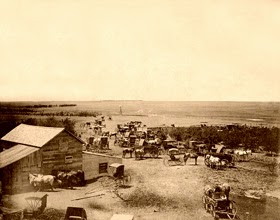
Dodge City, Kansas
![]() |
| Dodge City Gathering |
Dodge City. The name itself conjures up images of saloons,
brothels and gun fights in the street. Wyatt Earp and his brothers come to
mind. So do Bat Masterson and Bill Tilghman. But long before these men brought
law and order to the notorious cowtown, Dodge City
started out as nothing more than an army post.
Fort Dodge was
established in 1865 along the Santa Fe Trail. The main
objectives of the army was to keep wagon trains and the U.S. mail safe from
attacking Indians and to serve as a supply base for detachments participating
in the Indian wars. The Cheyenne,
Kiowa and other tribes populated the area, as buffalo and other wild game were
abundant. Six years later, at the foot of a hill west of the fort, Henry L.
Sitler built a three-room sod home. Sitler was a cattle rancher and his home
quickly became a twenty-four hour stopover for travelers and buffalo hunters.
George M. Hoover arrived shortly after Sitler and opened
Dodge’s first business; a saloon. After Hoover,
a group of businessmen from Forts Dodge, Riley and Leavenworth
organized the Dodge City Town Company. The company began the planning and
developing of the town. Originally, they named the settlement Buffalo
City, but since a town with that
name already existed, they changed the name to Dodge City.
The Atchison, Topeka
and Santa Fe Railroad arrived in September 1872 and Dodge grew rapidly in size
and population over the next few years.
Buffalo hunters,
railroad workers, soldiers and drifters came to town, packing the saloons,
dance halls and brothels. Laws didn’t exist and the military had no
jurisdiction. Gunfights abounded, with men dying in their boots; hence the need
for a burial place. Boot Hill
Cemetery was developed and remained
in use until 1878. Before that, men were buried wherever a hole could be dug,
or, if he had friends or money, he was buried in the post cemetery.
![]() |
| Buffalo Hide Yard 1878 |
Dodge City was
known as the Buffalo Capital, until mass slaughters destroyed the herds. By
1875, the Buffalo were gone, and so
was the source of income for local farmers who gathered the bones and sold them
for profit. The bones were used to make china and fertilizer. Luckily, the
cattle trade shifted from Ellsworth and Wichita
to Dodge City, keeping Dodge from
going belly-up. But along with thousands of Longhorn making their way to Dodge
in a ten year span came more lawlessness in the form of cowboys. The mayor
contacted Wyatt Earp, who was a lawman in Wichita
at the time, and asked him for help, offering an unheard of salary of $250 per
month. Wyatt took the job and hired four deputies to assist him; Bat Masterson,
Charlie Basset, Bill Tilghman and Neal Brown.
![]() |
| Peace Keepers |
Wyatt Earp and his deputies assessed the layout of Dodge and
the best course of action to bring law and order to the town. Earp initiated a
‘Deadline’ north of the railroad yards on Front Street.
The area north of the deadline was mainly commercial business and it was his
intent to keep this area quiet. South of the ‘Deadline’ consisted of saloons
and brothels. A gun ordinance went into effect banning guns from being worn or
carried. Those on the south side who didn’t cotton to the new ordinance carried
on as usual.
The term ‘red light district’ sprung from here, as railroad
men carried their red caboose lanterns at night to visit the brothels. With so
many disobeying the new ordinance, Earp soon found his jail cells full.
Friday, March 28, 2014
Confessions of a Crazy Canuck
![]() |
| Me in Mazatlan, age five. |
It started in Mexico.
My sister and I had whooping cough. I was five; Joanne was two. She was the reason we had to seek out a warm, dry climate for Christmas instead of visiting family in Montreal. Since my parents weren’t exactly flush with funds, they packed up my father’s company station wagon and we drove south, headed for Mazatlan.
With the self-centred clarity of a child, I only remember the parts of the trip that had an impact on me. I remember the switchback roads in the mountains. Dad loved them. Mum and Joanne were throwing up. Me - who was car sick on a straight road - was morbidly fascinated by the sheer drops out the side window.
I remember eating peeled shrimp like candy... and my first real pineapple.
When we finally reached the beach, I stepped on a crab and was scared of the sand for years after. (That's me, scared, photographed with my father.) I don't remember the crab, but I do remember being scared.
For some reason, I also remembered Laredo. I don’t remember much about the town except the name. It etched itself on my consciousness; the sound of the word was as exotic and exciting to me as Paris or Istanbul might be to someone else.
Traveling to Mexico became a family habit for a while - especially after we acquired a camper. It was in the camper that I started reading Zane Grey and Louis L’Amour. I had run out of Georgette Heyer and had not yet developed an interest in the mysteries my mother brought along for the trip. Dad gave me a copy of Riders of the Purple Sage, followed a couple of L’Amour’s short story collections. Suddenly I started taking an interest in the country we were traveling through. The United States - particularly Texas - ceased to be a geographic obstacle between home and our destination.
"Too often I would hear men boast of the miles covered that day, rarely of what they had seen." - Louis L'AmourWhen I needed to research Texas history and geography for Under A Texas Star, memories of those trips floated up to the surface.
One other trip cinched the deal – but it wasn’t one I took. My parents decided to go to Mexico when my mother retired. The family camper was long gone. Instead they outfitted a van with a kitchenette, bed and porta-potty. Feeling a bit envious, I wished them bon voyage one chill November morning. A couple of days later, they called from the Mexican border.
They had forgotten the vehicle permit. They couldn’t get into Mexico.
Stifling a laugh that I would have paid dearly for, I suggested they visit Texas while they were there – and bring back guide books. I was setting my mystery in the old west.
And now the confession. Since I'm hip-deep in book edits, I stole most of this post from an early self. As I keep telling my kids: "Recycle. Reuse. Re-purpose."
![]() |
| My sister wasn't afraid of the sand. |
Thursday, March 27, 2014
Counting Coup
![]() |
| keefer269.tripod.com |
In one of my chapters, I mentioned 'counting coup' and confused the heck out of everyone. I consider it might be an interesting topic to share here since this is the fifth week and no one else is scheduled to blog.
The Plains Indians, about which I write, were a proud people, and even in warfare, there were honors and recognition to be earned. In fact, the more risks one took, the more honor he brought to himself and his tribe.
'Coup', I learned comes from a french word meaning, 'blow.' Coup was counted when a warrior was able to touch an enemy...often with a long stick aptly named a 'coup stick', or even their lance or bow. The warrior received more honor when an opponent was not killed. Coup was counted on women and children as well, or touching the tepee of an enemy or his horse. 'Touching' in some form was required, as killing an enemy from a distance with an arrow or bullet did nothing to garner favor.
A warrior who claimed to have counted coup was expected to describe his deed in great detail before the tribal council, and MUST have someone who witnessed the act. If the story was found to be truthful, then the warrior was awarded a tail feather from a golden eagle...a bird admired for it's own courage and swiftness.
An array of feathers was not a uncommon sight as young men vied to add to their reputation and the ability to recount their brave deeds at various ceremonies.
To give you an idea of the great lengths the Sioux went to to recognize accomplished 'coups,' consider these examples as shown above:
1. First coup - A feather to be worn upright with a horsehair tuft at the top.
2. Wearer wounded - Upright feather dyed red.
3. Wearer wounded but killed foes - upright feather with quilled bands (one per foe.)
4. Wearer killed foe - Red spot on feather.
5. Wearer cut foe's throat and took scalp - notch in feather.
6. Wearer wounded many times - Split feather.
7. Wearer cut foe's throat - Top of feather clipped on diagonal.
8. Wearer counted coup four times - Serrated ages on feather.
9. Wearer counted coup five times - Side of feather partially removed.
So, you can see, there was a lot to remember in recognizing counting coup and equally as much work put into preparing the proper feather for each claim.
I don't know about you, but I find this sort of information so interesting. I value the day I discovered America's Fascinating Indian Heritage as a research resource, published by Reader's Digest. It's from this book, I've gleaned so much history about the Lakota and their rites and rituals. Love it, but hate that I've used it so much the binding is coming apart. *picture me frowning.*
Subscribe to:
Posts (Atom)